Search This Blog

Friday, October 31, 2014

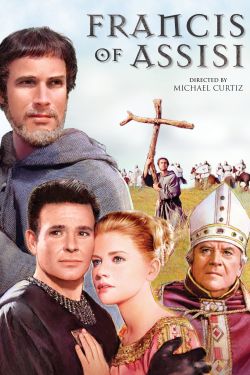
Francis of Assisi


Year:  1961

Filming:  Color

Length:  105 minutes

Genre:  Biography/Drama/Inspirational/Religious

Maturity:  PG (for intense thematic elements)

Cast:  Bradford Dillman (Francis Bernadone), Delores Hart (Clare), Stuart Whitman (Count Paolo of Vandria), Finlay Currie (Pope Innocent III), Mervyn Johns (Brother Juniper), Russell Napier (Brother Elias), Cecil Kellaway (Cardinal Hugolino), John Welsh (Canon Cattanei)
         
Director:  Michael Curtiz

Personal Rating:  5 Stars

***

    As you all must know by know, I have a particular soft spot in my heart for religious epics from yesteryear. Now that we have a pope who bears the name of Francis, it’s only natural that the public should have an increased interest in the nature-loving saint from Assisi who they are vaguely familiar with through garden saints and book marker prayers. To begin the journey towards of deeper understanding of St. Francis, I would say that the following film is a must-watch-classic that brings him to life with a perfect balance of gentility and passion.

    Bradford Dillman stars as Francis Bernadone, the high-spirited son of an Italian merchant who indulgences in the various pleasures of life in the medieval town of Assisi. With the world at his feet, he marches off in armor and chain mail to fight in a conflict between the city states. He also befriends Count Paolo of Vandria, a dashing Italian noble who takes the young man under his wing as they both embark as brothers-in-arms. But Francis is haunted by strange voices, urging him to abandon his worldly lifestyle and embrace a higher calling God has planned for him. To his father’s dismay, he deserts the army and is thrown into prison as a result. His pious mother, however, understands the workings of his soul and prays for her son’s speedy release.

    Paolo is disillusioned by his friend’s perceived cowardice, but the beautiful noblewoman Clare persuades him to show mercy and use his position to pardon Francis. Paolo does so, but with the understanding that he hopes to win Clare’s hand in marriage. But she, like her childhood friend Francis, is being stirred by a deeper calling. After he is released, Francis cannot return to his former life and feels uncertain how best to proceed until he has a mystical experience at the dilapidated Church of San Domiano. There he hears a voice coming from the crucifix, instructing him to “rebuild my Church which is falling into ruin.”

    Taking this literally, Francis takes to the streets in a simple robe and sandals, begging for stones to rebuild San Domiano. While many of Assisi’s prominent citizens dismiss him as a lunatic, he begins to draw a following among those who seek to live the rule of total poverty in the spirit and service of Christ. Soon, his “brotherhood” grows to the number of 12, and they journey to Rome to have the Rule of their new order approved by Pope Innocent III. They are almost turned away because the strictness of the Rule, but then the Pope recalls a dream he had, in which Francis upheld the pillars of the Basilica of St. Peter which were crumbling. He takes this as a sign for God, and approves the Franciscan Order.

    Meanwhile, Clare makes a decision of her own to join the Franciscan order as a nun, much to the distaste of both her father and Paolo, who has received her father’s approval to marry her, whether she is willing or not. Nevertheless, she escapes with the help Francis and takes her vows. When Paolo breaks into the church, she shows him that her long golden hair has been cut, and calmly walks away from him. She goes on to be the foundress of the Franciscan Sisterhood. While the order grows in Italy, Francis journeys to the Holy Land in hopes of bringing peace to war-torn Palestine by converting the Sultan.

    But a series of disheartening events beset him, and he must return to Europe empty-handed. To make matters worse, one Brother Elias has been planning to relax the Rule of the Order, and Francis must learn to curb his own pride and take a back seat as the changes go on beyond his control. Suffering from extended illnesses and blindness, Francis retreats to a cave where he once again waits for a sign from God. It comes in the form of the stigmata, which will forever mark him with the Wounds of Christ.

    Francis of Assisi combines epic story-telling with profound spiritual depth. The on-location footage shot in Italy is wonderful, as is the colorful medieval costuming reminiscent of Italian pageants that continue to this day, bringing to life all the fierce local pride that characterized the city states of the Middle Ages. I’ve heard some people accuse this film of being too Arthurian or “Disney-land-ish” in feel, and failing to achieve gritty realism. But I felt the color and gaiety shown as the men march off to war was in keeping with the pomp and ceremony surrounding local Italian pageantry, and making it clear why Francis would tantalized by the glories of the battlefield.

    Bradford Dillman does an excellent job portraying Francis, from his colorful youth to the darkness enveloping his old age. I particularly appreciate the scenes showing Francis searching his soul, such as when a beggar repeatedly approaches him with the words “Pax et Bonum”, only to vanish from sight as a procession holding aloft a crucifix comes into view. Another one of the deeply spell-binding sequences is when Francis receives his stigmata. It is telling that Dillman refused to smoke while in his Franciscan garb out of respect for the saint he was portraying, showing his own willingness to put his all into the production. However, he was more than happy to have Dolores Hart light him a cigarette on set while he was in his chivalric attire…and even have the photo man capture the moment on camera!

    Delores Hart has a particularly resonant voice and elegant beauty that makes her a perfect Clare. Interestingly, the actress herself eventually became a nun, and is today Mother Dolores Hart! I must say that the delivery of her lines sounded rather stinted at times, but nothing really serious to complain about. Overall, I thought the acting in this film was very well done. Again, I’ve heard some people accuse it of not being “dynamic” enough, but frankly, I don’t think it’s fair to accuse laid-back of some failure merely because they choose a different style of acting.
   
    I personally love the tender and charming moments in this movie, including Francis’ repartee with the animals, blessing the children’s pets, charming birds from the trees, and even making friends with some very hungry-looking cheetahs! Also, who can help but love the child-like innocence of Brother Juniper, played by Mervyn Johns? Another one of my favorite parts is when Francis and his brothers walk to Rome to ask for the Pope’s blessing on their new order, singing hymns of praise as they go. Then when they reach the gates, Francis miraculously manages to walk into the Vatican unopposed during the changing of the guard!

    And I’m going to enthuse about Finlay Currie again: he’s such a great character actor, and I think he makes a great “Papa” of the Church, whether he be St. Peter in Quo Vadis or Innocent III in Francis of Assisi. Of course we’re pretty sure that these historical characters didn’t really have Scottish accents (more like Hebrew and Italian!), but who’s gonna have the gall to complain about that? Finlay’s lilt is too wonderfully musical to listen to! I’ll also take the time mention here that the Catholic Church and Catholics in general are portrayed very well, with reverence and sympathy, but not hiding the flaws either. We see opulence in the Church hierarchy, collusion among the Franciscan Brotherhood, and an unreasonable streak in Francis himself when the letter of the law proves unlivable for his growing Order.

    We also see the dark side of the Crusaders-gone-wild (not romanticized at all really), and are allowed a sympathetic view of the Sultan Saladin who spares Francis’s life. I find their dialogue quite intriguing, allowing Francis to approach the Sultan in the name of love as an emissary of the God of Love, and willingly offers to prove the reality of his God by walking through a fire pit. Saladin is deeply impressed, and comments that although he has not made a convert, he has made a friend. Francis responds that that is the first step.

    Stuart Whitman is totally memorable in his role as the fictional Count Paolo of Vandria. Arrogant, hot-headed, courageous, and impulsive, he’s a great contrast the wistful, contemplative Francis, both as his friend and later rival. One cannot help but feel sorry for Paolo who is so caught up with his own emotions that he fails to take Clare’s feelings into consideration, nor even respect her spiritual quest. Her rejection of his advances wounds him deeply, and turns him into an embittered, and deeply hateful man, chasing after “booty and beauty” as a disillusioned crusader. While in the Holy Land, he happens to run into Francis (just chalk it up to coincidental screen-play-writer intervention!) where he disparages him as a sanctimonious hypocrite who failed to convert the Sultan or keep his Order living by the strict Rule of Poverty.

   In the end, he does make something of a come-back at Francis’ deathbed, but I'm afraid (to my eternal frustration) that Francis fails to give him as warm a reception as I might have hoped! He does mutter something like, “May God grant you His peace”, but that sounded way too distant for all they had gone through together. Can’t help but be reminded of the chilly way Moses treated Nefretiri in The Ten Commandments…and she wasn’t even being particularly repentant, but rather trying to get him to have an affair with her! But aside from this, I found Francis’ deathbed sequence moving, especially when Clare bids him a final farewell after his death, blessing him with the greeting that turned his heart to God so long ago: “Pax et Bonum.”

    So my summation: Francis of Assisi is a gentle, clean, deeply moving classic. I personally think the modern obsession with “grit” in period pieces is just another fad that will pass by, leaving movies like this behind to be enjoyed by all ages. Accuse me of being an incorrigible nerd; I like old-fashioned religious flicks! In fact, I LOVE old-fashioned religious flicks! While some may claim they lack “realism”, I return to challenge, and say that many modern attempts at religious epics are often sorry affairs, bereft with bad attitudes, 1990’s hair-dos, an unnecessary emphasis on guts and grime, and pathetic method acting! There, I feel calmer now. Now I’m ready to say the Prayer of St. Francis (that he evidently didn’t really write, but who cares?!): Lord, make me an instrument of your peace…;-)


Clare (Dolores Hart) is received into the Franciscan Order by Francis (Bradford Dillman)


Monday, October 20, 2014

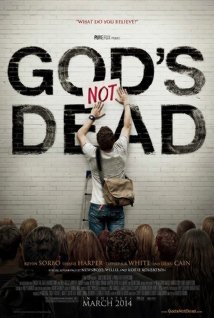
God's Not Dead

Year:  2014

Filming:  Color

Length:  113 minutes

Genre:  Christian/Drama/Inspirational

Maturity:  PG (for intense thematic elements)

Cast:  Shane Harper (Josh Wheaton), Kevin Sorbo (Professor Jeffrey Radisson), David A. R. White (Reverend Dave), Benjamin Ochieng (Reverend Jude), Trisha LaFache (Amy Ryan), Hadeel Sittu (Ayisha), Marco Khan (Misrab), Cory Oliver (Mina), Dean Cain (Mark), Paul Kwo (Martin)
         
Director:  Harold Cronk

Personal Rating:  1 Star

***

    I’ve been hearing advertisements for the new Christian independent production God’s Not Dead since it first came out this year. The title certainly caught my attention, and I had hopes that this might be a constructive that would make people think about the possibility that a Prime Mover does indeed exist. Perhaps it would move hearts towards the love of God, with gentleness and reasonability. Sadly, not only did the film fall short of these expectations, it actually set a perfect stage to turn non-Christians further away by contrived characture, constant proselytizing, and haughtiness totally contrary and detrimental to the Christian message.

    Our tale of woe begins with one Josh Wheaton, played by Shane Harper, a Christian college student who finds himself a very nasty mess indeed. His philosopher professor, Jeffrey Radission, is a rabid atheist who wishes to dispense with formalities by having all his students scribble “God is dead” on scraps of paper before the beginning of the course. Although all the other students do as they are told in order to avoid the time-consuming study of theism, Josh refuses to comply. In turn, his professor challenges him to prove to make his case that God’s not dead to the class. If they vote in favor of his argument, he will receive a positive grade. If not, he will be failed.

    Josh’s blonde and thoroughly annoying girlfriend tries to discourage him from taking up the challenge, playing the Eve role she was meant for, and threatening to leave him if he risks his grade on such a fool-hardy venture. But Josh remains undeterred and makes his case in a series of presentations before the class, making Radisson grow more and more obsessed with beating his student at his own game. He even goes so far as to seize him by the arm in the hall and threaten him (cheesily, of course) to destroy his chances of becoming a lawyer if he does not abandon his debate. As if there isn’t already enough going on to keep the viewers focused, we are jostled amidst a slew of awkwardly interlocking sub-plots.

    One of them involves a Muslim girl, Ayisha, who eventually is thrown out of the house by her traditionalist father for converting to Evangelical Christianity. Another subplot involves a liberal journalist, Amy, her struggle with cancer, and ignoble break-up with her big-bad-boy-friend, Mark (who is bigger and badder than we can credibly believe; I mean, even the meanest people I know would not respond to someone telling them about their cancer, “Couldn’t this wait?”). Yet another deviation involves Radisson’s girlfriend, Mina, who happens to be a sister of Mark (making the connection now?) and inner turmoil about staying with Radisson; and last but not least in ridiculousness, we are introduced to these two preacher guys with a busted car, supposedly introduced for comic relief purposes.

    To cut to the chase, Josh and Radisson eventually have a final show-down in the school room, and there is an attempted rehash of the conclusion of Twelve Angry Men, whereby it is revealed that Radisson really does believe there is a God, but he hates Him because his mother died when he was still a little boy. Needless to say, his students aren’t particularly impressed by this reasoning, and unanimously (quite a bit overdone on percentage, I would say) vote Josh to be the winner. But there is a final twist that allows us to meet the Christian Rock sensations “The News Boys” (all shouting and spinning lights on stage, making them anathema for someone who suffers vertigo!) and “The Duck Dynasty” (sorry, I’m with the liberal journalist on this one; how can they go through life with a clear conscious knowing they’ve killed all those innocent ducks?), and leaves Radisson flat on his back…er…literally?

    God’s Not Dead is an independent Christian film, and the genre pretty much has to be taken for what it is. And most of the time, it’s below sea level, if you take my meaning. Now, some are superior to others, but sadly the majority would be laughed out of town by a non-Christian audience for poor production quality and miserably preachy plots. Visually, this film was pretty average, with a certain desperation to be hip in setting. It lacked the innovative camera angles of October Baby, and was mediocre to the max. Acting ability was sketchy, with some moments revealing some ability, and the majority revealing nothing more than actors acting, which is exactly what actors should not look like they are doing!

    The initial plot premise was intriguing. There definitely are instances of atheistic heavy-handedness in our modern culture and the world of academia, and this story was supposedly loosely based off of a true one. Executed properly, this movie could have been portrayed as an exhilarating high stakes battle with full-bodied arguments on both side. There were a few scenes where Josh did make some impressive statements that do indeed prove helpful for Christian apologetics in showing that our faith is not irrational. But the tension and realism ultimately fell by the wayside for a number of reasons.

    The first one is the confusing style in which the plot was constructed. Instead of focusing exclusively on the debate between Josh and the Professor Radisson, the plot hops all over the place, and the characters connect far too late to make any sense out of it. The second truly unfortunate flaw in the movie is the underlying arrogance and triumphalism that will give non-Christian audiences a very shoddy picture of the essence of Christ’s teachings. The plot writers typify atheists as warped individual struggling with inner demons and personal tragedies that cause them to hate God. Christians, on the other hand, are shown as being consistently confident, somewhat obnoxiously straight-laced holy-rollers, who never seem to go through any personal doubts or dry spells in their spiritual life.

    Also, not enough quality time is spent with Josh to get to know him. What are his likes and dislikes, frustrations and heartaches, strengths and weaknesses? We don’t know. We don’t even get to follow his thought pattern as he pieces together the material for his debate, and are never allowed access to his true self at all. Not knowing him as a real person beyond his clean-cut, Christian cardboard image, it’s quite hard to feel for him. Besides, he doesn’t seem to go through much suffering at all. I mean, his girlfriend ditches him, but he doesn’t make much of a fuss over it, especially because it’s indicated she was pretty much of a shrew and didn’t really love him anyway.

    But there is something even more sinister at the root here: in the midst of all this intellectual debate, there is a noticeable lack of love in sharing the Christian message. Josh fails to show a visibly caring spirit towards his professor, even after it becomes evident that Radisson is suffering from various personal issues. Josh never even expressed his condolences for the death of his mother, whose loss propelled the professor down his atheistic path. The only real love shown to this guy in the film is revealed in a letter he finds from his late mother. But that’s it. Is it possible that we as the audience were never meant to feel compassion or kindness towards him at all?

    In contrast, there is a sense that we are supposed to want the professor to be run out of town on a rail, to beaten down and showed up in front of his class because he is the big-bad-atheist and therefore almost sub-human. We are also supposed to want him to be stripped of all earthly comforts, including his fiancée, who he actually does seem to genuinely love in spite of his selfishness. While I would be the first to agree that sometimes a person really most go through being emptied out before they can experience a spiritual awakening, all of that is in God’s hands. It’s not something that should be wished on anyone.

    The most shocking scene has to be at the end, when the professor is killed by an oncoming car as he tries to find his girlfriend who recently left him in a lurch. Lying in a rainy street, dying, the two itinerant preachers with the bum car get him to say The Sinner’s Prayer before he conks off. This is contrasted by the garish scene of all the Christians, including his ex-girlfriend, partying at the News Boys concert. Frankly, that is the one point in an otherwise extremely predictable film that I didn’t see coming. It was a mix of unexpectedly brutal and laughably hoaky, making the whole thing surreal and hard to swallow.

    What exactly are we supposed to take away from this? A sense of victory that “the bad guy” met a miserable, lonely fate only to be coerced into heaven at the last minute by “the good guys” so they can get another merit badge from God? The whole scene felt utterly repulsive, as it was so unnaturally enacted. If I ever came upon a man grievously injured, my first thought would be to try to do what I could to get him help and ease his pain, not proselytize him to death! If I thought he would die, I might ask if he were of any particular religion so that I could get the appropriate minister or pray with him, but I would not start rattling off Scripture verses in an attempt to shove my beliefs down his throat!

    Perhaps my main point is that the true sign of a Christian is the love that he/she shows for the people around him/her, as a natural flow of goodness and divine grace from one to another. It is not our mission to save as many people as we can just so we can make up a cute little list to present at the Pearly Gates. Also, it is extremely unfair to atheists and non-Christians of every stripe to paint them as monsters. Some atheists I am friends with are the kindest, most sensitive and considerate people I know. And this, I believe, is very much a proof of God and the soul made manifest through them, because they are indeed made in His Image and Likeness. Plus, to assume atheists secretly believe in God but hate Him is not always (although certainly can be) the case. There can be intellectually honest conclusions on both ends of the spectrum.

    The movie also makes a supposition that science speaks so clearly in favor of Christian perspective, that people who don’t embrace it are just plain dumb. This really is not the case. The fact is science cannot prove or disprove the existence of God, nor should it be able to. If there is an Omnipotent, Omnipresent Being, how on earth would we mere mortals be able to measure Him as a quantity with our scientific instruments? Let’s get real! But by presenting the case as if there is anything more than indirect indication for the existence of God, Christian apologists are bound to get a walloping. Josh himself does say this in the early stages of the debate, but by the end, it is extremely watered down. 

    So my case in point: God’s Not Dead was a good idea, but received a bad treatment. Actually, a worse than bad treatment; with a touchy subject like this one, harm is the only thing that could come from some of the blatantly un-Christian attitudes and ideas laced through the movie. To put it bluntly and definitively, it is one of the worst “Christian” films I’ve ever watched. Now it’s our job as living, breathing Christians to do damage control, and act like normal human beings instead of proselytizing robots. The very best way to evangelize is through example; it’s all about relationships, not shiny stickers we are trying to earn. We should want to help people, physically and spiritually, because we care about them. It should come naturally, and never be forced.


Josh Wheaton (Shane Harper) faces down Professor Jeffrey Radisson  (Kevin Sorbo)


Saturday, October 11, 2014

Amazing Grace


Year:  2006

Filming:  Color

Length:  117 minutes

Genre:  Biography/Drama/History/Inspirational

Maturity:  PG (for mild language and intense thematic elements)

Cast:  Ioan Gruffudd (William Wilberforce), Romola Garai (Barbara Spooner), Benedict Cumberbatch (William Pitt), Michael Gambon (Lord Charles Fox), Albert Finney (John Newton), Rufus Sewall (Thomas Clarkson), Youssou N’Dour (Olaudah Equiano), Ciaran Hinds (Lord Banastre Tarleton), Toby Jones (Duke of Clarence), Bill Paterson (Lord Dundas), Nicholas Farrell (Henry Thornton), Sylvestra le Touzel (Marianne Thornton), Jeremy Swift (Richard the Butler)
         
Director:  Michael Apted

Personal Rating:  5 Stars

***


      There are pathetically few movies that are able to deal with political/legal themes and still maintain a human touch that transcends the specialist category. But one of them on the top of the list is Amazing Grace, a biopic of the man who was instrumental in bringing an end to the British Slave Trade. As a period piece, it excels for good taste, balance, and a keen ability to connect the past with the present. As a story, it succeeds in intriguing, inspiring, and warming hearts with hope for humankind.

    Ioan Gruffudd stars as William Wilberforce, an energetic young Member of Parliament, who experiences a spiritual reawakening and becomes an Evangelical Christian. Discerning whether or not he should withdraw from the world and peruse the ministry, his friend William Pitt convince him to stay in politics by connecting him with abolitionists seeking to put an end to the British slave trade. Deciding to use his talents for the good of all, Wilberforce takes up the challenge, but his participation in the controversy makes him increasingly unpopular among powerful parliamentarians who have a vested interest in the trade.

    Working tirelessly to change the hearts and minds of the British people and show them the great inhumanities of the trade, Wilberforce makes allies with honest yet unkempt activist Thomas Clarkson, the former-slave turned elegant man-of-means Olaudah Equiano, and even the self-serving political survivor Lord Charles Fox. Together, they gather thousands of signatures in favor of abolition to present before the parliament. He also makes a point of impressing upon the powerful landed classes the plight of those suffering under their very noses, bringing to light how African men, woman, and children are made to endure a horrendous sea voyage and sold to sugar plantations to be worked to death.

    But in spite of the evidence, many politicians such as Lord Dundas decide to play it safe and refuse to vote for complete abolition. Even many of Wilberforce’s supporters fail him by going to a comic opera instead of turning up to vote. When the French Revolutionary Wars begin, Parliament shoves the issue on the back-burner, and Wilberforce is accused of being unpatriotic. Disillusioned, he considers resigning from his position in the government, and some of his supporters adopt revolutionary sympathies. But then Wilberforce meets his future-wife, Barbara Spooner, who encourages him to persevere in the face of any and all obstacles. From that point on, he is a newly driven man.

    This movie adroitly captures the dangerous ebb and flow of the political world while at the same time bringing out personal stories against the backdrop of epic historical events. The characters are portrayed in a very human light, whether they are from the upper or lower classes, pro-slavery or pro-abolition. The costuming and overall setting is exquisite and manages to capture the right balance between realism and flourish, accessibility and old-fashioned flare. We get to see fine dining halls, charming country estates, stuffy parliament chambers, dingy city streets, and bustling docks, getting a full-scaled panorama of 18th century Britain. The music score is also top-notch (highly recommend you get the CD!) which managed to bring out the flavor of both British and African cultures, interweaving past and present instruments flawlessly.

    Ioan Gruffud is at his acting best in his portrayal as William Wilberforce. Like Sir Thomas More in A Man for All Seasons, the character is so full of depth and humanity he seems to literally come to life through the actor depicting him, and by the end of the film, we can’t help but be an admirer of him. After all, he’s an affable and intelligent young man with a great career ahead of him, but he risks scuttling it in order to aid the oppressed and nearly destroys himself physically and emotionally in the process. He becomes a suffering soul, and a living martyr for those who have no voice. Gruffudd captures all these things with great passion and grace.

    Romola Garai makes a wonderfully warm and witty Barbara Spooner, urging Wilberforce to come out of his slump and return to the parliament floor. Her chemistry with Ioan Gruffudd on screen is delightful, especially their desperate attempt to find something to argue about in front of their match-making friends! One thing that bothered me, however, was the low-cut neckline in the dresses she usually wore in the production. I know that this could just be attributed to late 18th - early 19th century fashion, but I just thought it was a bit revealing and purposely seductive. It’s a Hollywood thing, but I must admit I was hoping for better.

    Rufus Sewall’s portrayal of Thomas Clarkson is lovably bluff and scruffy, revealing a good heart but also a dangerously passionate streak that threatens the whole enterprise. He gets into confrontation with Wilberforce over how best to handle their repeated defeats in parliament. Clarkson suggests that a revolution might be their only hope, but Wilberforce forcefully reminds him that he has taken an oath of loyalty to the king (who I do we wish would have made an appearance at some point in the film!). Clarkson retorts that the king is insane, and that he intends to go over to Paris to mingle with the revolutionaries. After several moments of tense listening, Wilberforce cuts him off, and orders him never to speak of revolution in his presence again.

    This is such a British moment in the film, because it exemplifies the realization Wilberforce experiences, and that the British people throughout history have clung to, that they must “hold back from the brink”; that needed changes can come through the due process of law, without shattering the governmental structure. Indeed, the film-makers evidently understood the importance of this project to the way people perceive the British People and their history and culture, because they made sure that all the filming would be done in Britain and that all the actors cast for the movie were British.

    The other great thing about Amazing Grace is the way that spiritual themes are handled without being preachy. Wilberforce is a deeply religious man, and the virtue of this shines through his actions and world view, but the script never reads like a proselytizing pamphlet. It’s sincere; it’s real; it’s naturally moving. I love the way he is portrayed as praying simply and openly, and the motif of the spider web symbolizing his love of The Creator and all His Creation. This point is also brought to the fore when he gets out of his carriage on a rainy night to stop a man from beating his horse, and the man listens to him because name of Wilberforce has now come to be respected by many as a symbol of principle.

    Getting to see Ciarin Hinds portray Banastre Tarleton in his post-revolutionary years was quite a treat. I must admit it took me a few minutes to make the connection between the pro-slavery MP and “Bloody Ban” of wartime infamy. But when he held up his hand to reveal missing fingers that he had lost fighting with the American rebels, it suddenly dawned on me, and I yelped, “It’s Ban!!” Nice to see him depicted as a well-rounded character, instead of the over-the-top villain in The Patriot. And at least this sets the record straight that he didn’t get impaled by Mel Gibson, but moved on to greener pastures in career as a consistent un-huggable.

    There are a few other moments in the film that hearken back to the American Revolution. One is when Wilberforce speaks out in favor of ending the war and making peace the rebels. It is often forgotten that there was a whole movement within British parliament opposing the taxes levied in America and seeking to give her representation in the mother country. When things began to look increasingly hopeless about politically reuniting, they urged a swifter peace to avoid further bloodshed. Another interesting moment in the film is when a legless beggar crawls over to Wilberforce in the street, saying that he “lost his legs fighting the Yankee rebels”. I wonder how often people ever think about the human cost of that war for Britain, and the social aftermath of it on both sides…

    Benedict Cumberbatch makes a wonderfully erudite and elegant William Pitt. One particularly good line is when Wilberforce exclaims that it is next to impossible for Pitt to become prime minister in his 20’s, to which he responds, “We’re too young to realize certain things are impossible, which is why we will do them anyway.” In reality, Wilberforce was never able to visit Pitt’s deathbed as shown in Amazing Grace, and they were actually somewhat estranged over some political differences at the time. But the portrayal of their friendship is touching nonetheless, and in reality, Wilberforce always seems to have treasured the memory of it. 

    I’ll admit that Albert Finney as John Newton looks rather different than I pictured him and that his portraits portray him, and I do sort of wish the film focused a bit more on his personal experiences since he is the one who wrote the title song! But he still does serve as a powerful example of the older generation passing on the mantle to the young, with his impassioned exhortation to “blast the slavers out of the water”. It is also deeply moving when he weeps and wonders if all the people he sold into slavery had names, and supposes that they must have been “good African names.”

     In connection with that, Youssou N’Dour as Olaudah Equiano puts a face and a voice to the millions of unnamed victims of the slave trade, whose lives were cruelly misused and cut short by the greed of others. Although Equiano pours himself out in the abolitionist cause, he tragically does live to see it succeed. Nevertheless, Thomas Clarkson does visit to grave when abolition is on the brink of passing, tells him the good news, and “shares a bottles” with him, drinking some and pouring the rest into the ground.

    One of the ironic inaccuracies of the movie had to do with the fact that the traditional tune of "Amazing Grace" is believe to have been added to Newton’s hymn at a much later date than the events depicted in the film. In spite of this, Wilberforce is shown singing the hymn to this tune and having it played at his wedding! While on the subject, it must be noted with some pain that, unlike the real Mr. Wilberforce who was said to have a glorious voice, Ioan Gruffudd really can’t hold a tune, and it shows when he stand up on that table belts out the beloved hymn before the unsympathetic throng! Oh, well. Chalk it up to good intentions gone awry?

    The finale is always a tear-jerker, when the trade is finally abolished and Wilberforce, struggling to contain his emotion, is given a round of applause. He exchanges a knowing look with his beloved wife in the balcony, realizing that without her, he may never have seen the cause to completion. The end credits are set against a rousing rendition of “Amazing Grace” played by a military pipe and drum band, and we get to see the kilted players lined up in rows outside Westminster Abbey, where both William Wilberforce and William Pitt are buried. I mean, how British can you get?

    Thinking about the injustice of the Slave Trade and how difficult it was to end, I cannot help but make a comparison to the ultimate injustice of our own era: Abortion. While it may be hard to visualize it being abolished now, perhaps a generation or so hence, we shall look back on the killing of the unborn with the same horror as we now look back on the buying and selling of slaves. What we really must pray for is that we may be given more leaders like Wilberforce and his associates to bear the pressure of an unsympathetic society and see the cause through. That is why stories like this one really must be told, and heroes like Wilberforce must be remembered. That is why I am so grateful this movie was made and is able to communicate his story in our modern era. It stands as proof that faith and endurance can overcome the most strident opposition. It is a manifestation of truly amazing grace.


William Wilberforce (Ioan Gruffudd) address the House of Commons


Monday, September 29, 2014

The Phantom of the Opera

Year:  2004

Filming:  Color

Length:  143 minutes

Genre:  Drama/Horror/Musical/Romance

Maturity:  PG-13 (for intense thematic elements and some sensuality)

Cast:  Gerard Butler (The Phantom), Emmy Rossum (Christine), Patrick Wilson (Raoul), Miranda Richardson (Madame Giry), Minnie Driver (Carlotta), Jennifer Ellison (Meg Giry), Ciaran Hinds (Firmin), Simon Callow (Andre)

Director: Joel Schumacher

Personal Rating:  3 Stars

***

    While I am not a specialist on musical theatre, two musicals that seem to be regarded as “must-sees” by the popular culture are Le Miserables and The Phantom of the Opera. This film production of the latter, while it occasionally sacrifices vocal expertise for acting ability, does a fair job of bringing to life a haunting tale of unrequited love and driving obsession with impressive special effects.

    Our story opens in a Parisian Opera House in the late 19th century. The new owners are experiencing some rather unusual difficulties – such as a masked man with a black cape hanging out in their subterranean cellar, demanding that the operas be performed according to his gourmet tastes and that he be paid for his “services”, or else he will sabotage the performances! To make matters worse, he’s exhibiting a particular interest in a young woman in the chorus named Christine and demanding that she be allowed to sing the main parts in the place of the haughty and pampered soprano, Carlotta.

    Unbeknownst to everyone, this gentleman, not-so-fondly referred to as “The Phantom of the Opera”, taught Christine to sing when she was first taken to be a ward of the opera as a little girl after her parents died. Somehow, he manages to do this through a two-way mirror by which he can see her but she can’t see him, and over the years she comes to believe that he is a visiting angel sent by her father to bring out her talent. As Christine grows in grace and beauty, Phantom becomes increasingly obsessed at the prospect of having her.

    When Christine’s childhood sweetheart, Raoul, a wealthy patron of the arts, comes to visit her, Phantom takes a gamble and reveals himself to her and lures her down a secret passage behind the mirror. Then he takes her on board a boat (a touch of Franco-Venetian romance?) and rows her along an underground river to a lake where he has pitched tent. Actually, he seems to have a talent for home-making since the place is really quite cozy with classical décor and some really nice upholstery. But the thing that freaks out Christine is the manikin that looks exactly like her, garbed in a wedding dress!

    Anyway, Phantom tries to express his ardor to Christine through the rather creepy “Music of the Night” solo, but then she pulls off his mask and sees (although the rest of us can’t see) that his face is distorted. Phantom pushes her away and completely falls apart. Christine feels pretty bad, and gives him back the mask. Then he takes her back upstairs and drops her off in her room. The plot basically follows a trend of Phantom trying to press for Christine’s advancement in the music world through devious means, and Raoul trying to “free her” from his possessive grasp that she is unable to break.

    Ultimately, it comes down to a climactic moment when Phantom coerces the opera house to perform one of his operas for Christine to sing. He then knocks off her leading man, and takes his place on stage. And then his mask gets taken off, and the chandelier falls down, and he drags Christine down through the underground tunnels again, with Raoul in hot persuit. And then he nabs “our hero” and threatens to hang him if Christine will not become his lover. So to find out whether she decides to save Raoul and run off with the obsessive masquerade man or tosses Raoul under the bus to be rid of the both of them so she can find a more normal match through online dating…you’ll have to watch the movie!

    Visually, this film version of The Phantom of the Opera is really quite impressive. The general mood is dark and gothic, set against the garishly colorful attire of the opera company and the frightening possibilities behind the world of masks and mirrors. The use of smoke and mists are very spooky, especially the eerie green fog hovering over the underground lake! And who could help but be creeped out by such memorable motifs as the dusty chandelier, the toy monkey, and the single red rose? Elegant and sinister, all at the same time, just like The Phantom himself!

    There are also some wonderful shots of the Paris, capturing the panorama of the magnificent, enchanting, and sometimes terrifying city. One of the my favorite scenes finds Raoul and Christine on the opera house roof overlooking Paris, with ominous stone gargoyles peering over the edges, as snow flurries descend from the cloudy sky. The duet they sing sets off both their voices nicely, and is a comforting break after menacing events inside the gallery. One thing I must mention though: How smart is it for Raoul to pick up Christine and start spinning her around whilst they are on top of a roof?!

    Another memorable scene is the duel between Phantom and Raoul in the cemetery. It’s a fair piece of swordsmanship on both sides, as the two men dodge jutting gray headstones, sparks flying from the clashing weapons. The ground is blanketed with white snow, and Christine’s crimson cape, along with Raoul’s bleeding arm, make a powerful contrast. It is in this scene that Raoul bests the Phantom and is about to run him through, but Christine begs for his life and allows him to escape to haunt them another day.

    But then there are the set-backs. My personal reasons for not being overly enthused are that it falls under the genre of both “musical” and “horror”, two words that I am not overly enthralled by and that do not mix very well in my humble opinion. I am not much of a Broadway person whatsoever, and my favorite musicals are “fun” ones, such as Brigadoon and The Sound of Music. Plus, those movies actually had spoken dialogue to break up all the singing. I have a very hard time sitting through a film where almost the entire script is sung, and have an even harder time taking an intense plot to hear if everyone’s singing during a hanging sequence or something similar!

    There are not actual sexual encounters that take place in this film, although I would venture to say there is a strong current of underlying innuendoes that affect the way the characters often irrationally conduct themselves. Also, quite a few opportunities are sized upon to dress Christine in revealing attire, including something like a belly dancer costume in the opening and a series of gowns with very low bodices! In addition to this, she is sometimes posed in rather alluring positions, such as when she wakes up on the pillows in Phantom’s cellar hideaway.

    One of the reasons I don’t care much for the story as a romance is that so much is left unexplained, and that lack of logic is made up for by some type of all-consuming lust that The Phantom has for Christine, and that Christine evidently has for him, even though she does come to her senses and frees herself from him. Really, there whole relationship is quite creepy and distinctly different from true love against the odds of physical disability and misshapenness. Through the course of the story, not once do Christine and Phantom have a “normal” conversation, nor does she every try to dissuade him from wreaking havoc on those around him, making her extremely guilty of the sin of omission.

    Perhaps if Phantom had a better singing voice in the film, I might buy the theory that Christine was seduced by his sonorous tones. But the fact is that Gerard Butler has a raspy voice that can kindly be described as “earthy” or otherwise simply scratchy to the senses. Don’t get me wrong; the guy is a good actor, but obviously not up to par with Emmy Rossum and Patrick Wilson in the vocal realm. The problem would crop up in a later musical film, Le Miserables, when casting Russell Crowe in the part of Javert. But at least that character wasn’t supposed to be a great singer; this one was!

    Also, The Phantom’s “hideous face” is not so hideous at all when he finally pulls off the mask in the end. It just looks like he got into some sort of an accident, and the one side of his got burnt. It’s a bit swollen, and certainly might take a little getting used to, but not overtly grotesque. Is this really the reason why he was mistreated as a “devil child” in his youth, forced to go through life without love, and left to sink into a sadistic, criminalist lifestyle? Either the Parisians are just super-sensitive about looks, or they really, really blew that one out of proportion! My personal theory is that good-looking Gerard Butler didn’t want to spoil his image by being to badly beat up by the make-up people back stage!

    So my overview on The Phantom: for musical lovers with a taste for period costumes and Gothic horror plots, this is sure to be a treat. For others, it may prove a bit “much” in lieu of too much singing and too much creepiness. Certainly not a light-hearted film, and not one you’d necessarily want to watch before going to bed, it does go some way to teach the lesson that people with physical disfigurements must not allow themselves to become emotionally and spiritually disfigured as well because of the cruelty of others. Instead, they must rise above it and find peace within themselves by seeking out relationships based on true love, with God first and others second.


Christine (Emmy Rossum) sees The Phantom (Gerard Butler) for the first time in a mirror


Saturday, September 27, 2014

Brave

Year:  2012

Filming:  Color

Length:  93 minutes

Genre:  Adventure/Animated/Family/Fantasy

Maturity:  PG (for some scary images and rude humor)

Cast:  Kelly McDonald (Princess Merida), Emma Thompson (Queen Elinor), Billy Connolly (King Fergus), Julie Walters (The Witch), Kevin McKidd (Lord MacGuffin), Craig Ferguson (Lord MacKintosh), Robbie Coltrane (Lord Dingwall)

Directors: Brenda Chapman and Mark Andrews

Personal Rating:  3 Stars


***

    I am admittedly new to the world of modern animation, and by modern I mean anything newer than the 1970’s. This is especially the case with Disney Cartoons. With regards to Pixar productions, I am even less accustomed to the 3-D characters and scenery, and hence certainly no professional commenter. However, due to the encouragement of friends, I finally took a plunge and got acquainted with a few Pixar Princess Productions. One of them was Brave.

    The story opens in the lush and magical Highlands of Scotland, where we meet Princess Merida, a feisty teenaged royal with a strong will and a head full of unruly red hair, whose voice is brought to life by Kelly McDonald. A free-spirited youth who takes after her rugged yet lovable warrior father, King Fergus, Merida excels at archery, horseback riding, and climbing treacherous precipices. But her mother, Queen Elinor, insists that her daughter become a proper lady and start to behave like a true princess.

    Merida grumbles at having to take etiquette lessons, but when is informed about an ancient custom by which the young lords of the land will vie for her hand in marriage through an archery contest, she takes matters into her own hands to restore her freedom. So taking up her bow and arrow, she wins the contest herself and sets the lords of the realm in an uproar. She and her mother have an intense confrontation, and Merida impulsively tears the tapestry portraying them both together.

    The red-headed princess rides off into the woods on her faithful steed, and finds herself in a magical circle of stones. Spying some strang, moving lights in the darkness of the woods, she follows them to a small cottage where an old woman gives her a potion to “change her mother” and her fate. But instead of convincing her mother not to force her into an unwanted marriage, her mother literally “changes”…into a bear!

    Tracking back an ancient curse involving three brothers who shared a kingdom and one who was turned into a ravenous beast called Mordu for his desire to possess all the power himself, Merida sets out on a mission to break the spell and rescue her mother before her King Fergus finds a “bear” in the palace! Famous for losing a leg in a battle with Mordu, the king has no love for bears, and will stop at nothing to irradiate them should they be found. In the end, love will conquer all – but this time it will not be the kiss of Prince Charming and his Lady Fair, but the abiding love between a mother and her daughter.

    I love the setting of Brave, so that tended to make me more forgiving towards the plot foibles and occasional bad taste. The artwork is just so gorgeous, especially the spread of the Scottish Highlands. It looks so real! Mirada climbing the sheer cliff and drinking from the rushing waterfall was breath-taking. And I simply loved all the darling Scottish accents. They were terrific! Plus, Mirada herself is so lovably fiery, with her wild red hair and skill at archery. The music score is also pretty cool, especially the first song as she gallops through the forest to “freedom”.

    But I’m sorry to say all these goodies are pretty much sabotaged by a major plot twist that altered the whole course of the film. It had to do with the bears. I mean, come on, what do you bears have to do with medieval Scotland, please tell me? No one seems to know. Okay, so if I had had control over this whole production, my first thought have been would be to utilize a Loch Ness Monster-type creature if we had to have some sort of big scary monster for our young heroine to face. But honestly, I don’t even know if that was necessary for the plot.

    I think the story-line could have developed in a slew of other interesting ways aside from having her mother magically transferred into some sort of creature in order for them to be reconciled! Plus, after the archery contest, Merida’s skill with the bow hardly influenced the plot at all. The whole setting of a fantastical medieval Scotland was so delightful to begin with, and so many allusions could have been made to real legends from Scottish lore. Who needed the bear twist? Save it for another movie!

    Perhaps the screen writers were just suffering from overwork and too little pay or something. Maybe weak coffee, too. Actually, the most likely explanation for the sudden switch in the plot is that the directors were switched out in mid-production, and it definitely shows. Thankfully, all was not lost in the way of a meaningful tale, because the outcome shows a strong sense of family cohesiveness and the need for mutual understanding, respect, and love between parents and their children. Also, King Fergus and Queen Elinor share a loving relationship, and I love the dignified power the queen holds among the warring factions of the land, allowing to merely walk in the midst of a brawl and break it up by her very presence!

    Unfortunately, the humor turned a bit raunchy at times, and there was some temporarily shocking (though not excessively graphic) animation of nudity. This involved bare back-sides on the part of the kilted warriors (to quote one of the lords lifting up his plaid: “Feast your eyes, me ladies!”) and some jiggling cleavage on the part of the plump castle governess. For most people, the first category is pretty perplexing, but having been familiarized with the long-running Scottish joke about whether or not Scotsmen wear underwear under their kilts, it made some degree of sense! Nevertheless, I really think it could have been done without, especially since this film is ostensibly supposed to be for younger audiences.

    I have seen the ongoing “joke” executed tastefully in the wonderful film The Hasty Heart, but nothing was ever shown on screen. Of course, as I’ve mentioned in the past, there is a scene in Braveheart where the whole thing is visually photographed (highly disturbing!), and that may well have been why they decided to include a version in this cartoon. While this was animation and not live action, it was a very real sort of animation, and as such, equally inappropriate and ultimately unnecessary to the plot.

    Another aspect of the story that has caused parents some consternation was the inclusion of a “good” witch who goes off to a Wicca Convention at Stonehenge. Also, the whole mood of the magic that takes place in this story is not the tinker-bell type. In fact, it has a mysterious and sinister element, neither entirely good nor entirely bad, capable of causing good or harm depending on the circumstances. I can understand why some parents have taken a step back because of this, and do wish they had left the word “Wicca” out of the film entirely. However, I will say that the darker feel matches with Celtic mythology and fits the Scottish setting appropriately. A lighter approach, with Peter Pan and pixie dust, would probably have felt out of place.

    Like The Hunchback of Notre Dame, Brave proves that Disney animation is not primarily aimed at younger audiences anymore. The frightening bear battles alone make that quite clear. If anything it’s more of a “family” show, often geared towards the older members in lieu of plot complexity, scary images, and some off-color insinuations. I’m not against the concept of making animation that all ages can enjoy, but I don’t think producers should have to “test the boundaries” of the censors to see what they can get away with under the cover of “maturity”. Also, if intense aspects are put into a cartoon, it should be more specifically explained that this is not a kid’s film per se.

    The naming of the film apparently follows the chic trend of one-word titles used by Disney for Tangled and Frozen. But after a while, that sort of thing can get overdone quickly. I must say I’m not exactly sure what made bravery such a big part of the plot; if anything, the main morals of the story were reconciliation and togetherness. I personally think it was just a gimmick to make a kiddie-friendly variant of the extremely popular and prosperous Braveheart and draw attention to that connection, especially since the Scottish Independence Referendum was looming when the film was released. 

    To its credit, though, Brave did not carry a covert nationalist agenda to try to make money out of the unrest and division in The UK. As a matter of fact, if anything, it carried a message about the importance of unity. My favorite scene from this film is the part when Merida walks into her father’s hall, and just like her mother, manages to silence the warring lords by her dignified presence. Then she goes on to explain to them why they are “better together”, with each one of them working for the common good and protecting the common land. She also takes a cue from Queen Elinor, and announces that traditions should be honored, and yet they sometimes need to be altered. And so it is decided that the lord’s must win her heart before her hand.

    So while Brave has its multiple plot foibles, occasional innuendoes, and as Plugged In review site aptly put it, too many “bear rears and bare rears”, I think it is still a fun film that teaches a number of excellent lessons and can be enjoyed by families. I would say kids 10 and up should be prepared for it, although it’s really up to parental discretion. One thing’s for sure: after watching, I bet a crown you’ll be mimicking a Scottish burr in the bathroom mirror for days to come!


Princess Merida (voiced by Kelly McDonald) prepares to battle Mordu the Bear