Search This Blog

Showing posts with label Italy. Show all posts

Thursday, January 1, 2015

Prince of Foxes


Year:  1949

Filming:  Black & White

Length:  107 minutes

Genre:  Adventure/Drama/History/Swashbuckler

Maturity:  PG (for intense thematic elements)

Cast:  Tyrone Power (Andrea Orsini), Orson Welles (Cesare Borgia), Wanda Hendrix (Camilla Verano), Marina Berti (Angela Borgia), Everett Sloane (Mario Belli), Felix Aylmer (Count Marc Antonio Verano), Katina Paxinou (Mona Constanza Zoppo), Eduardo Ciannelli (Art Dealer)  

Director:  Henry King

Personal Rating:  5 Stars

***

    In case you haven’t noticed by now, I am quite a fan of swashbucklers, and have been since I was knee-high to a grasshopper. My dad and I made quite a thing of dueling with foam noodles and rolled up skid-prevention rubber. Of course, Robin Hood was first true love. But I do reserve a special place in my heart for several other dashing rogues with sword in hand. One of them is Andrea Orsini from Prince of Foxes.  

    Our story opens in Renaissance Italy. Tyrone Power stars as Captain Orsini, an unlikely hero who starts out as an envoy of the power-hungry Cesare Borgia. Climbing the ladder of successes and hoping to bury his humble beginnings, Orsini believes that he has found the true fulfillment of his life. What could be better than living as a nobleman in a society of learning and culture, respected for shrewdness and cunning, in which every man is his own master and can compete as equals according to their skills?

    But the glamour of the world and the thirst of raw ambition do not satisfy, but only warp. Orsini’s pious widowed mother, Mona Constanza Zoppo, had tried to teach him this long ago, but he had refused to listen, and she had prayed he would be converted, even if it meant he would lose all his earthly powers. Orsini experiences this prayed-for enlightenment in the most unexpected of ways, while he is on a mission of intrigue and seduction to weaken the fortifications of a small province so Borgia can overrun it.   

    However, this will set him on a journey into his inner self and a powerful encounter with those who can see through his silky façade to his restless heart. One of these people is Marc Antonio Verano, the elderly count of the province he is sent to undermine; another is the count's much younger wife, Dona Camilla, who refuses to be seduced by Orsini. Gradually, he begins to be drawn away from his partner-in-crime, the assassin Mario Belli, and loses his nerve to unleash to pursue his devious plans. The rest of the story seems to mirror the life of a saint.  

    When Camilla remains loyal to her husband, and that husband refuses to submit to Borgia’s threats and prepares to defend his tiny domain from aggression, Andrea experiences a total change of heart and declares that he will use all his wits as “Prince of Foxes” to aid the defense. It is their own sense of nobility that taps into his better nature and brings him to the realization that Borgia’s philosophy of life is profoundly perverse, even though the trappings are appealing. The ultimate reality is that it is far better to die in a good cause than prosper in a bad one.

   Prince of Foxes stands out as an all-time classic swashbuckler gem with an atypical in its plot twists and moral potency. This is a story about what’s really important in life.     The acting in this film is excellent, led by Tyrone Power and Orson Welles. The plot is full of intricacies and unexpected twists and turns. There is also some wonderful sword-play and battle sequences. I will say that I felt the ending wrapped up rather abruptly with a few lose ends left dangling, due to budget cuts.

    We are sadly deprived of seeing the splendor of the Italian setting in color. The makers erroneously believed Tyrone Power to be past his time and washed up, and didn’t want to put too much into the production. This was a terrible miscalculation, since even with its limited budget and obvious time constraints impressed up on it. However, the masterful shadow effects are something of a saving grace in this regard.  

    For once, we have a romance based on true nobility! Indeed, it is quite evident that Lady Camilla is quite smitten with Orsini, but still she will not betray her husband. The reason is that she truly loves him for his goodness and wisdom, and whole-heartedly supports the cause which he champions. In effect, she is a nobler version of Queen Guinevere. After the count is mortally wounded, he joins the hands of Orsini and his wife, thanking them for their faithfulness and entrusting Orsini with her safety and that of the city. Orsini uses his wits to out-fox Borgia for as long as he can, then gallantly agrees to turn himself over to the enemy so Camilla and the inhabitants will be spared from slaughter.
 
    The power and beauty of art is an important motif in Prince of Foxes, which is no surprise, considering the setting is Renaissance Italy! Orsini first wins the respect and affection of Dona Camilla when he meets her at an art dealer’s shop and makes her a gift of a painting he was going to sell. Later, at the castle, Camilla asks him to pain her portrait. Since he is talented with the brush and has an eye for beauty, he accepts the commission, thinking this will be a means of seducing her. But instead, his heart is open to true love and honor through the project, as he learns that that the deepest sort of beauty is found in the intangible things, which he must embrace before he can fulfill his destiny and deepest desires.  

    I do have several questions left unanswered: what made the assassin Belli spare Orsini’s life at Borgia’s court? It’s left pretty much a mystery, but I must say that Everett Sloane made a wonderfully ferret-like villain. Another question is how did the rebels manage to toss Borgia out of the province at the end? All the odds were against them, and the idea that they could just storm the place with farming tools doesn’t really hold up to logic. It seems as if Orsini would have come up with a more mentally stimulating plan. Lastly, why wasn’t the Lady Borgia, who Orsini once courted, more vengeful after he ditched for another woman? I mean, she’s a woman, she’s Italian, and she’s a Borgia!

     Speaking of Italian women, one of the most important women in this movie was Andrea’s mother. The unusual way things played out seems likely to have found origin in her prayers for her son. When he is tortured by Borgia, she comes to care for him, obviously devastated by his condition, and he weakly murmurs, “Mama…mama…” This is such a touchingly human moment, and so reminiscent of Mary seeing her Son crucified. This whole scene was set-up by Borgia to prove to Dona Camilla that Orsini was of common stock, but she boldly responds that he was never nobler to her than at that moment.
   
    The main thing that makes Prince of Foxes so special is its call to conversion and deep spirituality running through all the action. It is a story of true nobility and Christ-like sacrifice, transforming conversion, and death-defying courage. Unlike many action and adventure films made solely for distraction, this production, though sadly little-known, manages to penetrate the surface and reach for deeper treasures. For those who appreciate this sort of depth, and who also love a rousing tale of adventure set against the backdrop of historical fiction, this classic is a must-see of the swashbuckler genre.


Dona Camilla (Wanda Hendrix) speaks with Andrea Orsini (Tyrone Power) about his painting of her


Friday, October 31, 2014

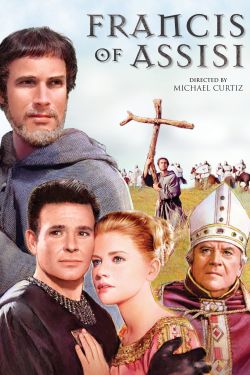
Francis of Assisi


Year:  1961

Filming:  Color

Length:  105 minutes

Genre:  Biography/Drama/Inspirational/Religious

Maturity:  PG (for intense thematic elements)

Cast:  Bradford Dillman (Francis Bernadone), Delores Hart (Clare), Stuart Whitman (Count Paolo of Vandria), Finlay Currie (Pope Innocent III), Mervyn Johns (Brother Juniper), Russell Napier (Brother Elias), Cecil Kellaway (Cardinal Hugolino), John Welsh (Canon Cattanei)
         
Director:  Michael Curtiz

Personal Rating:  5 Stars

***

    As you all must know by know, I have a particular soft spot in my heart for religious epics from yesteryear. Now that we have a pope who bears the name of Francis, it’s only natural that the public should have an increased interest in the nature-loving saint from Assisi who they are vaguely familiar with through garden saints and book marker prayers. To begin the journey towards of deeper understanding of St. Francis, I would say that the following film is a must-watch-classic that brings him to life with a perfect balance of gentility and passion.

    Bradford Dillman stars as Francis Bernadone, the high-spirited son of an Italian merchant who indulgences in the various pleasures of life in the medieval town of Assisi. With the world at his feet, he marches off in armor and chain mail to fight in a conflict between the city states. He also befriends Count Paolo of Vandria, a dashing Italian noble who takes the young man under his wing as they both embark as brothers-in-arms. But Francis is haunted by strange voices, urging him to abandon his worldly lifestyle and embrace a higher calling God has planned for him. To his father’s dismay, he deserts the army and is thrown into prison as a result. His pious mother, however, understands the workings of his soul and prays for her son’s speedy release.

    Paolo is disillusioned by his friend’s perceived cowardice, but the beautiful noblewoman Clare persuades him to show mercy and use his position to pardon Francis. Paolo does so, but with the understanding that he hopes to win Clare’s hand in marriage. But she, like her childhood friend Francis, is being stirred by a deeper calling. After he is released, Francis cannot return to his former life and feels uncertain how best to proceed until he has a mystical experience at the dilapidated Church of San Domiano. There he hears a voice coming from the crucifix, instructing him to “rebuild my Church which is falling into ruin.”

    Taking this literally, Francis takes to the streets in a simple robe and sandals, begging for stones to rebuild San Domiano. While many of Assisi’s prominent citizens dismiss him as a lunatic, he begins to draw a following among those who seek to live the rule of total poverty in the spirit and service of Christ. Soon, his “brotherhood” grows to the number of 12, and they journey to Rome to have the Rule of their new order approved by Pope Innocent III. They are almost turned away because the strictness of the Rule, but then the Pope recalls a dream he had, in which Francis upheld the pillars of the Basilica of St. Peter which were crumbling. He takes this as a sign for God, and approves the Franciscan Order.

    Meanwhile, Clare makes a decision of her own to join the Franciscan order as a nun, much to the distaste of both her father and Paolo, who has received her father’s approval to marry her, whether she is willing or not. Nevertheless, she escapes with the help Francis and takes her vows. When Paolo breaks into the church, she shows him that her long golden hair has been cut, and calmly walks away from him. She goes on to be the foundress of the Franciscan Sisterhood. While the order grows in Italy, Francis journeys to the Holy Land in hopes of bringing peace to war-torn Palestine by converting the Sultan.

    But a series of disheartening events beset him, and he must return to Europe empty-handed. To make matters worse, one Brother Elias has been planning to relax the Rule of the Order, and Francis must learn to curb his own pride and take a back seat as the changes go on beyond his control. Suffering from extended illnesses and blindness, Francis retreats to a cave where he once again waits for a sign from God. It comes in the form of the stigmata, which will forever mark him with the Wounds of Christ.

    Francis of Assisi combines epic story-telling with profound spiritual depth. The on-location footage shot in Italy is wonderful, as is the colorful medieval costuming reminiscent of Italian pageants that continue to this day, bringing to life all the fierce local pride that characterized the city states of the Middle Ages. I’ve heard some people accuse this film of being too Arthurian or “Disney-land-ish” in feel, and failing to achieve gritty realism. But I felt the color and gaiety shown as the men march off to war was in keeping with the pomp and ceremony surrounding local Italian pageantry, and making it clear why Francis would tantalized by the glories of the battlefield.

    Bradford Dillman does an excellent job portraying Francis, from his colorful youth to the darkness enveloping his old age. I particularly appreciate the scenes showing Francis searching his soul, such as when a beggar repeatedly approaches him with the words “Pax et Bonum”, only to vanish from sight as a procession holding aloft a crucifix comes into view. Another one of the deeply spell-binding sequences is when Francis receives his stigmata. It is telling that Dillman refused to smoke while in his Franciscan garb out of respect for the saint he was portraying, showing his own willingness to put his all into the production. However, he was more than happy to have Dolores Hart light him a cigarette on set while he was in his chivalric attire…and even have the photo man capture the moment on camera!

    Delores Hart has a particularly resonant voice and elegant beauty that makes her a perfect Clare. Interestingly, the actress herself eventually became a nun, and is today Mother Dolores Hart! I must say that the delivery of her lines sounded rather stinted at times, but nothing really serious to complain about. Overall, I thought the acting in this film was very well done. Again, I’ve heard some people accuse it of not being “dynamic” enough, but frankly, I don’t think it’s fair to accuse laid-back of some failure merely because they choose a different style of acting.
   
    I personally love the tender and charming moments in this movie, including Francis’ repartee with the animals, blessing the children’s pets, charming birds from the trees, and even making friends with some very hungry-looking cheetahs! Also, who can help but love the child-like innocence of Brother Juniper, played by Mervyn Johns? Another one of my favorite parts is when Francis and his brothers walk to Rome to ask for the Pope’s blessing on their new order, singing hymns of praise as they go. Then when they reach the gates, Francis miraculously manages to walk into the Vatican unopposed during the changing of the guard!

    And I’m going to enthuse about Finlay Currie again: he’s such a great character actor, and I think he makes a great “Papa” of the Church, whether he be St. Peter in Quo Vadis or Innocent III in Francis of Assisi. Of course we’re pretty sure that these historical characters didn’t really have Scottish accents (more like Hebrew and Italian!), but who’s gonna have the gall to complain about that? Finlay’s lilt is too wonderfully musical to listen to! I’ll also take the time mention here that the Catholic Church and Catholics in general are portrayed very well, with reverence and sympathy, but not hiding the flaws either. We see opulence in the Church hierarchy, collusion among the Franciscan Brotherhood, and an unreasonable streak in Francis himself when the letter of the law proves unlivable for his growing Order.

    We also see the dark side of the Crusaders-gone-wild (not romanticized at all really), and are allowed a sympathetic view of the Sultan Saladin who spares Francis’s life. I find their dialogue quite intriguing, allowing Francis to approach the Sultan in the name of love as an emissary of the God of Love, and willingly offers to prove the reality of his God by walking through a fire pit. Saladin is deeply impressed, and comments that although he has not made a convert, he has made a friend. Francis responds that that is the first step.

    Stuart Whitman is totally memorable in his role as the fictional Count Paolo of Vandria. Arrogant, hot-headed, courageous, and impulsive, he’s a great contrast the wistful, contemplative Francis, both as his friend and later rival. One cannot help but feel sorry for Paolo who is so caught up with his own emotions that he fails to take Clare’s feelings into consideration, nor even respect her spiritual quest. Her rejection of his advances wounds him deeply, and turns him into an embittered, and deeply hateful man, chasing after “booty and beauty” as a disillusioned crusader. While in the Holy Land, he happens to run into Francis (just chalk it up to coincidental screen-play-writer intervention!) where he disparages him as a sanctimonious hypocrite who failed to convert the Sultan or keep his Order living by the strict Rule of Poverty.

   In the end, he does make something of a come-back at Francis’ deathbed, but I'm afraid (to my eternal frustration) that Francis fails to give him as warm a reception as I might have hoped! He does mutter something like, “May God grant you His peace”, but that sounded way too distant for all they had gone through together. Can’t help but be reminded of the chilly way Moses treated Nefretiri in The Ten Commandments…and she wasn’t even being particularly repentant, but rather trying to get him to have an affair with her! But aside from this, I found Francis’ deathbed sequence moving, especially when Clare bids him a final farewell after his death, blessing him with the greeting that turned his heart to God so long ago: “Pax et Bonum.”

    So my summation: Francis of Assisi is a gentle, clean, deeply moving classic. I personally think the modern obsession with “grit” in period pieces is just another fad that will pass by, leaving movies like this behind to be enjoyed by all ages. Accuse me of being an incorrigible nerd; I like old-fashioned religious flicks! In fact, I LOVE old-fashioned religious flicks! While some may claim they lack “realism”, I return to challenge, and say that many modern attempts at religious epics are often sorry affairs, bereft with bad attitudes, 1990’s hair-dos, an unnecessary emphasis on guts and grime, and pathetic method acting! There, I feel calmer now. Now I’m ready to say the Prayer of St. Francis (that he evidently didn’t really write, but who cares?!): Lord, make me an instrument of your peace…;-)


Clare (Dolores Hart) is received into the Franciscan Order by Francis (Bradford Dillman)


Monday, February 10, 2014

Don Bosco


Year:  1988

Filming: Color

Length:  108 minutes

Genre:  Biography/Drama/Inspirational/Religious

Maturity:  PG (for brief language and intense thematic elements)

Main Cast:  Ben Gazzara (Don Bosco), Patsy Kensit (Lina), Karl Zinny (Giuseppe),  Laurent Terzieff (Monsignor Gastaldi), Raymond Pellegrin (Pope Pius IX),  Phillipe Leroy (Pope Leo XIII), Piera Degli Espotsi (Lina’s mother), Edmund Purdom (Urbano Rattazzi)

Director:  Leandro Castellani

Personal Rating:  5 Stars

***

    Italian film-makers always seem to have the upper hand in the arena of turning out biopics on saints. And this does make sense, since Italy is overflowing with canonized natives, not least among them being St. John Bosco, a visionary priest who dedicated his life to helping destitute boys during the turbulent 19th century. This movie, directed by Leandro Castellani, tells his story which stands out as a beautiful blend of drama, humanity, and mysticism.

    Ben Gazzara stars as Don Bosco, urged on by his prophetic dreams and passion for the poor to open an oratory in the city of Turin where boys can have decent work and decent living conditions. He earns the trust of hardened gang members through his athletic skills, sense of humor, and straightforward approach, and soon he draws so many boys to his oratory that the government begins to complain that he is abetting a bunch of “misfits”.

    Don Bosco’s funds also begin to run low even as his health begins to fail him, and he is threatened with eviction unless he can pay the rent. Instead of abandoning his mission as is suggested, he relocates his boys to a dilapidated barn which they work hard to restore. The one major down-side is that their new center is located right next to the infamous Jardinière, a house of prostitution.

    But all things are meant to be for a reason. Giuseppe, one of the boys Don Bosco took from the streets, falls in love with Lena, a troubled girl who is forced to work at the Jardinière by her insensitive mother to help provide for the family. When she refuses to continue at the job, she is thrown out of the house only to be rescued by Giuseppe who takes her to a secret alcove in the streets. Don Bosco learns of this, and arranges for her to work as a shop assistant of a friend. But Giuseppe’s impatience to marry her results in his getting arrested for robbery, and a dramatic subplot steeped in trust and redemption unfolds.

     Meanwhile, a student rebellion breaks out in favor of Italian unification and a constitution. But the situation quickly grows out-of-control and mobs take to streets. Don Bosco tries unsuccessfully to break up a group of rebels attacking the local government buildings, but only succeeds in incurring the vengeance of the revolutionaries who make an attempt on his life by giving him poisoned wine. They hope to lure his boys over to the side of the rebellion, but they remain steadfast behind the beloved cleric. The government officials, on the other hand, are just as ruthless in their methods of trying to stop Don Bosco’s work among the young people of Turin. When they cannot pay him off to close down his oratory, they resort to hiring assassins of their own. One is thwarted by the timely appearance of a large grey dog which Don Bosco believes to be sent by Heaven.

     Even the Church officials begin to put pressure on him to give up his efforts. The pompous bishop goes so far as to suspend Don Bosco’s right to hear Confession and refute his ability to give confirmation to his boys. When it is suggested that he take a restful vacation in the countryside, Don Bosco responds that instead he will travel to Rome. And so he does, gaining an audience with and the respect of Pope Pius IX.  Bolstered by Papal support, he returns to Turin and starts a new religious order among his oratorians known as “The Silesians” in honor of St. Francis De Sales. But his health has been broken by trials, and his final days draw near in a deeply emotional conclusion.

    This film is a deeply moving story of sacrificial love. It is, needless to say, steeped in spirituality and mysticism, and Don Bosco’s dreams are used as a consistent motif. We learn that he has dreamt about having to encounter the Jardinière before they even see the new location of their oratory. When he reveals to Giuseppe that he knows about Lena, he assures him that he did not found out by spying. He knew already. Before the pope in Rome, he tells about his dreams of the Christ Child and the Blessed Mother who inspired him to embrace his mission in Turin.

     As much as this film is intrinsically Catholic in nature, it does not white-wash the failings of Church members. Both good and bad members of the Catholic hierarchy are depicted with strict honesty, but the movie never takes underhanded jabs at the institution as a whole. This is a balanced critique, and an enlightening one. Also, these spiritual elements are equally balanced with suspenseful action, from the student rebellion to the multiple assassination attempts, all of which Don Bosco handles with admirable aplomb. I love the scene when he finds himself being threatened by government officials, and declares that even though he is a man of the cloth, he is also from sturdy farm stock, and more than capable of using his strength to give them a pounding! He starts to strip off his outer cassock, and the agents decide its best to just back down!

    This is an ‘80s foreign film, and as such the production quality is not always tops. And yet the purity of the story and simplicity of the setting enables it have a quiet quality in its own right. It knows its limitations, and does not try to overshoot itself. I really respect his in a movie, and many of my personal favorites are similarly small-budget, and yet beautifully intimate. Perhaps this hearkens back to time-honored truth that it is not the outward but the inward beauty that ultimately shines through the strongest.

    Gazzara does an excellent job in his role, and I would say without hesitation that I find it to be his greatest. He projects just the right combination of earthy realism and heavenly mysticism that is quintessentially Bosco, and quintessentially Italian! As for the other actors and actresses, the quality of their performances tends to vary. Some of the Italian players apparently said their lines in Italian and had to have English lines dubbed in for them. This could be kind of irksome, although I’ve learned to get past it. Besides I do appreciate the fact they actually cast real Italians in the picture for the most part, and it was worth dealing with the dubbed in track. But this contrasts starkly contrasts with the decision to cast the golden-haired, English-born Patsy Kensit as Lena. Every time I see her fair face and hear her whiny voice, and I can’t help but wish some dark-haired, deep-voiced Italian signorina had gotten the part!

    But regardless of this irksome choice, the production is a religious classic and a love story of the first degree. It is about the kind of love the pours itself out until the giver is bled dry. It is about the kind of love that is grounded in a prevailing humility. It a supernatural love, and not of this world. One of the most moving portrayals of this was Don Bosco’s love for the young man Giuseppe. Even after he is imprisoned for robbery, the priest still acknowledges him as one of “his boys” and is willing to risk a blow to his own reputation and even possible incarceration in order to help the young man reunite with Lena during a brief supervised outing in the country. Even when Giuseppe appears to have betrayed him, Don Bosco never loses faith in him, but through prayer and fortitude helps him turn his life around.

    This is the Love of Christ; it is the kind that never falters but gives unconditionally. Indeed, being drawn into the love of Christ and reflecting that love to others is one of the definitions of being a saint. It is a dying to self, so that Christ can live within you. “I am an insect, that cries out and dies,” Don Bosco whispers in one of the final scenes in the film. He never saw himself as anything more than a broken instrument of God, struggling to fulfill His Will while on earth. And it would be the perseverance of this holy priest and visionary that would save the lives and souls thousands of impoverished boys and inspired others to carry on his work, which continues to the present day. Don Bosco, by Leonardi Castellani, does justice to this Man of God and his powerful legacy.


Don Bosco (Ben Gazzara) defends one of his  "boys"against a labor boss