Search This Blog

Showing posts with label romance. Show all posts

Friday, May 29, 2015

Battle of the Brave


Year:  2004

Filming:  Color

Length:  143 minutes

Genre:  Drama/History/Romance/War

Maturity:  PG-13 (for intense thematic elements, language, and some sexuality)

Cast:  Noemie Godin-Vigneau (Marie-Loup Carignan), David la Haye (Francois la Gardeur), Juliette Gosselin (France Carignan), Sebastian Huberdeau (Xavier Maillard), Bianca Gervais (Acoona), Gerard Depardieu (Fr. Thomas Blondeu), Tim Roth (William Pitt), Jason Isaacs (General James Wolfe), Michael Maloney (Governor James Murray), Philippe Dormoy (Voltaire)
         
Director:  Jean Beaudin

Personal Rating:  2 Stars

***

    One day, while fishing through the period piece section on NetFlix, I stumbled across Battle of the Brave. I sort of had a feeling it wasn't going to be good when I heard it was set during the French and Indian War (how could Hollywood keep from going on a splurge about evil Europeans and stuffy decorum?), but I wanted to see anyway. I’m not above being surprised by an unexpectedly good film. But my intuition proved more than correct this time, although I will admit I was surprised…by the blatant differences between the plot-line as outlined in the advertisements and how it played out in the actual production!    

    What story there is opens in Colonial French Canada, not long before the British conquest of Quebec in 1759. A young French nobleman named Francois la Gardeur has just returned from a trapping venture in the wilderness, a journey he had embarked upon to distance himself from his upper-class roots. Seeking out amour in Quebec, he rekindles an affair with a fellow nobleman’s wife, but at the same time finds himself bewitched by a beautiful and independent-minded young widow and single mother named Marie-Loup Carignan, who has learned to be a healer in the Native American tradition, and is accused of practicing dark magic.

    Meanwhile, sinister historical forces are at work. The French government in Canada is riddled through with corruption, and willing to let Quebec fall to the British to prevent an inquiry into their conduct. It is up to our wild-haired hero Francois to warn the French government about the plot, but the local authorities will stop at nothing to silence him. Throw Fr. Thomas Blondeau, a Catholic priest who is sort-of-good in that he wants to defend the poor from the desperation of a crumbling regime and the rapine of an ascending one, and yet is having sexual affairs and has this secret love for would-be witch-woman...and the whole thing degenerates into a confusing mess!

    Our noble messenger to the court of France sends a message to his lover, asking her to accompany him. But the priest, for motives that are a bit complex, mistranslated the message to keep her from going with him. This strikes off a chain reaction of unintended events…none of which are directly related to the war, nor the fact that Quebec falls to the British, without even enough production courtesy to show us the epic-ness of the Battle of the Plains of Abraham! Gah! But to summarize: “our hero” has a heart-to-heart chat with philosopher Voltaire, but fails to get an audience at the decadent court of France until after the British invasion is completed, and returns to discover that beloved witch-woman has gotten herself hitched to a his less-than-upstanding-former-friend-turned-British-lackey.

     But never fear…Gallic Lover Boy is here! Actually, cancel that…we should fear, because it doesn’t seem he has any definite plan, and one he tries to launch to rescue his lady-love from her abusive husband backfires miserably. Ultimately, deadbeat hubby has an unfortunate collision with an axe, but no one is sure who administered the fatal blow. Marie-Loup gets arrested and framed for her husband’s murder, which everyone is content to let lie since she is already a social outcast. At this point, the two main men in her life – Francois and Fr. Blondeau – try to “save her” in different ways. The former makes a vain attempt to plead mercy before the new British Governor James Murray, and the second tries to give her absolution for the murder, which she refuses. It will only be at the end of the old man’s life when the truth will be revealed and the mysterious case laid to rest with Mary-Loup.

     This film had some artistic pluses in the form of beautiful cinematography and a lush music score. It gave a good feel of the Colonial era of sprawling forests and Old World settlements, inhabited by a mix of different races struggling for survival and domination. The acting was fair enough, and the relationship between Mary-Loup and her little daughter France was touchingly rendered. Also, some of the romantic interplay between Francois and Mary-Loup was worth salvaging, even though their overall romance was pretty lame. David la Haye and Noemie Godin-Vigneau seemed to have good on-screen chemistry, and they have a talent for conveying emotions through facial expressions. And I will admit this much: the leading lady has amazingly bewitching eyes!

     But in spite of these perks, the story was a horrible miss-match of themes and plot threads that failed to coalesce into any definite vision. It is permeated with modern sentiment jet-lagged into a past time period, with Francois and Mary-Loup serving as symbolic of liberalism and modernity as opposed to the narrow-minded, old-fashioned, and corrupt characters that surround and ultimately destroy them. In this sense, the whole story takes on the visage of a morality play, even though the morals are foggy at best.

      It is not by accident that we see Francois “connect” with the ultimate liberal, Voltaire, after his repeated efforts to shake off his noble heritage which is portrayed as being corrupt overall. Needless to say, there certainly was corruption in the nobility, particularly among the French Colonial ruling class in Quebec. But portraying the upper classes as “all bad” just doesn’t do them justice. I would have liked to meet the Marquis de Montcalm, the epitome of a French gentleman, dedicated to honor, duty, and his country. So while we can sympathize with Francois’ issues to some extent, the movie fails to portray the pros-and-cons of the class system with balance.

    Likewise, we can certainly sympathize with the more open and curious ways of Mary-Loup, and her willingness to learn the ways of the Native Americans through her friendship with the Indian girl, Acoona. But trying to make almost everyone else around her into 2-dimnsional villains fails to appreciate their own perspectives, and the “comfortableness” these characters would have had holding these beliefs in their own time periods. Plus, Mary-Loup does seem to be a bit “loose in love”, so to speak, and has adapted some of the superstitious practices associated with witch-craft, so even a few eye-brows raise, it’s not a huge wonder. And of course, there has to be a priest struggling with his vow of celibacy, in a kind of creepy way…I mean, isn’t he old enough to be Mary-Loup’s father? Weird.

    Not only do the characters feel strangely out of place in their respective era, but Battle of the Brave doesn’t even live up to its own advertisement as a flick about French resistance fighters battling for “freedom.” Literally, on the cover there are three indicative words: “Rise. Unite. Fight.” But none of this ever comes about. There are no resistance fighters, and there is no battle! The war, which is supposed to be so central to the plot, is skipped through with nothing more than a shelling sequence, which kills a side character but does not influence the central plot. Instead, the story-line is totally hinged on the love affair, which reaches a dead-end and fails to support the movie with needed substance.

     On an historical note, we do get to make a brief foray made into the British establishment, whence we get to meet Tim Roth (infamous for his role as Archie-the-Villain in Rob Roy) as William Pitt (no! no!!!) and a totally-too-old, totally-too-deranged Jason Isaacs (infamous for his role as Tavington-the-Villain in The Patriot!) as General James Wolfe (Say what???!!!) who fails to do anything impressive but rant about wildly and mutter poetry with a weird gleam in his eye. These blatant miscasts can be accurately classified as nothing more than a generic British villains convention, to purposely purport a politically correct and historically incorrect depiction of The French and Indian War.

    As someone who has spent more than a few years studying Wolfe and pouring over his personal letters, I was particularly frustrated to death by this obtuse portrayal. I understand that the film may have been trying to paraphrase an incident in which Wolfe, slightly inebriated and out-of-character, is said to have bragged about what he would accomplish in America, and pounded his sword hilt on the table in front of Pitt. But the way it came off was that he was always behaving like a nut, and everything he did was viewed as off-beat by those around him, including poetic recitation. This fails to explain why the legend of Wolfe has been such an inspiration to fighting men for generations.

    Wolfe was certainly a very complex character, who could often be judgmental and sometimes quite brutal. He also might have seemed a bit “manic” every once in a while. But this is only one side of the coin. A reading of his letters and the testimony of contemporaries also show him to also have had many attractive qualities, and was not some chronic maniac. He was deeply philosophical, had a marvelously witty sense of humor, and a profound sense of duty to his country and the men under his command. His soldiers adored him, and found his eccentricities inspirational, including his love of quoting poetry. Furthermore, memorization of poetry was much more common in the 18th century than it is now, and wouldn’t have even been considered as outlandish as it might be today.

     The film also messed up the character of British governor James Murray, who is portrayed as being unscrupulous and willing to have Mary-Loup executed even though he has proof she is innocent of the murder of her husband. He doesn’t want to risk putting his job in danger by angering those who are stuck in the “dark ages” and opposed to modernistic Mary-Loup. First off, they got his accent wrong: He was Scottish, not English. Second, portraying him as a fall-back villain is character assassination, unless they have some sort of proof he actually behaved in this manner. Historically, the worse thing that can be said of him was that he was jealous of General Wolfe and gave him a hard time, but as governor of Quebec, he was known for being fairly compassionate to the plight of the inhabitants and proved himself to be an able and just administrator.

     Basically, the history buff and story-lover in me was deeply disappointed by this goofed-up attempt to bring The French and Indian War to life on screen. With a predominately French cast and crew, I knew the chances of them being fair to the British were slim. But they even missed out on giving the French their proper due by getting hung up in too many soap-opera-esque love affairs and an obscure moral tags about the blessings of modernity, and the ill-fated consequences of intolerance, which is viewed as the ultimate evil in our modern age. I’m certainly not advocating it, but I think there are other vices to be brought to the fore as well, some perhaps not so politically correct…like character assassination in big-budget historical butcheries!

    I’m afraid that I must make fanfare of tossing Battle of the Brave into the ceremonial fibrotic fire-pit with its kith and kin on the death-row shelf:  The Last of the Mohicans, Titanic, The Patriot, Braveheart, Rob Roy, etc.! Judging from this illustrious accumulation of painful productions, I’d say it’s about time to have a smores fest! If I’m sarcastically harping on this subject too much for my educated readership, please bare with me. I really must write about how messed up I feel Hollywood is getting with these historical "epics", for my own sanity, and perhaps to better the planet. Perhaps it will rouse the masses to demand better fare...or something! Every little voice helps.

Francois la Gardeur (David la Haye) rides with Mary-Loup Carignan ( Noemie Godin-Vigneau)

Tuesday, January 20, 2015

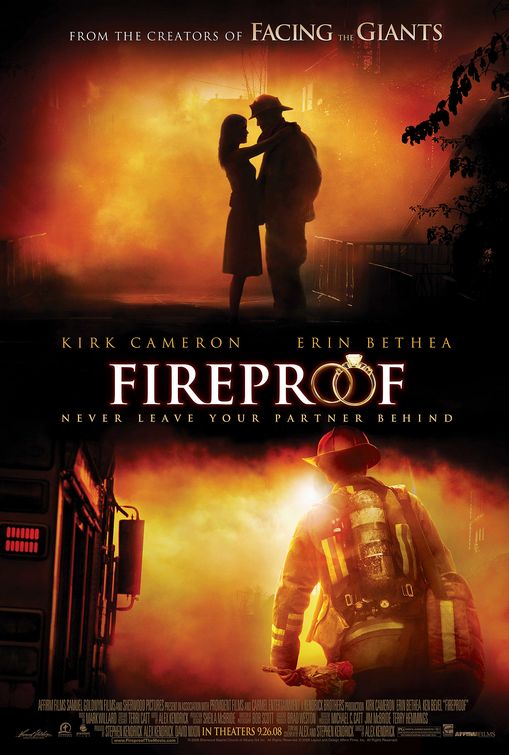
Fireproof


Year:  2008
Filming:  Color
 Length:  122 minutes
Genre:  Christian/Drama/Romance
Maturity:  PG (for intense thematic elements)
Cast:  Kirk Cameron (Caleb Holt), Erin Bethea (Catherine Holt), Ken Bevel (Michael Simmons), Alex Kendrick (Pastor Strauss), Ken Bevel (Michael Simmons), Stephen Dervan (Wayne Floyd), Eric Young (Terrell Sanders), Pastor Strauss (Alex Kendrick), Harris Malcolm (John Holt), Phyllis Malcolm (Cheryl Holt), Tommy McBride (Kyle) 
Director:  Alex Kendrick  
Personal Rating:  2 Stars
***
    
     As I think I’ve mentioned in the past, many independent Christian productions are sorry cases of good intentions gone awry and sacrificing art for message. This is especially the case when utilizing a largely untrained cast and crew primarily comprised of church volunteers. While the intent may be to “change the world”, these films usually never make the trek beyond church basements and marriage counseling groups. Such is generally the case with the much-spoken-about Christian romance called Fireproof 


    Our story begins with Caleb Holt, starring Kirk Cameron, and Catherine Holt, starring Erin Bethea, whose marriage is rapidly disintegrating. Neither one seems particularly proficient in the art of communication, especially when it comes to stocking the fridge and caring for Catherine’s elderly mother. Both of them are busy as beavers with their respective careers, Caleb as a fireman and Catherine as a hospital worker, and they seem to have little time for each other anymore. Instead of trying to remedy that problem, they grow more and more intolerant of one other.

    With things falling apart bit by bit, Caleb finds distraction in online porn, while Catherine finds consolation with an attentive doctor in her ward. At this point, Caleb’s Evangelical Christian father steps in, and provides his son with a journal that was once used when his own marriage was on the brink of collapse. Although Caleb is skeptical, he honestly wants to preserve his marriage and is willing to try anything. So day-by-day, he makes an effort to be more considerate of Catherine, making her coffee, buying her flowers, setting up a candlelight dinner, etc.

    Sadly, Catherine is being influenced by her well-intentioned yet busy-body friends who insist that Caleb is merely buttering her up for ulterior motives such as a juicy divorce settlement. So instead of reciprocating to his attempted kindnesses, she grows more standoffish and continues to pursue preparations for the divorce. Caleb is burned out by the continued rejections, and is on the brink of abandoning the project when his father insists that he think more deeply about the nature of abandonment and suffering, and embraces Christianity. His also gets moral support from his best friend and fellow fireman, Michael Simmons.

    Although things seem to get worse before they get better, Catherine is eventually moved to give Caleb another chance after he goes the extra mile to be nice to her when she gets sick (he even gets her a bag of fast-food from Chick Fila…umm…is that really healthy food for a sick person??). But what really clinches the deal is when it is discovered that Caleb has purchased her elderly mom special mobility equipment with the money he had been saving to buy a boat. Things wrap up fairly quickly (low budget), and the two agree to stick it out and reaffirm their vows, symbolized by a salt and pepper shaker set…glued together…stuck on top of a wedding cake…yeah!

    Fireproof is what it is: a small-time Christian film about love and marriage, pieced together by a predominately amateur cast and crew. While the concept is laudable, the production values plummet. The acting in general is pretty painful, and the relationship between Caleb and Catherine lacks depth and realism. He’s always stomping around, and she’s constantly whining about something, with a few in-your-face “how dare you treat me this way” moments to try and break up the monotony. October Baby had similar problems, but at least that managed to achieve some character development and genuinely heart-tugging scenes.

    The whole conundrum of Fireproof could best be described as a tempest in a teapot. Even the action sequences are clunky and predictable. Frankly, the sappy dialogue and obvious plot set-ups made it impossible to be drawn into the story. I will agree with Caleb that Catherine is virtually impossible to deal with, and ever so annoying. I’m really having a hard time feeling for her through the whole ordeal of this flick. Caleb may have his issues, like a growing addiction to pornography, workaholic tendencies, and a demanding attitude about breakfast yogurt. But all that confirms is that the two of them are equally immature.

    One of the main problems with Christian films today is the feeling that one is being wacked over the head with a proselytizing pamphlet. There is always the dramatic moment when the main character gets “saved”, which most non-Christian viewers can see coming from a mile away and take offense at the attempt to shove them into salvation. Even as a Catholic, I find the anticipated “big moment” quite alien. My own tradition relies on a quieter, steadier, more gradual growth as opposed to a slam-bang instant. I’m not saying that some conversation don’t have a dramatic catapult, but probably not the majority.

    While I can appreciate the work of firemen in general, the plot tends to emphasize consistent melodrama in association with the job. Actually, just like the army, there’s a longer “cool out” period waiting for something to happen than life-threatening incidences of high tensity day-in and day-out. Nevertheless, this film tries to milk the heroic moments, and make the job seem as glamorous as possible. There are two main actions sequences in the movie, both of which struck me as being rather hokey. One is the car stuck on the railroad track; the other is the rescue of a little girl from a burning building.
   

   The big action sequence when Caleb rescues a little girl from a burning building was pretty lack-luster. I thought he might get hurt and Catherine would feel some sense of compassion and appreciation for his heroism and be drawn towards him again. But instead, she continues going out with this cheesy doctor guy who seems planted in the story specifically to lead her astray. Caleb eventually confronts the guy (dume-dee-dum-dum) with fist upraised (great way to handle a situation…couldn’t he get arrested for threatening a medical professional?).

    The spranglings of over-the-top humor, especially the “me time” fireman and the Tabasco sauce drinking contest. It was pretty imbecilic and did little to enhance, or even alleviate, the finer points of the plot. The ending is also too “perfect”, as she suddenly decides that she really does love her husband after he buys her elderly mother mobility equipment. She also decides that she wants to be “saved” as well. I’m all for happy endings (in fact, I’m quite down-cast and frustrated when they are not at the very least hopeful!), and yet when they’re too sappy, it really undermines the believability of the story.

    In spite of all these things, I will admit that there are some broad spiritual concepts in the plot that rarely make it into movies these days. One of the main ideas is that marriage is a covenant of honor between two persons before God, not based on mere emotions but on a soulful vow of commitment that should last a lifetime. The concept of a day-by-day journal, trying to turn the relationship around through prayer and good works, is an interesting one. Also, the realization that all rejection we experience is a mere drop in the bucket to the rejection experienced by Jesus Christ on the Cross. We must trust God, turn over everything to His will, and rely on His help us get through our struggles in this world. Meanwhile, we should “praise Him while we’re waiting”.

    Judging by independent Christian production standards, I will not say Fireproof was a total bomb – at least, not in the same warped theological sense that permeates God’s Not Dead. But on an artistic scale, this one still sinks pretty low. Non-Christians will probably just laugh it off because of its instant-coffee style of conversion, and even many Christians will realize that the quality is shabby even if the message if full of good intent. That having been said, there is a nugget of goodness to be salvaged. To quote the film, “Fireproof doesn’t mean the fire will never come; it means when the fire comes, that you will be able to withstand it.” For firefighters and married couples alike, it is paramount “never to leave your partner behind.”    
 
Caleb Holt (Kirk Cameron) begs Catherine Holt (Erin Bethea) to forgive him

Wednesday, January 14, 2015

The Scarlet Pimpernel

Year:  1982 

Filming:  Color 

Length:  142 minutes 

Genre:  Action/Drama/Romance 

Maturity:  PG (for mild language and sexual innuendos)

Cast:  Anthony Andrews (Sir Percy Blakeney), Jane Seymour (Marguerite St. Just), Sir Ian McKellan (Paul Chauvelin), Malcolm Jamieson (Armande St. Just), Dominic Jephcott (Sir Andrew Ffoulkes), Christopher Villiers (Lord Anthony Dewherst), Denis Lill (Count de Tournay), Ann Firbank (Countess de Tournay), Tracey Childs (Suzanne de Tournay), Richard Charles (The Dauphin), Julian Fellowes (The Prince Regent)

Director:  Clive Donner 

Personal Rating:  4 Stars 

***

    I first read Baroness Orczy’s The Scarlet Pimpernel in grade-school, and for a girl with my imagination and love of romantic historical adventures, I found the concept exhilarating. After all, this was the prototype of the all the swashbuckling heroes with dual identities, from Zorro to Superman. But instead of the Colonial Southwest or the bustling Metropolis, this one was planted firmly in the old world and commuted between the historical rivals, England and France. Just my style, and obviously I’m not the only one who thought so since quite a few film adaptations sprung to life. The following film is just such a dramatic endeavor.

    Anthony Andrews stars as Sir Percy Blakeney, English gentleman and seemingly incorrigible fop who most everyone views as a harmless and brainless party animal with a gourmet taste for clothing and travel. However, his sojourns in France reveal another side to his character: that of the Scarlet Pimpernel, daring rescuer of aristocrats condemned to the guillotine by the French Revolutionary government! With an array of disguises at his disposal and a handful of chosen companions at his side, his pursuers are unable to bring him in, and his successes across the channel make him the toast of the table back home in England.

    During one of his missions in France, Percy rescues one Armand St. Just from a severe beating and falls in love with his glamorous sister, Marguerite St. Just, a French actress who is soon drawn to the passion she detects beneath Percy’s sleepy-eyed countenance. But there a slight problem: someone is already courting Marguerite, and it’s none other than Paul Chauvelin, the ruthless agent of the Revolutionary Committee of Public Safety whose greatest aspiration is to capture The Scarlet Pimpernel! In spite of his realization of the danger, Percy persists in his wooing, and charms Marguerite into accepting his proposal of marriage.

     But just a few hours after their marriage in an elegant Catholic ceremony, Percy learns some shocking news that changes everything. Circumstantial evidence indicates that Marguerite betrayed a royalist family to the Republican government, and the entire family was guillotined as a result! The marriage swiftly turns cold, and Percy retreats into his make-believe shell of shallow snobbery, much to Marguerite's confusion and disillusionment. Meanwhile, in his professional life, the Scarlet Pimpernel and his loyal band (now including Armand St. Just) hatch a plan to rescue King Louis XVI's young son. But Chauvelin begins to suspect Sir Percy is more than he seems to be, and travels to England to find out for himself.

     Meeting up with a disgruntled Marguerite, Chauvelin threatens to have her brother Armand arrested for secretly cooperating with The Scarlet Pimpernel unless she will help him hunt down his prey. She has no idea that her husband is the man, and is reluctantly pressured into spying for the French at an elaborate gala including the Prince of Wales among his guests. She passes on bits of information to Chauvelin, but then is overcome with remorse and tries to contact the Pimpernel to warn him. The result is a shocking discovery and climactic finale in a fortress on the rocky French coast.

     I enjoyed this film because it breathed new life into Baroness Orczy’s classic adventure novel series, and ironed out some of the vaguer bits from the book and other movie adaptations without straying too much into the land of revision. I believe the plot filled in some of the gaps in the relationship between Percy and Marguerite and also did a better job illustrating the past relationship between her and Chauvelin. Since this movie did draw from material in both the original book The Scarlet Pimpernel and the third book in the series El Dorado there was certainly a roomier feel.
    It must always be brought to the fore that this is a made-for-TV movie, produced in the ‘80’s, so the artistic quality is what it is. The background music is fits some of the acting in over-dramatic flair. That having been said, the costuming is generally a treat to behold. I love Marguerite’s riding outfit in particular, and all of Percy’s gentleman attire (cravats and all!) are delightful to behold. However, as I have mentioned in past film reviews, I believe Hollywood goes the extra mile with of the low-cut bodice style of the 18th century, trying to heighten sex appeal, which is pretty much a cheap trick to boost ratings through lustful eyes. Another rather unnecessary addition involves Armand’s “sleeping around”, although this is a brief interlude and was found in the third book as part of his character.

     Getting back to the acting, I feel that Anthony Andrews tended to overdo the fop part to the point of being quite obnoxious and rather corny. However, to his credit, he also did an excellent job candidly revealing the passion beneath the exterior in certain scenes. Once such scene was when he suddenly revealed his dual identity to Armand. Another was when he fought to conceal his feelings of disgust from Marguerite after learning of her supposed betrayal on their wedding day. Also, he makes a good “gentleman charmer”, from quipping (“They seek him here, they seek him there…”) to romancing (“You don’t know me now, but you’ll have the rest of your life to find out!), and fencing (can’t help but enjoy watching the final duel, when Percy “defrocks” Chauvelin by cutting the buttons from his coat!).
   
    Jane Seymour managed to “redeem” the character of Marguerite in my opinion (in spite of the hair style that sort of looks like a poodle sitting on her head!). I never really liked her in the book or alternate story adaptations because she was portrayed as selfish and whiney, growing cynical and flippant towards her husband and refusing to contradict the accusation against her to test Percy and see if he would love her even if she had sent that family to their deaths. Percy could not. In this film version, however, Marguerite is a much sweeter and more loving character, who is deeply hurt and confused by Percy’s sudden coldness, and takes for granted that he would believe her to be innocent of such cruelty.

    Furthermore, even though he is disillusioned with her, she never completely gives up on him. She indicates this as they return home from a social function, explaining that she is confused why he should play the fool in private as well as public. He mutters that perhaps this in fact the real Percy after all, but Marguerite retorts that she will never believe that. Also, she never loses her own innate goodness, and even when she is unsure of the Scarlet Pimpernel’s identity, she still makes an effort to warn him about Chauvelin after she was forced to provide him with information. This leads to a deeply romantic scene in which Marguerite speaks with Percy standing behind her in the shadows, not knowing who he is, but sensing something familiar about him. She then tells him that she was innocent of the betrayal, and asks him to lay his hand on her shoulder to assure her that he is real.
    For those who are fans of The Lord of the Rings, the first response upon seeing Ian McKellan playing Paul Chauvelin is: “It’s Gandalf!!!” Of course, recognizing this point might take a few scenes, as he’s quite a bit younger in this flick, but his voice is wonderfully sardonic and his facial structure memorable. And, like his fellow British actors Basil Rathbone and Laurence Olivier, he has the talent of being an equally good villain as he is a hero, and a very fine fencer! (Note: does anyone find is slightly humorous how every single character in this movie, whether they are supposed to be French or English, have proper BBC accents?)

    I definitely think this portrayal of Chauvelin fills him out and explains why Marguerite chose to part company with him, which is refreshing after the vagueness of the book.    Basically, she explains that she has become increasingly aware of the way the revolution had made Chauvelin ruthless and cold-blooded, in contrast to the young idealist she had originally fallen in love with and supported. He has changed beyond recall, to the point of betraying her confidence and maliciously implicating her in the arrest and execution of a royalist family to destroy her marriage to Percy.

    The storyline is definitely from a royalist slant, which fits in with Baroness Orczy’s own experiences as an aristocratic exile who had to flee a revolution in Hungary as a girl. Of course, looking at the broad scope of history, I would have to agree with her that most revolutions do create a domino effect of anarchy followed by a worse tyranny than the original one (chalk it up to fallen human nature…). That having been said, I would definitely put in a good word for many of the original revolutionaries who had justified complaints against the arrogance and folly of the establishment.

    But beyond historical realities, I believe there is something about The Scarlet Pimpernel that taps into our deepest yearnings for romance and adventure, heroism and even an element of hierarchical inequality (who can deny the magic of the monarchy, the mystical hereditary right to reign, even among Americans like us?). As C.S. Lewis once said, all these things are “the tap-root to Eden”, something integral to the human consciousness that set us apart from all living things as story-tellers and yarn-weavers. Also, while Sir Percy Blakeney dedicated to an old-fashioned chivalric honor and enjoys gourmet living, he is willing to risk all the comforts of his life in France and act the part of the insipid fool in England. This lack of recognition is epitomized by the wayside English flower that he uses as his symbol, and stands out poignantly as a symbol for all unsung heroes.  

Sir Percy Blackney (Anthony Andrews) admires Marguerite (Jane Seymour)