Search This Blog

Showing posts with label history. Show all posts

Monday, June 29, 2015

Waterloo


Genre:  Drama/History/War
 

Rating:  PG (for mild language and battle sequences)
 

Personal Rating:  4 Stars
***
 
    
    Christopher Plummer stars as the dour yet dogged Duke of Wellington who must pit his outnumbered troops against the forces of Napoleon Bonaparte, who recently escaped from captivity on the Isle of Elba. The two armies converge on a rain-drenched Belgian field near Waterloo, and Wellington determines to hold his position until Prussian troops arrive to defeat the French Emperor once and for all. 

     Napoleon, meanwhile, broods about his future and causes more trouble for himself by issuing impulsive commands to his officers. Several sub-plots in the film include one about dashing young British officer who is haunted by premonitions of his own death and another about a cheeky Enniskillen Dragoon who is always getting into mischief. 

    Waterloo is one of those quinisentially British movies with a sense of dark humor underpinning the dialogue. Wellington is cracking witicisms right and left as shells burst around him, revealing the stiff-upper-lip cool under fire of his class and country. Indeed, this is sometimes taken to a humorous extreme, and while Wellington was certainly known to have an acerbi wit, I highly doubt the banter continued quite as light-heartedly throughout one of the most intense battles of world history! 

     The British have always enjoyed gallows humor, and portraying themselves as possessing it, but this unrealistic flippancy risked turning Wellington into a comic relief figure in contrast with the brooding and intense Napolean. Ultimately it didn’t do justice to the complexity of his own multi-faceted personality, and he become something of a characature for his nation.  

     In spite of this, Christopher Plummer makes up for the early fooling around by demonstrating his amazing acting ability in later stages of the battle. This is most apparent when trying to demonstrate Wellington’s increased distain for war. It starts when the young officer he has been trying to protect stands up in the middle of a British square to encourage his men, shouting “Think of England! Think of England!” He is shot in the head by a French soldier, and falls dead. Wellington stares blankly at the spot where he fell, and the unreadable expression on his face speaks volumes. 

     Later, a second young aid is shot in the back immediately after Wellington gives him an order. He staggers forward several paces in agony, trying gallatnly to stay on his feet, before finally collapsing in the arms of some nearby soldiers. This time, Wellington cannot even look, and awkwardly turns his eyes down, blinking nervously and swallowing hard. Its becoming increasingly apparent by his body language that his struggle to avoid displaying emotion is becoming harder.  

     Then in the last moments of the battle, when Wellington finally has cause to celebrate after turning the tide, his friend Lord Uxbridge reels in his saddle and cries out, “My God, sir…I have lost my leg!” Wellington does not even look at the leg, but rather stares at the man’s face with a look of shock and horror, still struggling to supress his own emotions. “My God, sir,” he murmurs, in a daze. “So you have.” Then he supports Uxbridge as he falls against him, and cries out for a medic.  

     Finally, Wellington struggles to deal with the fact that his Prussian allies are far more set on vengence against the French then his own troops, and set about butchering them without mercy. Wellington tries to play the gentleman, and procure the surrender from a group of French survivors who are determined to resist. As he waits for the answer from the survivors, it is obvious how tense he is, hoping beyond hope they will take the mercy offered. They don’t, and he is forced to use the artillery on them. Once again, he closes his eyes, and looks down.  

     At the very end of the film, we get to see Wellington one more time, riding about the field, littered with wounded and dying men and horses, as scavengers pull the clothes off the bodies. Again, his face is almost a complete blank, scanning the horrific scene. Then suddenly, his eyes fall on a young Scotsman, lying dead in his kilt, with his pipes lying near him. The wail of the pipes is heard, as if in a flash of Wellington’s memory, the music builds, and he has a visible surge of emotion, which he manages to pull himself out of with the greatest struggle, before riding off the field. Through all this, you get the feeling that the initially haughty and unapproachable Wellington, and witty and dapper nobleman who never gets flustered, is far more human and relatable than all that. First appearances can indeed be deceiving.  

    The battle footage is spectacular, but the movie also spends time on the uneventful periods between the fighting. Since this is a European production, the pacing is slightly different from what most Americans are accustomed to. It's more introspective and internal, giving one insight into the thoughts of the characters as well as their actions. 

    Some people find the lulls in the plot to be boring, but I think they let the viewers get a good taste of all dimensions of the conflict, both physical and emotional. Also, it gives the viewer the chance to catch a glimpse of the hum-drum duties of early 19th century soldiering.  

     The traditional British folk-songs such as “Macpherson’s Farewell”, “Boney Was a Warrior,” and “The Girl I Left Behind Me” that are weaved into the scenes are also a nice flavoring. I definitely think this film a nice overview of the last phase of the Napoleonic Wars that culminated in 1815. History lovers will be thrilled.


The Duke of Wellington (Christopher Plummer) at the ball in Brussels
 

Friday, May 29, 2015

Battle of the Brave


Year:  2004

Filming:  Color

Length:  143 minutes

Genre:  Drama/History/Romance/War

Maturity:  PG-13 (for intense thematic elements, language, and some sexuality)

Cast:  Noemie Godin-Vigneau (Marie-Loup Carignan), David la Haye (Francois la Gardeur), Juliette Gosselin (France Carignan), Sebastian Huberdeau (Xavier Maillard), Bianca Gervais (Acoona), Gerard Depardieu (Fr. Thomas Blondeu), Tim Roth (William Pitt), Jason Isaacs (General James Wolfe), Michael Maloney (Governor James Murray), Philippe Dormoy (Voltaire)
         
Director:  Jean Beaudin

Personal Rating:  2 Stars

***

    One day, while fishing through the period piece section on NetFlix, I stumbled across Battle of the Brave. I sort of had a feeling it wasn't going to be good when I heard it was set during the French and Indian War (how could Hollywood keep from going on a splurge about evil Europeans and stuffy decorum?), but I wanted to see anyway. I’m not above being surprised by an unexpectedly good film. But my intuition proved more than correct this time, although I will admit I was surprised…by the blatant differences between the plot-line as outlined in the advertisements and how it played out in the actual production!    

    What story there is opens in Colonial French Canada, not long before the British conquest of Quebec in 1759. A young French nobleman named Francois la Gardeur has just returned from a trapping venture in the wilderness, a journey he had embarked upon to distance himself from his upper-class roots. Seeking out amour in Quebec, he rekindles an affair with a fellow nobleman’s wife, but at the same time finds himself bewitched by a beautiful and independent-minded young widow and single mother named Marie-Loup Carignan, who has learned to be a healer in the Native American tradition, and is accused of practicing dark magic.

    Meanwhile, sinister historical forces are at work. The French government in Canada is riddled through with corruption, and willing to let Quebec fall to the British to prevent an inquiry into their conduct. It is up to our wild-haired hero Francois to warn the French government about the plot, but the local authorities will stop at nothing to silence him. Throw Fr. Thomas Blondeau, a Catholic priest who is sort-of-good in that he wants to defend the poor from the desperation of a crumbling regime and the rapine of an ascending one, and yet is having sexual affairs and has this secret love for would-be witch-woman...and the whole thing degenerates into a confusing mess!

    Our noble messenger to the court of France sends a message to his lover, asking her to accompany him. But the priest, for motives that are a bit complex, mistranslated the message to keep her from going with him. This strikes off a chain reaction of unintended events…none of which are directly related to the war, nor the fact that Quebec falls to the British, without even enough production courtesy to show us the epic-ness of the Battle of the Plains of Abraham! Gah! But to summarize: “our hero” has a heart-to-heart chat with philosopher Voltaire, but fails to get an audience at the decadent court of France until after the British invasion is completed, and returns to discover that beloved witch-woman has gotten herself hitched to a his less-than-upstanding-former-friend-turned-British-lackey.

     But never fear…Gallic Lover Boy is here! Actually, cancel that…we should fear, because it doesn’t seem he has any definite plan, and one he tries to launch to rescue his lady-love from her abusive husband backfires miserably. Ultimately, deadbeat hubby has an unfortunate collision with an axe, but no one is sure who administered the fatal blow. Marie-Loup gets arrested and framed for her husband’s murder, which everyone is content to let lie since she is already a social outcast. At this point, the two main men in her life – Francois and Fr. Blondeau – try to “save her” in different ways. The former makes a vain attempt to plead mercy before the new British Governor James Murray, and the second tries to give her absolution for the murder, which she refuses. It will only be at the end of the old man’s life when the truth will be revealed and the mysterious case laid to rest with Mary-Loup.

     This film had some artistic pluses in the form of beautiful cinematography and a lush music score. It gave a good feel of the Colonial era of sprawling forests and Old World settlements, inhabited by a mix of different races struggling for survival and domination. The acting was fair enough, and the relationship between Mary-Loup and her little daughter France was touchingly rendered. Also, some of the romantic interplay between Francois and Mary-Loup was worth salvaging, even though their overall romance was pretty lame. David la Haye and Noemie Godin-Vigneau seemed to have good on-screen chemistry, and they have a talent for conveying emotions through facial expressions. And I will admit this much: the leading lady has amazingly bewitching eyes!

     But in spite of these perks, the story was a horrible miss-match of themes and plot threads that failed to coalesce into any definite vision. It is permeated with modern sentiment jet-lagged into a past time period, with Francois and Mary-Loup serving as symbolic of liberalism and modernity as opposed to the narrow-minded, old-fashioned, and corrupt characters that surround and ultimately destroy them. In this sense, the whole story takes on the visage of a morality play, even though the morals are foggy at best.

      It is not by accident that we see Francois “connect” with the ultimate liberal, Voltaire, after his repeated efforts to shake off his noble heritage which is portrayed as being corrupt overall. Needless to say, there certainly was corruption in the nobility, particularly among the French Colonial ruling class in Quebec. But portraying the upper classes as “all bad” just doesn’t do them justice. I would have liked to meet the Marquis de Montcalm, the epitome of a French gentleman, dedicated to honor, duty, and his country. So while we can sympathize with Francois’ issues to some extent, the movie fails to portray the pros-and-cons of the class system with balance.

    Likewise, we can certainly sympathize with the more open and curious ways of Mary-Loup, and her willingness to learn the ways of the Native Americans through her friendship with the Indian girl, Acoona. But trying to make almost everyone else around her into 2-dimnsional villains fails to appreciate their own perspectives, and the “comfortableness” these characters would have had holding these beliefs in their own time periods. Plus, Mary-Loup does seem to be a bit “loose in love”, so to speak, and has adapted some of the superstitious practices associated with witch-craft, so even a few eye-brows raise, it’s not a huge wonder. And of course, there has to be a priest struggling with his vow of celibacy, in a kind of creepy way…I mean, isn’t he old enough to be Mary-Loup’s father? Weird.

    Not only do the characters feel strangely out of place in their respective era, but Battle of the Brave doesn’t even live up to its own advertisement as a flick about French resistance fighters battling for “freedom.” Literally, on the cover there are three indicative words: “Rise. Unite. Fight.” But none of this ever comes about. There are no resistance fighters, and there is no battle! The war, which is supposed to be so central to the plot, is skipped through with nothing more than a shelling sequence, which kills a side character but does not influence the central plot. Instead, the story-line is totally hinged on the love affair, which reaches a dead-end and fails to support the movie with needed substance.

     On an historical note, we do get to make a brief foray made into the British establishment, whence we get to meet Tim Roth (infamous for his role as Archie-the-Villain in Rob Roy) as William Pitt (no! no!!!) and a totally-too-old, totally-too-deranged Jason Isaacs (infamous for his role as Tavington-the-Villain in The Patriot!) as General James Wolfe (Say what???!!!) who fails to do anything impressive but rant about wildly and mutter poetry with a weird gleam in his eye. These blatant miscasts can be accurately classified as nothing more than a generic British villains convention, to purposely purport a politically correct and historically incorrect depiction of The French and Indian War.

    As someone who has spent more than a few years studying Wolfe and pouring over his personal letters, I was particularly frustrated to death by this obtuse portrayal. I understand that the film may have been trying to paraphrase an incident in which Wolfe, slightly inebriated and out-of-character, is said to have bragged about what he would accomplish in America, and pounded his sword hilt on the table in front of Pitt. But the way it came off was that he was always behaving like a nut, and everything he did was viewed as off-beat by those around him, including poetic recitation. This fails to explain why the legend of Wolfe has been such an inspiration to fighting men for generations.

    Wolfe was certainly a very complex character, who could often be judgmental and sometimes quite brutal. He also might have seemed a bit “manic” every once in a while. But this is only one side of the coin. A reading of his letters and the testimony of contemporaries also show him to also have had many attractive qualities, and was not some chronic maniac. He was deeply philosophical, had a marvelously witty sense of humor, and a profound sense of duty to his country and the men under his command. His soldiers adored him, and found his eccentricities inspirational, including his love of quoting poetry. Furthermore, memorization of poetry was much more common in the 18th century than it is now, and wouldn’t have even been considered as outlandish as it might be today.

     The film also messed up the character of British governor James Murray, who is portrayed as being unscrupulous and willing to have Mary-Loup executed even though he has proof she is innocent of the murder of her husband. He doesn’t want to risk putting his job in danger by angering those who are stuck in the “dark ages” and opposed to modernistic Mary-Loup. First off, they got his accent wrong: He was Scottish, not English. Second, portraying him as a fall-back villain is character assassination, unless they have some sort of proof he actually behaved in this manner. Historically, the worse thing that can be said of him was that he was jealous of General Wolfe and gave him a hard time, but as governor of Quebec, he was known for being fairly compassionate to the plight of the inhabitants and proved himself to be an able and just administrator.

     Basically, the history buff and story-lover in me was deeply disappointed by this goofed-up attempt to bring The French and Indian War to life on screen. With a predominately French cast and crew, I knew the chances of them being fair to the British were slim. But they even missed out on giving the French their proper due by getting hung up in too many soap-opera-esque love affairs and an obscure moral tags about the blessings of modernity, and the ill-fated consequences of intolerance, which is viewed as the ultimate evil in our modern age. I’m certainly not advocating it, but I think there are other vices to be brought to the fore as well, some perhaps not so politically correct…like character assassination in big-budget historical butcheries!

    I’m afraid that I must make fanfare of tossing Battle of the Brave into the ceremonial fibrotic fire-pit with its kith and kin on the death-row shelf:  The Last of the Mohicans, Titanic, The Patriot, Braveheart, Rob Roy, etc.! Judging from this illustrious accumulation of painful productions, I’d say it’s about time to have a smores fest! If I’m sarcastically harping on this subject too much for my educated readership, please bare with me. I really must write about how messed up I feel Hollywood is getting with these historical "epics", for my own sanity, and perhaps to better the planet. Perhaps it will rouse the masses to demand better fare...or something! Every little voice helps.

Francois la Gardeur (David la Haye) rides with Mary-Loup Carignan ( Noemie Godin-Vigneau)

Thursday, April 30, 2015

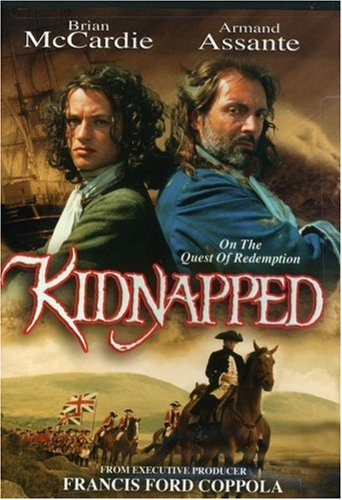
Kidnapped


Year:  1995

Filming:  Color

Length: 155 minutes

Genre:  Action/Adventure/Drama

Maturity:  PG (for intense thematic elements)

Cast:  Brian McCardie (David Balfour), Armand Assante (Alan Breck Stewart), Patrick Malahide (Ebenezer Balfour), Michael Kitchen (William Reed), Adam Blackwood (Captain Forbes), Brian Blessed (Cluny MacPherson), Brian McGrath (James Stewart of the Glen), Brendan Gleeson (Colin Campbell, “The Red Fox”), Antoine Byrne (Mary MacDonald of Dunbrae), Catherine Byrne (Flora)

Director:  Ivan Passer

Personal Rating:  4 Stars

***

    As a Scottish/British history buff, I often lament the shoddy depiction of the Jacobite Rebellions on screen. They are reduced politically-driven drivel about the evil English and their attempts to subjugate the independent-minded Scots. All the nuances of the period are shunted to the wayside, which irks me to no end. However, I am pleased to report that this version of Robert Louis Stevenson’s classic adventure story Kidnapped does a fair job staying true to history for us buffs, and making it exciting for the public at large.

    Brian McCardie stars as Davie Balfour, a young gentleman from the Lowlands of Scotland, coming of age in the mid-18th century. Upon the death of his father, he goes in search of his long-lost uncle Ebenezer, who has been hoarding his rightful inheritance by pretending to be the elder of the two brothers, when in fact he was the younger one. Still, after some investigating and surviving nearly falling through a broken stair-well (yes…it’s a set-up!), he manages to get Ebenezer to promise him some share in the family fortune. Instead, the all-too-trusting Davy winds up being kidnapped and sold into slavery on board a ship headed for the Americas. 

    But his course is interrupted when Alan Breck Stuart, a Jacobite exile on a mission to France, boards the ship and bargains for safe passage. Thrown together by mutiny and shipwreck, Davie and Alan are washed ashore on the Scottish Highlands where they must learn to trust one another if they except to survive in an atmosphere of political tension and military occupation in the aftermath of the failed Jacobite rising of 1745.  

     Davie is determined to return to the Lowlands and reclaim his rightful inheritance; Alan is set on getting to France and delivering money to finance the Jacobite cause. Even though their perspectives clash and they find it difficult to get along, circumstances pull them together after they are both framed for assassinating Red Campbell “the Fox”, a powerful pro-government laird shot down on the road. With no hope of being acquitted in a land dominated by brutal martial law, Davie and Alan set off on a race across the Highlands to avoid capture by redcoat troops.

     But the stakes are raised when the murder of Campbell the Fox is blamed on James Stewart of the Glen, Alan Breck’s surrogate father. Eager to prove his innocence, Alan Breck goes in search of the real killer with the legally-astute Davie in toe. But when James is captured and cruelly executed, the goal changes from a rescue mission to fulfilling a vendetta. Along the way, the unlikely pair enlists the aid of Mary MacDonald of Dunbrae, a young lady who Davie begins to fancy, in spite of their initial clash of customs and beliefs. They also meet with the rowdy Cluny MacPherson in his mountain stronghold called “Cluny’s Cage”.

    There is danger aplenty as they stay one step ahead of William Reed, a ruthless government official from London obsessed with capturing Alan, using any means at his disposal to do so. Along with Reed is Captain Forbes, a young British officer whose desperation for promotion stifles the dictates of his conscience. But an unexpected twist ultimately makes him vitally important in deciding the fates of Davie and Alan as they reenter the Lowlands, hell-bent on reclaiming Davie’s rightful inheritance and avenge James of the Glen. In the process, they learn that friendship can be developed in the most trying of circumstances, and in spite of many differences, unity can be forged.
   
     I found this version of Kidnapped to be a good adaptation of Robert Louis Stevenson's classic novel about the aftermath of the Jacobite Risings. Although it does stray from the book in various places, I think it manages to do so with skill, building subplots that succeed in enhancing the main storyline rather than demolishing it. I also think that this version does a fair job in keeping with the proper terminology of the historical period, which is refreshing in comparison with some later versions that rely heavily on the "bad English/good Scottish" stereotype and overlook the complexities of the rebellions.

    Of course, there were still historical inaccuracies. It’s a fact that no one knows for sure who murdered Campbell the Fox, and inserting a fictional character to blame it on doesn’t really solve the mystery…although I could almost believe that a government official might have. And were they seriously trying to say that Alan Breck had an illegitimate child with Flora MacDonald? Or was this a totally different Flora they had make a debut? That whole sequence was really awkwardly explained! I appreciate it was trying to point out the difference in a man and a woman’s perspective on the ongoing strife, but still!

      I appreciate the way Davie is shown as maintaining his position as a government supporter while at the same coming to be more sympathetic towards the Jacobites, as opposed to “going rebel”, as the 2010 version indicates. I particularly liked the scene in which he made a case that the rebellion was over, and Scotland had made her choice for King George, the Whig administration, and with it the Act of Union. It quite reminded me of the current conflict in Scotland over the issue of independence, and how some people refuse to give up the ghost on the matter or acknowledge the will of the majority in a “once-in-a-lifetime” opportunity to decide the matter.

     On the other hand, Alan is shown as being continually loyal to Jacobitism and “the king across the water” while at the same time coming to better understand the logic of the government supporters, and the realization that the future lies with them. Over the course of their adventures together, Davie manages to successfully demonstrate that his law-abiding position is a logical one, even as we cannot help but agree with Alan Breck’s insistence that he should get some more “poetry in his soul.” Another part of the movie that I liked was the way that both characters have different ideas about what it means to be a “Christian gentleman”, and yet each one knows the importance of it. It seems that Alan is a Catholic (he makes the sign of the cross in one scene), and Davie is a Presbyterian, and yet both learn to respect each other and their mutual dedication to honor. My only complaint is the way the two parted in the end; it was so cut-dry, after all they had been through together! A little emotion was needed!

    The acting overall was fair enough. Brian McCardie and Armand Assante make an excellent team, sparring with wit and ultimately swords (all in good humor!). I simply love McCardie’s rich Scottish accent, and the way that when he is frustrated, he forces himself to speak through a plastered grin! Assante also brought Alan Breck Stuart to life as a rugged yet lovable rogue, very human and able to tug at the hearts of the audience through his tragic heroism in a lost cause. And who could pick a better British villain than Michael Kitchen? Okay, so those who know me well know that I was a fan of his role as terrifyingly imperturbable Judge Jeffries in Lorna Doone, and he does not disappoint as the sardonic, sarcastic, ever-smirking, black-clad William Reed in Kidnapped.

    This is a made-for-TV movie, so perfection is not to be grasped at. However, the scenery shots are beautiful, with the hills and glens all wonderfully wild and resonating with Celtic connotations. Indeed, it taps into that very inner poetry that Alan is so desperate to get Davie to acknowledge (the artist in me has tried that with many-a-stiff-necked doldrum…;-) Period costuming was also very good, and I especially liked the red-coat uniforms (don't I always?!). Unfortunately, the music track, which repeated itself over and over again throughout the film, was certainly lacking and sometimes sounded like it was pounded out on a cheesy studio keyboard! The 2010 version certainly had a catchier theme, although I will say there were several moments of musical grace involving a stirring whistle tune, and a few bagpipe interludes.

     So I would definitely rate this movie as an enjoyable historical adventure flick with a good plot-line, memorable characters, and some lovely scenery snap-shots. As I’ve often mentioned in the past, it’s interesting that little-known, small-budget productions actually do a better job with historical retellings than big-budget Hollywood-ized block-busters. Without all the schmaltz, there is time to be more subtle in exploring the characters and time periods in which they live and work and fight and bond with one another. Robert Louis Stevenson was a great author, and he deftly managed to capture a complex time period in Scottish history through his novel Kidnapped. I think this movie adaption, although certainly not perfect, did a good job keeping in line with the spirit of the original work.

Cluny McPherson (Brian Blessed) shares a drink with Alan Breck Stuart (Armande Assante)