Search This Blog

Showing posts with label biography. Show all posts

Friday, October 31, 2014

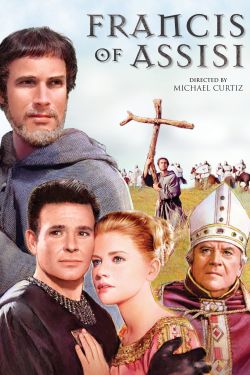
Francis of Assisi


Year:  1961

Filming:  Color

Length:  105 minutes

Genre:  Biography/Drama/Inspirational/Religious

Maturity:  PG (for intense thematic elements)

Cast:  Bradford Dillman (Francis Bernadone), Delores Hart (Clare), Stuart Whitman (Count Paolo of Vandria), Finlay Currie (Pope Innocent III), Mervyn Johns (Brother Juniper), Russell Napier (Brother Elias), Cecil Kellaway (Cardinal Hugolino), John Welsh (Canon Cattanei)
         
Director:  Michael Curtiz

Personal Rating:  5 Stars

***

    As you all must know by know, I have a particular soft spot in my heart for religious epics from yesteryear. Now that we have a pope who bears the name of Francis, it’s only natural that the public should have an increased interest in the nature-loving saint from Assisi who they are vaguely familiar with through garden saints and book marker prayers. To begin the journey towards of deeper understanding of St. Francis, I would say that the following film is a must-watch-classic that brings him to life with a perfect balance of gentility and passion.

    Bradford Dillman stars as Francis Bernadone, the high-spirited son of an Italian merchant who indulgences in the various pleasures of life in the medieval town of Assisi. With the world at his feet, he marches off in armor and chain mail to fight in a conflict between the city states. He also befriends Count Paolo of Vandria, a dashing Italian noble who takes the young man under his wing as they both embark as brothers-in-arms. But Francis is haunted by strange voices, urging him to abandon his worldly lifestyle and embrace a higher calling God has planned for him. To his father’s dismay, he deserts the army and is thrown into prison as a result. His pious mother, however, understands the workings of his soul and prays for her son’s speedy release.

    Paolo is disillusioned by his friend’s perceived cowardice, but the beautiful noblewoman Clare persuades him to show mercy and use his position to pardon Francis. Paolo does so, but with the understanding that he hopes to win Clare’s hand in marriage. But she, like her childhood friend Francis, is being stirred by a deeper calling. After he is released, Francis cannot return to his former life and feels uncertain how best to proceed until he has a mystical experience at the dilapidated Church of San Domiano. There he hears a voice coming from the crucifix, instructing him to “rebuild my Church which is falling into ruin.”

    Taking this literally, Francis takes to the streets in a simple robe and sandals, begging for stones to rebuild San Domiano. While many of Assisi’s prominent citizens dismiss him as a lunatic, he begins to draw a following among those who seek to live the rule of total poverty in the spirit and service of Christ. Soon, his “brotherhood” grows to the number of 12, and they journey to Rome to have the Rule of their new order approved by Pope Innocent III. They are almost turned away because the strictness of the Rule, but then the Pope recalls a dream he had, in which Francis upheld the pillars of the Basilica of St. Peter which were crumbling. He takes this as a sign for God, and approves the Franciscan Order.

    Meanwhile, Clare makes a decision of her own to join the Franciscan order as a nun, much to the distaste of both her father and Paolo, who has received her father’s approval to marry her, whether she is willing or not. Nevertheless, she escapes with the help Francis and takes her vows. When Paolo breaks into the church, she shows him that her long golden hair has been cut, and calmly walks away from him. She goes on to be the foundress of the Franciscan Sisterhood. While the order grows in Italy, Francis journeys to the Holy Land in hopes of bringing peace to war-torn Palestine by converting the Sultan.

    But a series of disheartening events beset him, and he must return to Europe empty-handed. To make matters worse, one Brother Elias has been planning to relax the Rule of the Order, and Francis must learn to curb his own pride and take a back seat as the changes go on beyond his control. Suffering from extended illnesses and blindness, Francis retreats to a cave where he once again waits for a sign from God. It comes in the form of the stigmata, which will forever mark him with the Wounds of Christ.

    Francis of Assisi combines epic story-telling with profound spiritual depth. The on-location footage shot in Italy is wonderful, as is the colorful medieval costuming reminiscent of Italian pageants that continue to this day, bringing to life all the fierce local pride that characterized the city states of the Middle Ages. I’ve heard some people accuse this film of being too Arthurian or “Disney-land-ish” in feel, and failing to achieve gritty realism. But I felt the color and gaiety shown as the men march off to war was in keeping with the pomp and ceremony surrounding local Italian pageantry, and making it clear why Francis would tantalized by the glories of the battlefield.

    Bradford Dillman does an excellent job portraying Francis, from his colorful youth to the darkness enveloping his old age. I particularly appreciate the scenes showing Francis searching his soul, such as when a beggar repeatedly approaches him with the words “Pax et Bonum”, only to vanish from sight as a procession holding aloft a crucifix comes into view. Another one of the deeply spell-binding sequences is when Francis receives his stigmata. It is telling that Dillman refused to smoke while in his Franciscan garb out of respect for the saint he was portraying, showing his own willingness to put his all into the production. However, he was more than happy to have Dolores Hart light him a cigarette on set while he was in his chivalric attire…and even have the photo man capture the moment on camera!

    Delores Hart has a particularly resonant voice and elegant beauty that makes her a perfect Clare. Interestingly, the actress herself eventually became a nun, and is today Mother Dolores Hart! I must say that the delivery of her lines sounded rather stinted at times, but nothing really serious to complain about. Overall, I thought the acting in this film was very well done. Again, I’ve heard some people accuse it of not being “dynamic” enough, but frankly, I don’t think it’s fair to accuse laid-back of some failure merely because they choose a different style of acting.
   
    I personally love the tender and charming moments in this movie, including Francis’ repartee with the animals, blessing the children’s pets, charming birds from the trees, and even making friends with some very hungry-looking cheetahs! Also, who can help but love the child-like innocence of Brother Juniper, played by Mervyn Johns? Another one of my favorite parts is when Francis and his brothers walk to Rome to ask for the Pope’s blessing on their new order, singing hymns of praise as they go. Then when they reach the gates, Francis miraculously manages to walk into the Vatican unopposed during the changing of the guard!

    And I’m going to enthuse about Finlay Currie again: he’s such a great character actor, and I think he makes a great “Papa” of the Church, whether he be St. Peter in Quo Vadis or Innocent III in Francis of Assisi. Of course we’re pretty sure that these historical characters didn’t really have Scottish accents (more like Hebrew and Italian!), but who’s gonna have the gall to complain about that? Finlay’s lilt is too wonderfully musical to listen to! I’ll also take the time mention here that the Catholic Church and Catholics in general are portrayed very well, with reverence and sympathy, but not hiding the flaws either. We see opulence in the Church hierarchy, collusion among the Franciscan Brotherhood, and an unreasonable streak in Francis himself when the letter of the law proves unlivable for his growing Order.

    We also see the dark side of the Crusaders-gone-wild (not romanticized at all really), and are allowed a sympathetic view of the Sultan Saladin who spares Francis’s life. I find their dialogue quite intriguing, allowing Francis to approach the Sultan in the name of love as an emissary of the God of Love, and willingly offers to prove the reality of his God by walking through a fire pit. Saladin is deeply impressed, and comments that although he has not made a convert, he has made a friend. Francis responds that that is the first step.

    Stuart Whitman is totally memorable in his role as the fictional Count Paolo of Vandria. Arrogant, hot-headed, courageous, and impulsive, he’s a great contrast the wistful, contemplative Francis, both as his friend and later rival. One cannot help but feel sorry for Paolo who is so caught up with his own emotions that he fails to take Clare’s feelings into consideration, nor even respect her spiritual quest. Her rejection of his advances wounds him deeply, and turns him into an embittered, and deeply hateful man, chasing after “booty and beauty” as a disillusioned crusader. While in the Holy Land, he happens to run into Francis (just chalk it up to coincidental screen-play-writer intervention!) where he disparages him as a sanctimonious hypocrite who failed to convert the Sultan or keep his Order living by the strict Rule of Poverty.

   In the end, he does make something of a come-back at Francis’ deathbed, but I'm afraid (to my eternal frustration) that Francis fails to give him as warm a reception as I might have hoped! He does mutter something like, “May God grant you His peace”, but that sounded way too distant for all they had gone through together. Can’t help but be reminded of the chilly way Moses treated Nefretiri in The Ten Commandments…and she wasn’t even being particularly repentant, but rather trying to get him to have an affair with her! But aside from this, I found Francis’ deathbed sequence moving, especially when Clare bids him a final farewell after his death, blessing him with the greeting that turned his heart to God so long ago: “Pax et Bonum.”

    So my summation: Francis of Assisi is a gentle, clean, deeply moving classic. I personally think the modern obsession with “grit” in period pieces is just another fad that will pass by, leaving movies like this behind to be enjoyed by all ages. Accuse me of being an incorrigible nerd; I like old-fashioned religious flicks! In fact, I LOVE old-fashioned religious flicks! While some may claim they lack “realism”, I return to challenge, and say that many modern attempts at religious epics are often sorry affairs, bereft with bad attitudes, 1990’s hair-dos, an unnecessary emphasis on guts and grime, and pathetic method acting! There, I feel calmer now. Now I’m ready to say the Prayer of St. Francis (that he evidently didn’t really write, but who cares?!): Lord, make me an instrument of your peace…;-)


Clare (Dolores Hart) is received into the Franciscan Order by Francis (Bradford Dillman)


Saturday, October 11, 2014

Amazing Grace


Year:  2006

Filming:  Color

Length:  117 minutes

Genre:  Biography/Drama/History/Inspirational

Maturity:  PG (for mild language and intense thematic elements)

Cast:  Ioan Gruffudd (William Wilberforce), Romola Garai (Barbara Spooner), Benedict Cumberbatch (William Pitt), Michael Gambon (Lord Charles Fox), Albert Finney (John Newton), Rufus Sewall (Thomas Clarkson), Youssou N’Dour (Olaudah Equiano), Ciaran Hinds (Lord Banastre Tarleton), Toby Jones (Duke of Clarence), Bill Paterson (Lord Dundas), Nicholas Farrell (Henry Thornton), Sylvestra le Touzel (Marianne Thornton), Jeremy Swift (Richard the Butler)
         
Director:  Michael Apted

Personal Rating:  5 Stars

***


      There are pathetically few movies that are able to deal with political/legal themes and still maintain a human touch that transcends the specialist category. But one of them on the top of the list is Amazing Grace, a biopic of the man who was instrumental in bringing an end to the British Slave Trade. As a period piece, it excels for good taste, balance, and a keen ability to connect the past with the present. As a story, it succeeds in intriguing, inspiring, and warming hearts with hope for humankind.

    Ioan Gruffudd stars as William Wilberforce, an energetic young Member of Parliament, who experiences a spiritual reawakening and becomes an Evangelical Christian. Discerning whether or not he should withdraw from the world and peruse the ministry, his friend William Pitt convince him to stay in politics by connecting him with abolitionists seeking to put an end to the British slave trade. Deciding to use his talents for the good of all, Wilberforce takes up the challenge, but his participation in the controversy makes him increasingly unpopular among powerful parliamentarians who have a vested interest in the trade.

    Working tirelessly to change the hearts and minds of the British people and show them the great inhumanities of the trade, Wilberforce makes allies with honest yet unkempt activist Thomas Clarkson, the former-slave turned elegant man-of-means Olaudah Equiano, and even the self-serving political survivor Lord Charles Fox. Together, they gather thousands of signatures in favor of abolition to present before the parliament. He also makes a point of impressing upon the powerful landed classes the plight of those suffering under their very noses, bringing to light how African men, woman, and children are made to endure a horrendous sea voyage and sold to sugar plantations to be worked to death.

    But in spite of the evidence, many politicians such as Lord Dundas decide to play it safe and refuse to vote for complete abolition. Even many of Wilberforce’s supporters fail him by going to a comic opera instead of turning up to vote. When the French Revolutionary Wars begin, Parliament shoves the issue on the back-burner, and Wilberforce is accused of being unpatriotic. Disillusioned, he considers resigning from his position in the government, and some of his supporters adopt revolutionary sympathies. But then Wilberforce meets his future-wife, Barbara Spooner, who encourages him to persevere in the face of any and all obstacles. From that point on, he is a newly driven man.

    This movie adroitly captures the dangerous ebb and flow of the political world while at the same time bringing out personal stories against the backdrop of epic historical events. The characters are portrayed in a very human light, whether they are from the upper or lower classes, pro-slavery or pro-abolition. The costuming and overall setting is exquisite and manages to capture the right balance between realism and flourish, accessibility and old-fashioned flare. We get to see fine dining halls, charming country estates, stuffy parliament chambers, dingy city streets, and bustling docks, getting a full-scaled panorama of 18th century Britain. The music score is also top-notch (highly recommend you get the CD!) which managed to bring out the flavor of both British and African cultures, interweaving past and present instruments flawlessly.

    Ioan Gruffud is at his acting best in his portrayal as William Wilberforce. Like Sir Thomas More in A Man for All Seasons, the character is so full of depth and humanity he seems to literally come to life through the actor depicting him, and by the end of the film, we can’t help but be an admirer of him. After all, he’s an affable and intelligent young man with a great career ahead of him, but he risks scuttling it in order to aid the oppressed and nearly destroys himself physically and emotionally in the process. He becomes a suffering soul, and a living martyr for those who have no voice. Gruffudd captures all these things with great passion and grace.

    Romola Garai makes a wonderfully warm and witty Barbara Spooner, urging Wilberforce to come out of his slump and return to the parliament floor. Her chemistry with Ioan Gruffudd on screen is delightful, especially their desperate attempt to find something to argue about in front of their match-making friends! One thing that bothered me, however, was the low-cut neckline in the dresses she usually wore in the production. I know that this could just be attributed to late 18th - early 19th century fashion, but I just thought it was a bit revealing and purposely seductive. It’s a Hollywood thing, but I must admit I was hoping for better.

    Rufus Sewall’s portrayal of Thomas Clarkson is lovably bluff and scruffy, revealing a good heart but also a dangerously passionate streak that threatens the whole enterprise. He gets into confrontation with Wilberforce over how best to handle their repeated defeats in parliament. Clarkson suggests that a revolution might be their only hope, but Wilberforce forcefully reminds him that he has taken an oath of loyalty to the king (who I do we wish would have made an appearance at some point in the film!). Clarkson retorts that the king is insane, and that he intends to go over to Paris to mingle with the revolutionaries. After several moments of tense listening, Wilberforce cuts him off, and orders him never to speak of revolution in his presence again.

    This is such a British moment in the film, because it exemplifies the realization Wilberforce experiences, and that the British people throughout history have clung to, that they must “hold back from the brink”; that needed changes can come through the due process of law, without shattering the governmental structure. Indeed, the film-makers evidently understood the importance of this project to the way people perceive the British People and their history and culture, because they made sure that all the filming would be done in Britain and that all the actors cast for the movie were British.

    The other great thing about Amazing Grace is the way that spiritual themes are handled without being preachy. Wilberforce is a deeply religious man, and the virtue of this shines through his actions and world view, but the script never reads like a proselytizing pamphlet. It’s sincere; it’s real; it’s naturally moving. I love the way he is portrayed as praying simply and openly, and the motif of the spider web symbolizing his love of The Creator and all His Creation. This point is also brought to the fore when he gets out of his carriage on a rainy night to stop a man from beating his horse, and the man listens to him because name of Wilberforce has now come to be respected by many as a symbol of principle.

    Getting to see Ciarin Hinds portray Banastre Tarleton in his post-revolutionary years was quite a treat. I must admit it took me a few minutes to make the connection between the pro-slavery MP and “Bloody Ban” of wartime infamy. But when he held up his hand to reveal missing fingers that he had lost fighting with the American rebels, it suddenly dawned on me, and I yelped, “It’s Ban!!” Nice to see him depicted as a well-rounded character, instead of the over-the-top villain in The Patriot. And at least this sets the record straight that he didn’t get impaled by Mel Gibson, but moved on to greener pastures in career as a consistent un-huggable.

    There are a few other moments in the film that hearken back to the American Revolution. One is when Wilberforce speaks out in favor of ending the war and making peace the rebels. It is often forgotten that there was a whole movement within British parliament opposing the taxes levied in America and seeking to give her representation in the mother country. When things began to look increasingly hopeless about politically reuniting, they urged a swifter peace to avoid further bloodshed. Another interesting moment in the film is when a legless beggar crawls over to Wilberforce in the street, saying that he “lost his legs fighting the Yankee rebels”. I wonder how often people ever think about the human cost of that war for Britain, and the social aftermath of it on both sides…

    Benedict Cumberbatch makes a wonderfully erudite and elegant William Pitt. One particularly good line is when Wilberforce exclaims that it is next to impossible for Pitt to become prime minister in his 20’s, to which he responds, “We’re too young to realize certain things are impossible, which is why we will do them anyway.” In reality, Wilberforce was never able to visit Pitt’s deathbed as shown in Amazing Grace, and they were actually somewhat estranged over some political differences at the time. But the portrayal of their friendship is touching nonetheless, and in reality, Wilberforce always seems to have treasured the memory of it. 

    I’ll admit that Albert Finney as John Newton looks rather different than I pictured him and that his portraits portray him, and I do sort of wish the film focused a bit more on his personal experiences since he is the one who wrote the title song! But he still does serve as a powerful example of the older generation passing on the mantle to the young, with his impassioned exhortation to “blast the slavers out of the water”. It is also deeply moving when he weeps and wonders if all the people he sold into slavery had names, and supposes that they must have been “good African names.”

     In connection with that, Youssou N’Dour as Olaudah Equiano puts a face and a voice to the millions of unnamed victims of the slave trade, whose lives were cruelly misused and cut short by the greed of others. Although Equiano pours himself out in the abolitionist cause, he tragically does live to see it succeed. Nevertheless, Thomas Clarkson does visit to grave when abolition is on the brink of passing, tells him the good news, and “shares a bottles” with him, drinking some and pouring the rest into the ground.

    One of the ironic inaccuracies of the movie had to do with the fact that the traditional tune of "Amazing Grace" is believe to have been added to Newton’s hymn at a much later date than the events depicted in the film. In spite of this, Wilberforce is shown singing the hymn to this tune and having it played at his wedding! While on the subject, it must be noted with some pain that, unlike the real Mr. Wilberforce who was said to have a glorious voice, Ioan Gruffudd really can’t hold a tune, and it shows when he stand up on that table belts out the beloved hymn before the unsympathetic throng! Oh, well. Chalk it up to good intentions gone awry?

    The finale is always a tear-jerker, when the trade is finally abolished and Wilberforce, struggling to contain his emotion, is given a round of applause. He exchanges a knowing look with his beloved wife in the balcony, realizing that without her, he may never have seen the cause to completion. The end credits are set against a rousing rendition of “Amazing Grace” played by a military pipe and drum band, and we get to see the kilted players lined up in rows outside Westminster Abbey, where both William Wilberforce and William Pitt are buried. I mean, how British can you get?

    Thinking about the injustice of the Slave Trade and how difficult it was to end, I cannot help but make a comparison to the ultimate injustice of our own era: Abortion. While it may be hard to visualize it being abolished now, perhaps a generation or so hence, we shall look back on the killing of the unborn with the same horror as we now look back on the buying and selling of slaves. What we really must pray for is that we may be given more leaders like Wilberforce and his associates to bear the pressure of an unsympathetic society and see the cause through. That is why stories like this one really must be told, and heroes like Wilberforce must be remembered. That is why I am so grateful this movie was made and is able to communicate his story in our modern era. It stands as proof that faith and endurance can overcome the most strident opposition. It is a manifestation of truly amazing grace.


William Wilberforce (Ioan Gruffudd) address the House of Commons


Saturday, July 5, 2014

A Man for All Seasons

 
Year:  1966

Filming:  Color

Length:  120 minutes

Genre:  Biography/Drama/Inspirational/Political/Religious

Maturity:  PG (for brief language and intense thematic elements)

Cast:  Paul Scofield (Sir Thomas More), Robert Shaw (King Henry VIII), Wendy Hiller (Alice More), Susannah York (Margaret More Roper), Leo McKern (Thomas Cromwell), John Hurt (Richard Rich), Orson Welles (Cardinal Wolsey), Nigel Davenport (The Duke of Norfolk)

Director:  Fred Zinnemann  

Personal Rating:  5 Stars

***

      If I had to pick my favorite movie of all time, it would have to be A Man for All Seasons. As one of the only movies to make a Catholic English Martyr its main focus, it will always hold a special place in my Anglophile heart. But beyond that, I believe the film is true to its title and subject by being relatable to all people and applicable to all seasons.

    Paul Scofield stars as Sir Thomas More, an honorable man caught in the grip of religious and political upheaval in Tudor England. A political figure and personal friend of King Henry VIII, his future advancement seems likely even as he enjoys a quiet life with his wife and daughter at his country estate in Chelsea. However, dark clouds loom on the horizon when the king takes it upon himself to divorce his wife, Catherine of Aragon, and marry his mistress, Anne Boleyn, on a “point of conscience.”

    Pressured to support the move by the corrupt Cardinal Wolsey, the devoutly Catholic More maintains that annulments are a matter for the Holy See, but his refusal to speak for or against the proceedings sparks the anger of the irascible king. Nevertheless, Sir Thomas is appointed Lord Chancellor of England, making his position more precarious than ever. When King Henry visits More at Chelsea, he once again tries to force him to make a statement about the divorce which results in a bitter show-down between the two men.

   When the pope definitively refuses to grant an annulment for the king, Henry breaks ties with Rome and declares himself to be Head of the Church of England. More, in turn, resigns his commission as Lord Chancellor, and he and his family adjust to a life of more limited means. But when the Oath of Supremacy acknowledging the king as Head of the Church is made mandatory, More refuses to sign it. As a result, he is thrown into the Tower of London.

    Using all his legal knowledge and pristine wit, he attempts to avert his fate while still keeping the faith, refusing to reveal his true opinions to anyone and maintaining his right to remain silent. When repeated interrogations from the peers of the realm fail to shake his resolve, his family is recruited to sway him, and a deeply emotional encounter takes place in prison. In spite of this, More holds fast to his convictions, which sets him on the bitter path of mock trial and martyrdom.

   In true British fashion, the style of this film is dry yet potent, full of both amusing wit and emotional depth. The camera techniques and visuals also aim for an almost stark depiction of the past which seemingly manages to transcend the centuries. The quick cuts from one scene to another and general lack of background music add to this poignant sense of realism. It is not cluttered with the hyperbole and sensationalism of an epic, but rather approached in a straightforward manner of a docu-drama.

    This does not mean there are not some splendors for the eye. Thank heavens, this movie filmed on location in England which makes it feel all the more authentic and personally sparks my imagination. It all seems to be as it should be – the great river used as a highway, the foggy landscapes, the Tudor buildings, the interiors of Westminster Hall. And those sinister gargoyles that serve as a constant motif are a deeply evocative display of both power and peril.

    While the music overall is sparse, the introductory theme for A Man for All Seasons is deeply impactful for me, full of the pageantry of the age but also containing undercurrents of the turmoil in the plot. There are other musical highlights to be mentioned as well. I am always moved by the scene where Sir Thomas is being led to the interrogation at Richmond Palace, and he passes a room full of revelers, laughing and dancing. Their trivial display in the face of such depth of spirit is a powerful contrast. The same is true for the bombastic music played when Henry VIII and his brightly-clad, fumbling courtiers visit Chelsea by barge.

    The cast is stellar, and Paul Scofield makes a perfect Thomas More. His expressions are wonderfully readable, and his voice has a terrific range, from his usual quiet demeanor to the bellowing finale in Westminster Hall. Wendy Hiller makes a delightfully grouchy Mrs. More, and one of the most emotional scenes is her final parting from her husband in the cell, when he tries to compliment her dress and custard to put her in a good mood. She explodes in anger and says she fears she will hate him if he should let himself be killed, and he repeats in a broken voice, “No, you mustn’t Alice…you mustn’t…” She eventually breaks down and embraces him, saying she’d gladly tell the king what she thinks of him. He affectionately repeats, “I married a lion, I married a lion!”

    The film also does an excellent job portraying the relationship between Thomas and his favorite daughter, Meg, which I always relate to because of my own close relationship with my father. Another relationship I find deeply fascinating is the one between More and The Duke of Norfolk. It is obvious that Thomas deeply values their friendship, but he also says that as deep as his affection towards Norfolk runs, God is the only one who is love through and through, and He must come first. Then he tries on purpose to get Norfolk to break their friendship so he will not be implicated with More. It always gives me a little pang in the heart as their argument escalates and The Duke tries to strike Thomas, leaving him sprawled on the ground with a look of intense pain on his face.

    To my never-ending angst, some have insisted that A Man for All Seasons is a “boring”, “unimaginative”, “conservative” film. If by boring they mean no Indiana Jones-style action sequences, well, they would happily be correct. If by unimaginative and conservative they mean that there is actually a moral conundrum that can be defined into “right” and “wrong” categories, and this film celebrates the right, they would happily be correct. It is not meant to be light entertainment, nor is it meant to be strictly academic. As Sir Thomas tells his sobbing daughter Meg, after all the arguments are finished, love is what remains. An interesting fact is that Robert Bolt, the screenplay writer of A Man for All Seasons, was an agnostic, yet always felt an abiding connection with St. Thomas for his principled stand against tyranny. The result was that Bolt did an exceptional job portraying religious conviction without being arrogant or preachy.

    As a side-effect, non-religious themes were stressed to make the film more palatable to non-Catholic viewers. At times, liberty of conscious is made to eclipse the issue of loyalty to Papal Authority and The Catholic Church. It is much easier to swallow for broader audiences, but oftentimes misrepresents the real Thomas More, who was actually stridently fought against heresy within the realm. The fact is he was a man of his age, and some of the things he did may seem rather small-minded and even a bit hypocritical in modern times. But he was also very much an innovator and a Renaissance man, determined to make the world a better place through his role in politics and maintaining his integrity and devotion to Christ’s Church even at the cost of his life. And this was a man who deeply loved life.

    The finale in Westminster Hall is unfailingly inspiring, especially as I think of Pope Benedict XVI making a speech in that very same hall just a few years ago. It always strikes the inner core of my being, and sets my jaw on edge with the sheer level of intensity. There is Richard Rich, the superficial young man who becomes the lackey of Thomas Cromwell and perjures Sir Thomas in Court. More takes a look at the chain of around his neck, and sees the emblem of the red dragon. Inquiring as to its significance, he is told that Rich has been made the High Commissioner of Wales. Then the classic line from Sir Thomas: “Our Lord said it profits a man nothing to gain the whole world and lose his soul…but for Wales?”

    More’s final statements in the Hall are pretty explicit about his very Catholic convictions. He says Parliament has no power to meddle in the affairs of the Church or declare Henry head of the Church, and that by doing so they are going against both the Magna Charta and the king’s own coronation oath. Only the Pope has to power to judge on matters of ecclesiastical rulings, and only he can claim the title head of the Church, because it was given him by Christ Himself, who gave St. Peter the keys to the kingdom.     His execution follows swiftly afterwards, after his final words: “I die his Majesty’s good servant, but God’s first.” After this we are taken back to a shot of the gargoyles and the wonderfully unperturbed British narrator telling us that most of More’s tormenters would ultimately be executed as well, usually for lesser causes, and that Richard Rich would be made Chancellor of England…only to die in his bed.

    As a Catholic, this movie is a testament to the heart of my beliefs, and I would highly recommend it as one of the greatest religious films of all time. It also demonstrates the very best and very worst of Englishness and Britishness and brings me back to my roots of how I came to love that nation and that people so strongly. Besides being focused on a saint, A Man for All Seasons stands apart as a classically-crafted, moving historical drama about a man who was willing to sacrifice everything to stay true to his faith and his conscience. Its power and poignancy will never wane, but only grow with each passing season.


Sir Thomas More (Paul Scofield) refuses to submit to King Henry VIII (Robert Shaw)