
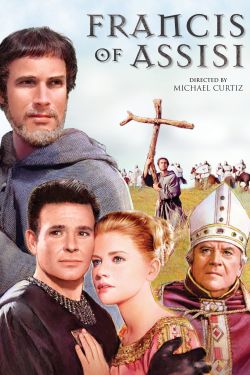
Year: 1961
Filming: Color
Length: 105 minutes
Genre: Biography/Drama/Inspirational/Religious
Maturity: PG (for intense thematic elements)
Cast: Bradford Dillman (Francis Bernadone), Delores
Hart (Clare), Stuart
Whitman (Count Paolo of Vandria), Finlay Currie (Pope Innocent III), Mervyn Johns
(Brother Juniper), Russell Napier (Brother Elias), Cecil Kellaway
(Cardinal Hugolino), John Welsh (Canon Cattanei)
Director: Michael Curtiz
Personal Rating: 5 Stars
***
As you all must
know by know, I have a particular soft spot in my heart for religious epics
from yesteryear. Now that we have a pope who bears the name of Francis, it’s
only natural that the public should have an increased interest in the
nature-loving saint from Assisi who they are vaguely familiar with through
garden saints and book marker prayers. To begin the journey towards of deeper
understanding of St. Francis, I would say that the following film is a
must-watch-classic that brings him to life with a perfect balance of gentility
and passion.
Bradford Dillman
stars as Francis Bernadone, the high-spirited son of an Italian merchant who
indulgences in the various pleasures of life in the medieval town of Assisi. With
the world at his feet, he marches off in armor and chain mail to fight in a
conflict between the city states. He also befriends Count Paolo of Vandria, a dashing
Italian noble who takes the young man under his wing as they both embark as
brothers-in-arms. But Francis is haunted by strange voices, urging him to
abandon his worldly lifestyle and embrace a higher calling God has planned for
him. To his father’s dismay, he deserts the army and is thrown into prison as a
result. His pious mother, however, understands the workings of his soul and
prays for her son’s speedy release.
Paolo is
disillusioned by his friend’s perceived cowardice, but the beautiful noblewoman
Clare persuades him to show mercy and use his position to pardon Francis. Paolo
does so, but with the understanding that he hopes to win Clare’s hand in
marriage. But she, like her childhood friend Francis, is being stirred by a
deeper calling. After he is released, Francis cannot return to his former life and
feels uncertain how best to proceed until he has a mystical experience at the
dilapidated Church of San Domiano. There he hears a voice coming from the
crucifix, instructing him to “rebuild my Church which is falling into ruin.”
Taking this
literally, Francis takes to the streets in a simple robe and sandals, begging
for stones to rebuild San Domiano. While many of Assisi’s prominent citizens
dismiss him as a lunatic, he begins to draw a following among those who seek to
live the rule of total poverty in the spirit and service of Christ. Soon, his
“brotherhood” grows to the number of 12, and they journey to Rome to have the
Rule of their new order approved by Pope Innocent III. They are almost turned
away because the strictness of the Rule, but then the Pope recalls a dream he
had, in which Francis upheld the pillars of the Basilica of St. Peter which
were crumbling. He takes this as a sign for God, and approves the Franciscan
Order.
Meanwhile, Clare
makes a decision of her own to join the Franciscan order as a nun, much to the
distaste of both her father and Paolo, who has received her father’s approval
to marry her, whether she is willing or not. Nevertheless, she escapes with the
help Francis and takes her vows. When Paolo breaks into the church, she shows
him that her long golden hair has been cut, and calmly walks away from him. She
goes on to be the foundress of the Franciscan Sisterhood. While the order grows
in Italy, Francis journeys to the Holy Land in hopes of bringing peace to
war-torn Palestine by converting the Sultan.
But a series of disheartening
events beset him, and he must return to Europe empty-handed. To make matters
worse, one Brother Elias has been planning to relax the Rule of the Order, and
Francis must learn to curb his own pride and take a back seat as the changes go
on beyond his control. Suffering from extended illnesses and blindness, Francis
retreats to a cave where he once again waits for a sign from God. It comes in
the form of the stigmata, which will forever mark him with the Wounds of
Christ.
Francis of Assisi combines epic
story-telling with profound spiritual depth. The on-location footage shot in
Italy is wonderful, as is the colorful medieval costuming reminiscent of
Italian pageants that continue to this day, bringing to life all the fierce
local pride that characterized the city states of the Middle Ages. I’ve heard
some people accuse this film of being too Arthurian or “Disney-land-ish” in
feel, and failing to achieve gritty realism. But I felt the color and gaiety
shown as the men march off to war was in keeping with the pomp and ceremony
surrounding local Italian pageantry, and making it clear why Francis would
tantalized by the glories of the battlefield.
Bradford Dillman
does an excellent job portraying Francis, from his colorful youth to the
darkness enveloping his old age. I particularly appreciate the scenes showing
Francis searching his soul, such as when a beggar repeatedly approaches him
with the words “Pax et Bonum”, only to vanish from sight as a procession
holding aloft a crucifix comes into view. Another one of the deeply
spell-binding sequences is when Francis receives his stigmata. It is telling
that Dillman refused to smoke while in his Franciscan garb out of respect for
the saint he was portraying, showing his own willingness to put his all into
the production. However, he was more than happy to have Dolores Hart light him
a cigarette on set while he was in his chivalric attire…and even have the photo
man capture the moment on camera!
Delores Hart has a
particularly resonant voice and elegant beauty that makes her a perfect Clare.
Interestingly, the actress herself eventually became a nun, and is today Mother
Dolores Hart! I must say that the delivery of her lines sounded rather stinted
at times, but nothing really serious to complain about. Overall, I thought the
acting in this film was very well done. Again, I’ve heard some people accuse it
of not being “dynamic” enough, but frankly, I don’t think it’s fair to accuse
laid-back of some failure merely because they choose a different style of
acting.
I personally love
the tender and charming moments in this movie, including Francis’ repartee with
the animals, blessing the children’s pets, charming birds from the trees, and
even making friends with some very hungry-looking cheetahs! Also, who can help
but love the child-like innocence of Brother Juniper, played by Mervyn Johns? Another
one of my favorite parts is when Francis and his brothers walk to Rome to ask
for the Pope’s blessing on their new order, singing hymns of praise as they go.
Then when they reach the gates, Francis miraculously manages to walk into the
Vatican unopposed during the changing of the guard!
And I’m going to
enthuse about Finlay Currie again: he’s such a great character actor, and I
think he makes a great “Papa” of the Church, whether he be St. Peter in Quo Vadis or Innocent III in Francis of Assisi. Of course we’re pretty sure that
these historical characters didn’t really have Scottish accents (more like
Hebrew and Italian!), but who’s gonna have the gall to complain about that?
Finlay’s lilt is too wonderfully musical to listen to! I’ll also take the time
mention here that the Catholic Church and Catholics in general are portrayed
very well, with reverence and sympathy, but not hiding the flaws either. We see
opulence in the Church hierarchy, collusion among the Franciscan Brotherhood,
and an unreasonable streak in Francis himself when the letter of the law proves
unlivable for his growing Order.
We also see the
dark side of the Crusaders-gone-wild (not romanticized at all really), and are
allowed a sympathetic view of the Sultan Saladin who spares Francis’s life. I find
their dialogue quite intriguing, allowing Francis to approach the Sultan in the
name of love as an emissary of the God of Love, and willingly offers to prove
the reality of his God by walking through a fire pit. Saladin is deeply
impressed, and comments that although he has not made a convert, he has made a
friend. Francis responds that that is the first step.
Stuart Whitman is
totally memorable in his role as the fictional Count Paolo of Vandria.
Arrogant, hot-headed, courageous, and impulsive, he’s a great contrast the
wistful, contemplative Francis, both as his friend and later rival. One cannot
help but feel sorry for Paolo who is so caught up with his own emotions that he
fails to take Clare’s feelings into consideration, nor even respect her
spiritual quest. Her rejection of his advances wounds him deeply, and turns him
into an embittered, and deeply hateful man, chasing after “booty and beauty” as
a disillusioned crusader. While in the Holy Land, he happens to run into
Francis (just chalk it up to coincidental screen-play-writer intervention!)
where he disparages him as a sanctimonious hypocrite who failed to convert the
Sultan or keep his Order living by the strict Rule of Poverty.
In the end, he does
make something of a come-back at Francis’ deathbed, but I'm afraid (to my eternal
frustration) that Francis fails to give him as warm a reception as I might have
hoped! He does mutter something like, “May God grant you His peace”, but that
sounded way too distant for all they had gone through together. Can’t help but
be reminded of the chilly way Moses treated Nefretiri in The Ten Commandments…and she wasn’t even being particularly
repentant, but rather trying to get him to have an affair with her! But aside
from this, I found Francis’ deathbed sequence moving, especially when Clare
bids him a final farewell after his death, blessing him with the greeting that
turned his heart to God so long ago: “Pax et Bonum.”
So my summation: Francis of Assisi is a gentle, clean,
deeply moving classic. I personally think the modern obsession with “grit” in
period pieces is just another fad that will pass by, leaving movies like this
behind to be enjoyed by all ages. Accuse me of being an incorrigible nerd; I
like old-fashioned religious flicks! In fact, I LOVE old-fashioned religious flicks!
While some may claim they lack “realism”, I return to challenge, and say that
many modern attempts at religious epics are often sorry affairs, bereft with
bad attitudes, 1990’s hair-dos, an unnecessary emphasis on guts and grime, and
pathetic method acting! There, I feel calmer now. Now I’m ready to say the
Prayer of St. Francis (that he evidently didn’t really write, but who cares?!):
Lord, make me an instrument of your peace…;-)
 |
| Clare (Dolores Hart) is received into the Franciscan Order by Francis (Bradford Dillman) |


