Search This Blog

Showing posts with label war. Show all posts

Monday, June 29, 2015

Waterloo


Genre:  Drama/History/War
 

Rating:  PG (for mild language and battle sequences)
 

Personal Rating:  4 Stars
***
 
    
    Christopher Plummer stars as the dour yet dogged Duke of Wellington who must pit his outnumbered troops against the forces of Napoleon Bonaparte, who recently escaped from captivity on the Isle of Elba. The two armies converge on a rain-drenched Belgian field near Waterloo, and Wellington determines to hold his position until Prussian troops arrive to defeat the French Emperor once and for all. 

     Napoleon, meanwhile, broods about his future and causes more trouble for himself by issuing impulsive commands to his officers. Several sub-plots in the film include one about dashing young British officer who is haunted by premonitions of his own death and another about a cheeky Enniskillen Dragoon who is always getting into mischief. 

    Waterloo is one of those quinisentially British movies with a sense of dark humor underpinning the dialogue. Wellington is cracking witicisms right and left as shells burst around him, revealing the stiff-upper-lip cool under fire of his class and country. Indeed, this is sometimes taken to a humorous extreme, and while Wellington was certainly known to have an acerbi wit, I highly doubt the banter continued quite as light-heartedly throughout one of the most intense battles of world history! 

     The British have always enjoyed gallows humor, and portraying themselves as possessing it, but this unrealistic flippancy risked turning Wellington into a comic relief figure in contrast with the brooding and intense Napolean. Ultimately it didn’t do justice to the complexity of his own multi-faceted personality, and he become something of a characature for his nation.  

     In spite of this, Christopher Plummer makes up for the early fooling around by demonstrating his amazing acting ability in later stages of the battle. This is most apparent when trying to demonstrate Wellington’s increased distain for war. It starts when the young officer he has been trying to protect stands up in the middle of a British square to encourage his men, shouting “Think of England! Think of England!” He is shot in the head by a French soldier, and falls dead. Wellington stares blankly at the spot where he fell, and the unreadable expression on his face speaks volumes. 

     Later, a second young aid is shot in the back immediately after Wellington gives him an order. He staggers forward several paces in agony, trying gallatnly to stay on his feet, before finally collapsing in the arms of some nearby soldiers. This time, Wellington cannot even look, and awkwardly turns his eyes down, blinking nervously and swallowing hard. Its becoming increasingly apparent by his body language that his struggle to avoid displaying emotion is becoming harder.  

     Then in the last moments of the battle, when Wellington finally has cause to celebrate after turning the tide, his friend Lord Uxbridge reels in his saddle and cries out, “My God, sir…I have lost my leg!” Wellington does not even look at the leg, but rather stares at the man’s face with a look of shock and horror, still struggling to supress his own emotions. “My God, sir,” he murmurs, in a daze. “So you have.” Then he supports Uxbridge as he falls against him, and cries out for a medic.  

     Finally, Wellington struggles to deal with the fact that his Prussian allies are far more set on vengence against the French then his own troops, and set about butchering them without mercy. Wellington tries to play the gentleman, and procure the surrender from a group of French survivors who are determined to resist. As he waits for the answer from the survivors, it is obvious how tense he is, hoping beyond hope they will take the mercy offered. They don’t, and he is forced to use the artillery on them. Once again, he closes his eyes, and looks down.  

     At the very end of the film, we get to see Wellington one more time, riding about the field, littered with wounded and dying men and horses, as scavengers pull the clothes off the bodies. Again, his face is almost a complete blank, scanning the horrific scene. Then suddenly, his eyes fall on a young Scotsman, lying dead in his kilt, with his pipes lying near him. The wail of the pipes is heard, as if in a flash of Wellington’s memory, the music builds, and he has a visible surge of emotion, which he manages to pull himself out of with the greatest struggle, before riding off the field. Through all this, you get the feeling that the initially haughty and unapproachable Wellington, and witty and dapper nobleman who never gets flustered, is far more human and relatable than all that. First appearances can indeed be deceiving.  

    The battle footage is spectacular, but the movie also spends time on the uneventful periods between the fighting. Since this is a European production, the pacing is slightly different from what most Americans are accustomed to. It's more introspective and internal, giving one insight into the thoughts of the characters as well as their actions. 

    Some people find the lulls in the plot to be boring, but I think they let the viewers get a good taste of all dimensions of the conflict, both physical and emotional. Also, it gives the viewer the chance to catch a glimpse of the hum-drum duties of early 19th century soldiering.  

     The traditional British folk-songs such as “Macpherson’s Farewell”, “Boney Was a Warrior,” and “The Girl I Left Behind Me” that are weaved into the scenes are also a nice flavoring. I definitely think this film a nice overview of the last phase of the Napoleonic Wars that culminated in 1815. History lovers will be thrilled.


The Duke of Wellington (Christopher Plummer) at the ball in Brussels
 

Friday, May 29, 2015

Battle of the Brave


Year:  2004

Filming:  Color

Length:  143 minutes

Genre:  Drama/History/Romance/War

Maturity:  PG-13 (for intense thematic elements, language, and some sexuality)

Cast:  Noemie Godin-Vigneau (Marie-Loup Carignan), David la Haye (Francois la Gardeur), Juliette Gosselin (France Carignan), Sebastian Huberdeau (Xavier Maillard), Bianca Gervais (Acoona), Gerard Depardieu (Fr. Thomas Blondeu), Tim Roth (William Pitt), Jason Isaacs (General James Wolfe), Michael Maloney (Governor James Murray), Philippe Dormoy (Voltaire)
         
Director:  Jean Beaudin

Personal Rating:  2 Stars

***

    One day, while fishing through the period piece section on NetFlix, I stumbled across Battle of the Brave. I sort of had a feeling it wasn't going to be good when I heard it was set during the French and Indian War (how could Hollywood keep from going on a splurge about evil Europeans and stuffy decorum?), but I wanted to see anyway. I’m not above being surprised by an unexpectedly good film. But my intuition proved more than correct this time, although I will admit I was surprised…by the blatant differences between the plot-line as outlined in the advertisements and how it played out in the actual production!    

    What story there is opens in Colonial French Canada, not long before the British conquest of Quebec in 1759. A young French nobleman named Francois la Gardeur has just returned from a trapping venture in the wilderness, a journey he had embarked upon to distance himself from his upper-class roots. Seeking out amour in Quebec, he rekindles an affair with a fellow nobleman’s wife, but at the same time finds himself bewitched by a beautiful and independent-minded young widow and single mother named Marie-Loup Carignan, who has learned to be a healer in the Native American tradition, and is accused of practicing dark magic.

    Meanwhile, sinister historical forces are at work. The French government in Canada is riddled through with corruption, and willing to let Quebec fall to the British to prevent an inquiry into their conduct. It is up to our wild-haired hero Francois to warn the French government about the plot, but the local authorities will stop at nothing to silence him. Throw Fr. Thomas Blondeau, a Catholic priest who is sort-of-good in that he wants to defend the poor from the desperation of a crumbling regime and the rapine of an ascending one, and yet is having sexual affairs and has this secret love for would-be witch-woman...and the whole thing degenerates into a confusing mess!

    Our noble messenger to the court of France sends a message to his lover, asking her to accompany him. But the priest, for motives that are a bit complex, mistranslated the message to keep her from going with him. This strikes off a chain reaction of unintended events…none of which are directly related to the war, nor the fact that Quebec falls to the British, without even enough production courtesy to show us the epic-ness of the Battle of the Plains of Abraham! Gah! But to summarize: “our hero” has a heart-to-heart chat with philosopher Voltaire, but fails to get an audience at the decadent court of France until after the British invasion is completed, and returns to discover that beloved witch-woman has gotten herself hitched to a his less-than-upstanding-former-friend-turned-British-lackey.

     But never fear…Gallic Lover Boy is here! Actually, cancel that…we should fear, because it doesn’t seem he has any definite plan, and one he tries to launch to rescue his lady-love from her abusive husband backfires miserably. Ultimately, deadbeat hubby has an unfortunate collision with an axe, but no one is sure who administered the fatal blow. Marie-Loup gets arrested and framed for her husband’s murder, which everyone is content to let lie since she is already a social outcast. At this point, the two main men in her life – Francois and Fr. Blondeau – try to “save her” in different ways. The former makes a vain attempt to plead mercy before the new British Governor James Murray, and the second tries to give her absolution for the murder, which she refuses. It will only be at the end of the old man’s life when the truth will be revealed and the mysterious case laid to rest with Mary-Loup.

     This film had some artistic pluses in the form of beautiful cinematography and a lush music score. It gave a good feel of the Colonial era of sprawling forests and Old World settlements, inhabited by a mix of different races struggling for survival and domination. The acting was fair enough, and the relationship between Mary-Loup and her little daughter France was touchingly rendered. Also, some of the romantic interplay between Francois and Mary-Loup was worth salvaging, even though their overall romance was pretty lame. David la Haye and Noemie Godin-Vigneau seemed to have good on-screen chemistry, and they have a talent for conveying emotions through facial expressions. And I will admit this much: the leading lady has amazingly bewitching eyes!

     But in spite of these perks, the story was a horrible miss-match of themes and plot threads that failed to coalesce into any definite vision. It is permeated with modern sentiment jet-lagged into a past time period, with Francois and Mary-Loup serving as symbolic of liberalism and modernity as opposed to the narrow-minded, old-fashioned, and corrupt characters that surround and ultimately destroy them. In this sense, the whole story takes on the visage of a morality play, even though the morals are foggy at best.

      It is not by accident that we see Francois “connect” with the ultimate liberal, Voltaire, after his repeated efforts to shake off his noble heritage which is portrayed as being corrupt overall. Needless to say, there certainly was corruption in the nobility, particularly among the French Colonial ruling class in Quebec. But portraying the upper classes as “all bad” just doesn’t do them justice. I would have liked to meet the Marquis de Montcalm, the epitome of a French gentleman, dedicated to honor, duty, and his country. So while we can sympathize with Francois’ issues to some extent, the movie fails to portray the pros-and-cons of the class system with balance.

    Likewise, we can certainly sympathize with the more open and curious ways of Mary-Loup, and her willingness to learn the ways of the Native Americans through her friendship with the Indian girl, Acoona. But trying to make almost everyone else around her into 2-dimnsional villains fails to appreciate their own perspectives, and the “comfortableness” these characters would have had holding these beliefs in their own time periods. Plus, Mary-Loup does seem to be a bit “loose in love”, so to speak, and has adapted some of the superstitious practices associated with witch-craft, so even a few eye-brows raise, it’s not a huge wonder. And of course, there has to be a priest struggling with his vow of celibacy, in a kind of creepy way…I mean, isn’t he old enough to be Mary-Loup’s father? Weird.

    Not only do the characters feel strangely out of place in their respective era, but Battle of the Brave doesn’t even live up to its own advertisement as a flick about French resistance fighters battling for “freedom.” Literally, on the cover there are three indicative words: “Rise. Unite. Fight.” But none of this ever comes about. There are no resistance fighters, and there is no battle! The war, which is supposed to be so central to the plot, is skipped through with nothing more than a shelling sequence, which kills a side character but does not influence the central plot. Instead, the story-line is totally hinged on the love affair, which reaches a dead-end and fails to support the movie with needed substance.

     On an historical note, we do get to make a brief foray made into the British establishment, whence we get to meet Tim Roth (infamous for his role as Archie-the-Villain in Rob Roy) as William Pitt (no! no!!!) and a totally-too-old, totally-too-deranged Jason Isaacs (infamous for his role as Tavington-the-Villain in The Patriot!) as General James Wolfe (Say what???!!!) who fails to do anything impressive but rant about wildly and mutter poetry with a weird gleam in his eye. These blatant miscasts can be accurately classified as nothing more than a generic British villains convention, to purposely purport a politically correct and historically incorrect depiction of The French and Indian War.

    As someone who has spent more than a few years studying Wolfe and pouring over his personal letters, I was particularly frustrated to death by this obtuse portrayal. I understand that the film may have been trying to paraphrase an incident in which Wolfe, slightly inebriated and out-of-character, is said to have bragged about what he would accomplish in America, and pounded his sword hilt on the table in front of Pitt. But the way it came off was that he was always behaving like a nut, and everything he did was viewed as off-beat by those around him, including poetic recitation. This fails to explain why the legend of Wolfe has been such an inspiration to fighting men for generations.

    Wolfe was certainly a very complex character, who could often be judgmental and sometimes quite brutal. He also might have seemed a bit “manic” every once in a while. But this is only one side of the coin. A reading of his letters and the testimony of contemporaries also show him to also have had many attractive qualities, and was not some chronic maniac. He was deeply philosophical, had a marvelously witty sense of humor, and a profound sense of duty to his country and the men under his command. His soldiers adored him, and found his eccentricities inspirational, including his love of quoting poetry. Furthermore, memorization of poetry was much more common in the 18th century than it is now, and wouldn’t have even been considered as outlandish as it might be today.

     The film also messed up the character of British governor James Murray, who is portrayed as being unscrupulous and willing to have Mary-Loup executed even though he has proof she is innocent of the murder of her husband. He doesn’t want to risk putting his job in danger by angering those who are stuck in the “dark ages” and opposed to modernistic Mary-Loup. First off, they got his accent wrong: He was Scottish, not English. Second, portraying him as a fall-back villain is character assassination, unless they have some sort of proof he actually behaved in this manner. Historically, the worse thing that can be said of him was that he was jealous of General Wolfe and gave him a hard time, but as governor of Quebec, he was known for being fairly compassionate to the plight of the inhabitants and proved himself to be an able and just administrator.

     Basically, the history buff and story-lover in me was deeply disappointed by this goofed-up attempt to bring The French and Indian War to life on screen. With a predominately French cast and crew, I knew the chances of them being fair to the British were slim. But they even missed out on giving the French their proper due by getting hung up in too many soap-opera-esque love affairs and an obscure moral tags about the blessings of modernity, and the ill-fated consequences of intolerance, which is viewed as the ultimate evil in our modern age. I’m certainly not advocating it, but I think there are other vices to be brought to the fore as well, some perhaps not so politically correct…like character assassination in big-budget historical butcheries!

    I’m afraid that I must make fanfare of tossing Battle of the Brave into the ceremonial fibrotic fire-pit with its kith and kin on the death-row shelf:  The Last of the Mohicans, Titanic, The Patriot, Braveheart, Rob Roy, etc.! Judging from this illustrious accumulation of painful productions, I’d say it’s about time to have a smores fest! If I’m sarcastically harping on this subject too much for my educated readership, please bare with me. I really must write about how messed up I feel Hollywood is getting with these historical "epics", for my own sanity, and perhaps to better the planet. Perhaps it will rouse the masses to demand better fare...or something! Every little voice helps.

Francois la Gardeur (David la Haye) rides with Mary-Loup Carignan ( Noemie Godin-Vigneau)

Thursday, April 23, 2015

Barry Lyndon


Year:  1975

Filming:  Color

Length: 184 minutes

Genre:  Adventure/History/Drama/War

Maturity:  PG (for intense thematic elements and some sexual innuendos)

Cast:  Ryan O’Neal (Barry Lyndon), Marisa Berenson (Lady Honoria Lyndon), Gay Hamilton (Nora Brady), Marie Kean (Barry’s Mother), Dominic Savage (Young Bullingdon), David Morley (Bryan Patrick Lyndon), Leonard Rossiter (Captain John Quinn), Godfrey Quigley (Captain Grogan), Patrick Magee (The Chevalier du Balibari), Hardy Kruger (Captain Potzdorf), Murray Melvin (Rev. Samuel Runt), Frank Middlemass (Sir Charles Lyndon), King George III (Roger Booth), Arthur O’Sullivan (Captain Feeny, Highwayman), Seamus Feeny (Billy Boyle), Michael Hordern (Narrator)

Director:  Stanley Kubrick

Personal Rating:  4 Stars
    
***

    
     As my loyal readers know, I have a hard time grinning and bearing the sorry succession of modern historical epics, inculcated with rampant historical accuracy and blatant revisionism that destroys both feel and form. And yet every once in a while, I am pleasantly surprised to watch a movie that captures an era in an artful and appropriate way. Such is the case with Barry Lyndon. While it may not be my favorite story-line in the world, for a period piece, it stands out as being comfortable in its own skin, with swagger, elegance, and wry British humor to boot. Also, looking for spiritual insights, I would say that this film should not be seen as light entertainment about a naughty boy who overplays his hand, but as an analysis of the mixed capacity of the human nature and dangers of seeking greatness before goodness.

    Ryan O’Neal stars as Redmond Barry, a young middle-class Irishman in the mid-18th century whose father was killed in a duel. He is raised by his devoted mother, who struggles monetarily and hopes that her son will climb socially and bring glory to the family name. However, when Barry falls in love with his flirtatious cousin, Nora Brady, he is almost undone by her wiles after she throws herself at Captain John Quinn, a wealthy British army officer who comes to Ireland on a recruiting mission upon the outbreak of the Seven Years’ War. Letting his fiery temper get the best of him, Barry throws a wine glass at his rival, and a duel is arranged between the two. When Barry hits his target, he thinks he has killed the man and must flee for fear of repercussions.

    But a twist of fate in the form a road-side robbery causes Barry to take a job as a redcoat in the British army. Taken under the wing of his friend, Captain Grogan, and able to win the respect of his comrades through his cheeky disposition and fighting prowess, it seems that he might have found his calling. But when Grogan is killed in their first skirmish in Germany, Barry begins to lose his taste for battle. The burning and pillaging only add to his distaste, and soon he determines to desert. He does so by commandeering one of his officer’s uniforms and claiming that he is carrying dispatches to the Prussian allies. But he is found out by the clever Prussian Captain Potzdorf, and inducted into the even more brutal Prussian service. 

     Barry takes a downward turn in his personal behavior, becoming a cynical survivor in what he sees as the game of life. However, he does save the life of Potzdorf after he is trapped in a burning building, and as a result is taken out of the army and put into the secret service to observe a certain Chevalier du Balibari, a noted gambler and gourmet whose allegiance is in question. When Barry discovers that the Chevalier is a fellow Irishmen, he becomes a double-spy for him and ultimately escapes the country as his partner in the art of the gaming table. His skill with the sword is also useful to gently persuade reluctant gentleman to pay the piper after losing at cards!

    In Belgium, Barry takes fate into his own hands in an effort to earn himself a title, and launches an affair with the beautiful Lady Honoria Lyndon, an English aristocrat on holiday with her aged husband, Sir Charles Lyndon, and their young son. After her husband’s death (stress-induced, after Barry taunts him), the two are married, and Barry believes that his way upward is secured. But Honoria’s son, now styled as Young Lord Bullingdon, is not duped by the swaggering Irish rogue and refuses to acknowledge him as his new father. Honoria also becomes disillusioned with her new husband over time, as his grasping after personal aggrandizement and multiple affairs drain the family wealth and leave her out in the cold. But Barry and his wife do have a son who they name Bryan Patrick, and Barry proved to be a tender and loving father, as much as he had been a neglectful husband. 

     As he grows older, Lord Bullingdon tries his best to bare up with Barry’s disgraceful flaunting of the family name (he adopts the style Lyndon, a slap-in-the-face to his dead rival) and squandering of his inheritance. Bullingdon also tries to be reasonably civil with his pampered little half-brother, but eventually he can stand the circumstances no longer, and after a major confrontation with Barry in the parlor, leaves his home in self-imposed exile. However, after little Bryan is killed by a horse, Barry rapidly deteriorates in grief, and Lady Honoria is kept a virtual prisoner in her own home, Young Bullingdon realizes that it is his duty to rescue his mother and reclaim his inheritance. 

    Artistically and cinematically, this film is breath-takingly beautiful. Stanley Kubrick, the director of Barry Lyndon, was inspired by the works of the 18th century painters, and determined to shoot the film using natural lighting techniques in both exterior and interior scenes. The result is a lush panorama of sequences that do look like images from an art gallery. The beautiful outdoor sky-shots look like water-colors. Costuming and sets are exquisite and detailed. From the military marches, to the country dances, to the gaming binges of the rich and famous, everything is richly portrayed. The gorgeous outfits sometimes made me want to squeal with delight. Those beautiful red coats and sparkling gorgets…ah!! Not to mention all the satin and silks of the dandies and their ladies…and the wigs!!! Sheer bliss!! The music too was perfectly period, including the almost continuous underpinning of a Baroque score and the rousing versions of “British Grenadiers” and “Lilli Burlero” and the haunting ballad “Women of Ireland” played by The Chieftains. 

    But beyond this, what I really admired about the film was able to capture the right feel of its chosen time period. All too often, movies will have all the visual splendors but are unable to penetrate the historical barrier, as it were. Instead of trying to make the viewer feel as if they are traveling back it time, the atmosphere is cluttered with modern presuppositions and prejudices foisted onto the past by liberalistic emissaries in costume, some depicting over-the-top villains who represent the evils of the age and others portraying forward-thinking, far-sighted wonder-bunnies for heroes and heroines. The whole thing becomes a hokey would-be morality play glorifying the modern world view. Not so with the slyly satirical yet admirably even-handed Barry Lyndon.     

    I love the way that the style and ceremony of the age was accurately depicted. These little details are often lacking in period pieces, or otherwise made a total mockery of. But the characters in this movie seem quite comfortable with all of it. They easily address each other easily as “Sir” and “Madam”, and there is a certain code of civility employed even in the most dangerous activities such as fist-fighting and dueling. Fair play is vitally important in these, as are the concepts of courage and personal honor. While some of these manifestations may seem strange to our modern sensibilities, and the dour British narrator takes light pricks at the inconsistencies of the era, one cannot help but admire such a code of behavior when accurately portrayed, even if not everyone followed it and some took it beyond the pale. 

   The individual character developments challenge stereotypes. Each one of the characters unique and has both good and bad traits, and there are no over-the-top baddies or hair-slicked-back-heroes to be found. Redmond Barry, of course, is the epitome of this complexity in the characterization. He starts out as warm-blooded young romantic, and is in some ways lovably roguish and daring as he makes his own fortune in a world where birth and breeding can make or break a man. And yet we find ourselves increasingly disillusioned by his methods, going from a deserter to a double-spy to a gambler to a romancer of nobleman’s wife. 

    Ultimately, his house proves to be built on sand, and his obsession with obtaining a title and becoming a member of the peerage drains his wife’s fortune. Furthermore, his own cynicism towards life that enabled him to survive and thrive now almost prevents him from being able to love, and he has multiple affairs and flirtations for the fleeting pleasure of it. And yet Barry still has some goodness left in him, which is brought out in his tender devotion to his young, mischievous son Brian. But it seems almost as if his degeneration of character has cast of a curse over his family, because the young Brian dies disobeying his father and mounting a horse alone. 

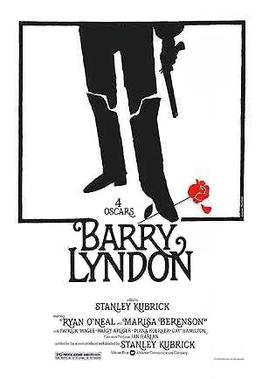
     I always wondered why the front cover of Barry Lyndon portrayed a shadowy figure pointing his pistol to the ground. Now I understand that it was alluding to the moment of his partial redemption. When his son-in-law, Lord Bullingdon, returns to rescue his mother and reclaim his rightful inheritance, the young man accidentally sets off his pistol before taking aim. According the strict rules of the duel, he has used up his shot, and must stand and receive the shot from his opponent. Bullingdon is horrified, and throws up in the corner before recovering himself and honorably standing to await the shot. That sparkle of decency that we always knew Barry had shows itself again, and he calmly fires his pistol into the ground. This allows Bullingdon to choose either end the contest, or to take another shot. He takes another shot, and hits Barry in the leg, which is later amputated ending his reign as a Lyndon. (Notice that dueling is the main motif of this film, which opens with Barry’s father being killed in a duel, hinges on his duel with John Quinn, and finishes with his duel with Bullingdon.) 

    The other characters, too, are given well-rounded treatment including Captain John Quinn, Reverend Samuel Rump, and Young Bullingdon. Quinn may be pompous, but he’s not evil, a fact which I have ceased to take for granted after watching too many horrendous epics with redcoat insta-baddies. In fact, he doesn’t really do anything wrong except fall in love with the same flirtatious female who stole the heart of Barry! It’s true that he has cash to back him, but Nora was ready and willing to accept his marriage proposal and the settlement. Barry is totally out-of-line in throwing the glass at Quinn, which smashes in his face and leaves a gash on his forehead. In the duel, Quinn is willing to let the whole thing go if Barry apologizes and goes off to Dublin, but Barry will have none of it. Unbeknownst to them all, Nora’s family put fake bullets in Barry’s gun, so his shot merely knocks Quinn out from the impact, but he later comes to and marries Nora!

      Rev. Rump is an intriguing character as well. While at first I thought they might characterize him as a pasty-faced paid hireling, using his religious robes to obtain a juicy income, he actually turns out to be a figure of moral strength and integrity. While he is the one chosen to marry Barry and Honoria, and initially encourages Young Bullingdon to except his “new father”, he later comes to realize that Lady Honoria’s Irish lover-turned-husband is a cad and wastrel. Rump is one of her sole supports during the years of neglect, and serves as the tutor of both her sons. When Bryan is tragically killed, he is the one who performs the funeral service, and again serves as a major support for Lady Lyndon, who is on the border of a nervous break-down and locked in her own house. 

    When Barry’s mother tries to fire Rump, he calmly states that he’d be happy to go without the pay, but he cannot leave Lady Lyndon in her present condition. He then stands up to her, and says they have no right to hold her prisoner in order to hide Barry’s misappropriation of funds and alcoholism. When he is forced to go anyway, Lady Lyndon tries to commit suicide. Rump and another loyal servant are then instrumental in bringing news to Young Bullingdon of the deteriorating situation, and encourage him to launch his rescue attempt. I have to admit that there were times I thought Rev. Rump might have had feelings for Lady Lyndon, and could not help but think that after all the suffering they had gone through together they would make a good pair. So yeah…can we file for an Anglican annulment for Barry and Honoria so Samuel and Honoria can get married and start afresh?? 

    Young Bullingdon is probably my favorite character in the movie. I can’t imagine what I would do in this kid’s position, but he handles it with a fair amount of dignified resolve I find quite admirable. I mean, Barry practically kills off his father, misuses his mother, squanders his inheritance, and usurps the family name only to disgrace it by his dissolute conduct. When his mother says he should kiss his “new father” goodbye, he responds boldly “My father was Sir Charles Lyndon…have you forgotten him, Madam?” (Round of applause from me!) He is therefore chastised with the whipping stick by Barry, but the fight is on, and the young nobleman will not be broken. 

   For most of movie, he manages to keep his emotions in check in spite of the worsening situation. Even in his very hottest moments, when he calls out Barry as “an Irish peasant and ruffian”, there is a certain noble bearing that contrasts with Barry’s striving for nobility. When Bullingdon finally takes his revenge, it is down out of necessity, to rescue his mother and estate. While some would accuse him of hardness for refusing to back down from the duel after Barry spared him, if he had done so his rescue mission would have been a sorry flop. Still, after he shoots his step-father in the leg, he does send a message to Barry’s mother informing her where he is. He also offers him an annuity to live on after his leg is amputated, providing that he leaves England never to return. The once-proud Barry has no option but to take the annuity and leave. 

         Barry Lyndon is a very British film, complete with dark humor, meandering pace, and a profound, cut-dry finale. Some people get lulled to sleep or puzzled by this style, and in some cases I would agree with them. But for this setting, I think it worked to a tee. It is also very British in the way it characterizes the Irish as a hot-tempered, somewhat untrustworthy race with charm and charisma but compromised morals and motives. Nevertheless, there is also a grudging respect for their indomitable spirit and refusal to be cowed, which is epitomized by Barry’s declaration to John Quinn (who was offering him a way out of the duel if he’d leave town), “I’d as soon go to Dublin as to Hell!” The real question is…are Barry and his Irish family and friends Catholic Celtic-Irish or Protestant Anglo-Irish? I think it might be the latter since they are middle-class land-holders capable of joining the military, even though Captain Grogan is once seen making the sign of the cross. Perhaps they are Catholics who apostatized under the pressure? 

    With regards to morality, this is the story of a rake’s rise and fall, so scandal is in the air. But for a ‘70s movie, it doesn’t get too “in the weeds” with regards to Barry’s sexual flings. Most are merely hinted at, and the worst we see are a few passionate kisses. There are a couple of scenes with brief flashes of female upper nudity, which can easily be skipped. There is also a scene indicating that two British officers might be homosexual, although nothing graphic is actually shown. An important part of the story does hinge on a “game” played by the promiscuous Nora Brady, who has Barry reach inside her bodice to pull out a ribbon…only to have John Quinn do the same a little later on! But that’s her character; she’s not above board. The guys, of course, shouldn’t be playing the game at all, but their participation ultimately makes them both pretty foolish looking. 

    While some people complained of the stiffness, slow-pace, and odd juxtaposition of satire and tragedy, one advertisement for the film trumpeted: “Its aching beauty will wipe you out!” I agree that there is something about Barry Lyndon that does have an aching beauty, and it’s not just the scenery. The story itself is so very human, and so very sad. By the end of the movie, Barry is a pathetic creature who sold his soul to get to the top, and lost everything. But we can’t just relish in his deserved decline, for he embodies too many of our own warped desires and desperations. He starts out as a naïve, starry-eyed romantic with hopes of greatness for the future, but the class system prevents him from ever achieving those goals, unless he plays crooked. He becomes his own worst enemy in seeing the world through cynical eyes and using other people as mere prongs on the ladder of success. 

     And still he is not all bad. He dearly loves his small son Bryan, and refuses to kill his arch-enemy step-son coming back to avenge the insults to his honor. Throughout the film, he also shown as being emotion and given to tears, especially upon the death of his friend Captain Grogan, the meeting of a fellow Irishman in Chevalier du Balibari, and the death of his beloved little boy Brian. It is during these heart-felt moments when one wants to console and rehabilitate Barry, telling him that there is still time to patch up the messes he’s made and live a different sort of life. There can be redemption for him yet, for a person’s identity does depend upon the titles of the world, but who they really are.

    But perhaps the story of Barry Lyndon must remain unfinished, for there are so many unfinished stories just like his in which he can make a difference today. Perhaps the lesson for us here is that we must commit him and all those like him to the mercy of God, before whom all are equal. This is formalized in the closing scene of the film where it is written: “It was the reign of King George III that the aforesaid personages lived and quarreled; good or bad, handsome or ugly; rich or poor…they are all equal now.” And that, I think, is a very profound epilogue for this panoramic picture of historical significance.
Redmond Barry (Ryan O'Neal) and Nora Brady (Gay Hamilton) play cards