Search This Blog

Showing posts with label 1990's films. Show all posts

Thursday, April 30, 2015

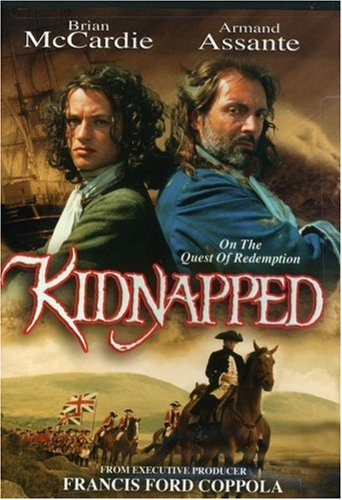
Kidnapped


Year:  1995

Filming:  Color

Length: 155 minutes

Genre:  Action/Adventure/Drama

Maturity:  PG (for intense thematic elements)

Cast:  Brian McCardie (David Balfour), Armand Assante (Alan Breck Stewart), Patrick Malahide (Ebenezer Balfour), Michael Kitchen (William Reed), Adam Blackwood (Captain Forbes), Brian Blessed (Cluny MacPherson), Brian McGrath (James Stewart of the Glen), Brendan Gleeson (Colin Campbell, “The Red Fox”), Antoine Byrne (Mary MacDonald of Dunbrae), Catherine Byrne (Flora)

Director:  Ivan Passer

Personal Rating:  4 Stars

***

    As a Scottish/British history buff, I often lament the shoddy depiction of the Jacobite Rebellions on screen. They are reduced politically-driven drivel about the evil English and their attempts to subjugate the independent-minded Scots. All the nuances of the period are shunted to the wayside, which irks me to no end. However, I am pleased to report that this version of Robert Louis Stevenson’s classic adventure story Kidnapped does a fair job staying true to history for us buffs, and making it exciting for the public at large.

    Brian McCardie stars as Davie Balfour, a young gentleman from the Lowlands of Scotland, coming of age in the mid-18th century. Upon the death of his father, he goes in search of his long-lost uncle Ebenezer, who has been hoarding his rightful inheritance by pretending to be the elder of the two brothers, when in fact he was the younger one. Still, after some investigating and surviving nearly falling through a broken stair-well (yes…it’s a set-up!), he manages to get Ebenezer to promise him some share in the family fortune. Instead, the all-too-trusting Davy winds up being kidnapped and sold into slavery on board a ship headed for the Americas. 

    But his course is interrupted when Alan Breck Stuart, a Jacobite exile on a mission to France, boards the ship and bargains for safe passage. Thrown together by mutiny and shipwreck, Davie and Alan are washed ashore on the Scottish Highlands where they must learn to trust one another if they except to survive in an atmosphere of political tension and military occupation in the aftermath of the failed Jacobite rising of 1745.  

     Davie is determined to return to the Lowlands and reclaim his rightful inheritance; Alan is set on getting to France and delivering money to finance the Jacobite cause. Even though their perspectives clash and they find it difficult to get along, circumstances pull them together after they are both framed for assassinating Red Campbell “the Fox”, a powerful pro-government laird shot down on the road. With no hope of being acquitted in a land dominated by brutal martial law, Davie and Alan set off on a race across the Highlands to avoid capture by redcoat troops.

     But the stakes are raised when the murder of Campbell the Fox is blamed on James Stewart of the Glen, Alan Breck’s surrogate father. Eager to prove his innocence, Alan Breck goes in search of the real killer with the legally-astute Davie in toe. But when James is captured and cruelly executed, the goal changes from a rescue mission to fulfilling a vendetta. Along the way, the unlikely pair enlists the aid of Mary MacDonald of Dunbrae, a young lady who Davie begins to fancy, in spite of their initial clash of customs and beliefs. They also meet with the rowdy Cluny MacPherson in his mountain stronghold called “Cluny’s Cage”.

    There is danger aplenty as they stay one step ahead of William Reed, a ruthless government official from London obsessed with capturing Alan, using any means at his disposal to do so. Along with Reed is Captain Forbes, a young British officer whose desperation for promotion stifles the dictates of his conscience. But an unexpected twist ultimately makes him vitally important in deciding the fates of Davie and Alan as they reenter the Lowlands, hell-bent on reclaiming Davie’s rightful inheritance and avenge James of the Glen. In the process, they learn that friendship can be developed in the most trying of circumstances, and in spite of many differences, unity can be forged.
   
     I found this version of Kidnapped to be a good adaptation of Robert Louis Stevenson's classic novel about the aftermath of the Jacobite Risings. Although it does stray from the book in various places, I think it manages to do so with skill, building subplots that succeed in enhancing the main storyline rather than demolishing it. I also think that this version does a fair job in keeping with the proper terminology of the historical period, which is refreshing in comparison with some later versions that rely heavily on the "bad English/good Scottish" stereotype and overlook the complexities of the rebellions.

    Of course, there were still historical inaccuracies. It’s a fact that no one knows for sure who murdered Campbell the Fox, and inserting a fictional character to blame it on doesn’t really solve the mystery…although I could almost believe that a government official might have. And were they seriously trying to say that Alan Breck had an illegitimate child with Flora MacDonald? Or was this a totally different Flora they had make a debut? That whole sequence was really awkwardly explained! I appreciate it was trying to point out the difference in a man and a woman’s perspective on the ongoing strife, but still!

      I appreciate the way Davie is shown as maintaining his position as a government supporter while at the same coming to be more sympathetic towards the Jacobites, as opposed to “going rebel”, as the 2010 version indicates. I particularly liked the scene in which he made a case that the rebellion was over, and Scotland had made her choice for King George, the Whig administration, and with it the Act of Union. It quite reminded me of the current conflict in Scotland over the issue of independence, and how some people refuse to give up the ghost on the matter or acknowledge the will of the majority in a “once-in-a-lifetime” opportunity to decide the matter.

     On the other hand, Alan is shown as being continually loyal to Jacobitism and “the king across the water” while at the same time coming to better understand the logic of the government supporters, and the realization that the future lies with them. Over the course of their adventures together, Davie manages to successfully demonstrate that his law-abiding position is a logical one, even as we cannot help but agree with Alan Breck’s insistence that he should get some more “poetry in his soul.” Another part of the movie that I liked was the way that both characters have different ideas about what it means to be a “Christian gentleman”, and yet each one knows the importance of it. It seems that Alan is a Catholic (he makes the sign of the cross in one scene), and Davie is a Presbyterian, and yet both learn to respect each other and their mutual dedication to honor. My only complaint is the way the two parted in the end; it was so cut-dry, after all they had been through together! A little emotion was needed!

    The acting overall was fair enough. Brian McCardie and Armand Assante make an excellent team, sparring with wit and ultimately swords (all in good humor!). I simply love McCardie’s rich Scottish accent, and the way that when he is frustrated, he forces himself to speak through a plastered grin! Assante also brought Alan Breck Stuart to life as a rugged yet lovable rogue, very human and able to tug at the hearts of the audience through his tragic heroism in a lost cause. And who could pick a better British villain than Michael Kitchen? Okay, so those who know me well know that I was a fan of his role as terrifyingly imperturbable Judge Jeffries in Lorna Doone, and he does not disappoint as the sardonic, sarcastic, ever-smirking, black-clad William Reed in Kidnapped.

    This is a made-for-TV movie, so perfection is not to be grasped at. However, the scenery shots are beautiful, with the hills and glens all wonderfully wild and resonating with Celtic connotations. Indeed, it taps into that very inner poetry that Alan is so desperate to get Davie to acknowledge (the artist in me has tried that with many-a-stiff-necked doldrum…;-) Period costuming was also very good, and I especially liked the red-coat uniforms (don't I always?!). Unfortunately, the music track, which repeated itself over and over again throughout the film, was certainly lacking and sometimes sounded like it was pounded out on a cheesy studio keyboard! The 2010 version certainly had a catchier theme, although I will say there were several moments of musical grace involving a stirring whistle tune, and a few bagpipe interludes.

     So I would definitely rate this movie as an enjoyable historical adventure flick with a good plot-line, memorable characters, and some lovely scenery snap-shots. As I’ve often mentioned in the past, it’s interesting that little-known, small-budget productions actually do a better job with historical retellings than big-budget Hollywood-ized block-busters. Without all the schmaltz, there is time to be more subtle in exploring the characters and time periods in which they live and work and fight and bond with one another. Robert Louis Stevenson was a great author, and he deftly managed to capture a complex time period in Scottish history through his novel Kidnapped. I think this movie adaption, although certainly not perfect, did a good job keeping in line with the spirit of the original work.

Cluny McPherson (Brian Blessed) shares a drink with Alan Breck Stuart (Armande Assante)


Monday, November 17, 2014

Dances with Wolves


Year:  1990

Filming:  Color

Length:  181 minutes

Genre:  Drama/History/Western

Maturity:  PG-13 (for violence, sexuality, and some language)

Cast:  Kevin Costner (Lieutenant John Dunbar), Mary McDonnell (Stands-with-Fist), Graham Greene (Kicking-Bird), Rodney A. Grant (Wind-in-His-Hair), Floyd Red Crow Westerman (Ten Bears), Tantoo Cardinal (Black Shawl), Robert Pastorelli (Timmons), Maury Chakin (Maj. Fambrough), Charles Rocket (Lt. Elgin), West Studi (Toughest Pawnee)
         
Director:  Kevin Costner

Personal Rating:  2 Stars


***

       Since the passing of the Golden Era of Epic Westerns, there have been countless attempts to create a modernized resurgence of the genre, usually from unusual perspectives and with painful results. Dances with Wolves had its good points, including a detailed portrayal of Native American life and an appreciation of the language barriers that existed between the Indian tribes and white settlers. But I’m afraid they were considerably mitigated by unnecessary “shock factors” that were nothing more than cheap attempts to boost ratings.

    Our story opens with Kevin Costner starring as Lieutenant John Dunbar, a Union soldier fighting in the American Civil War who is feeling really down-and-out by all the fighting and decides to do a suicidal dare-devil escapade to distract the Confederates while the Union commanders launch a surprise attack from the rear. This heroism/imbecility earns him a promotion and a transfer to the Wild, Wild West which is gradually vanishing into oblivion as more settlers move in and camp out.

    The next fifteen minutes of the film could really be skipped altogether. Dunbar’s utterly repulsive side-kick, Timmons, does a variety of disgusting things until he is put out his misery by Sioux arrows (the reason for this we don’t know…but we can’t say we miss his enlightened presence overly much!). Then we get to see Dunbar take a beauty bath – in the full resplendence of his birthday suit! (Somebody get the screen!!!). Have to say now would be an apt time to break for a reservoir pollution commercial, but suffice to say he settles down in his new station out in the great plains and befriends a lone wolf who lives nearby the run-down stockade.

    Meanwhile, he also attracts the curiosity of the Sioux tribe staked out nearby. After initial awkwardness on both sides and difficulty communicating due to the language barrier, they develop a mutual interest in and respect for one another. Oh, yeah, and if bath-time wasn’t enough to get stomachs churning, we also get to watch a certain white captive raised by the Indians stab herself (ill-explained…but don’t worry; she’ll be back!), and the many delights of buffalo hunting…and skinning…and hacking…yeah, you might want to fast-forward that, too!

    But never fear, the bathing beauty returns…with friends! Or shall we say a friend. Or to be even more specific, a lady friend with an Indian costume and ‘90’s hair. Actually, she’s the one who tried to stab herself. But she’s moved on since then. Now she’s translator-in-chieftess for Dunbar and the Sioux Commission, making it easier for the American Cavalry officer to assimilate with the tribe. Eventually they fall madly in the love (a little too madly for public viewing…) and get hitched in a Sioux ceremony.

    But unfortunately, this happy hiatus in the hills is wrecked when Dunbar is taken captive after going back to the fort for his diary (“My Diary!!!”), beat up by some blue-coated thugs (“My Head!!!”), and framed for high treason. But never fear (is that becoming a refrain?), the Sioux super warriors are here, ready to whisk our favorite naturalized native back to his beloved! After a long chat over a peace pipe, Dunbar finally decides he will be noble and leave his home among the Sioux to lead the Cavalry off their trail, and he and his bride ride off into the snow-capped summits of the Hollywood hills.

    Okay, so you’ve deducted from my tone, I’m being sarcastic again. And when I’m being sarcastic, well…you can deduct my general sense of appreciate for the flick I’m reviewing. But I shall make a point of being fair to Lieutenant Dunbar and his tribesmen. First off, Dancing with Wolves is supposed to be an epic about a lost world, and the filming panorama certainly lives up to that. We get to see the “wide open spaces”, golden plains as far as the eye can see, and towering mountains enwrapped in snow. There is a sense of grandeur and nostalgia about a wilderness on the brink of being conquered, and a man searching for the true worth of man in the face of sometimes heartless progress.

   I will start by saying that this film is almost the cinematic twin of The Last Samurai (actually, the other way round since Wolves was made before Samurai). Basically, they’re stories about disillusionment within one’s own progressive culture and a subsequent search for one’s true identity by embracing another, more indigenous culture. There are two main distinctions, however: the positive difference is that Wolves tends to be easier to understand than Samurai in its method of capturing emotions and following the plot; the negative difference is that Wolves also tends to be much bloodier and sexually explicit (which is ironic since Wolves is only PG-13, whereas Samurai is R!).

     Kevin Costner does a much job being a disillusioned Cavalry officer in Dances with Wolves than he does as a hippy outlaw in Prince of Thieves. No really, his character is well-meaning and curious about the world around him, making him an interesting guide through the story as he interacts with the harshness and beauty of the wilderness and native peoples. Also, I am pleased to report that this movie does a really good job focusing on the Native Americans as Characters. They are not cookie-cutter models; they are not savages, nor saints; they are human beings inured in their own specific culture and belief system, trying to understand Dunbar as much as he is trying to understand them.

    The emphasis on the language barrier is an overlooked factor in White-Native relations that is all too often overlooked. Scenes from The Seven Cities of Gold come to mind here, where the Spanish Fr. Serra is able to instantly communicate with the native tribes he encounters in California. I’m not even going to go into all the other Western series that make the same error in script, with all the Indian characters speaking some sort of broken-Italian-dialect with the John Wayne delegation. But anyway, Dances with Wolves really makes up for all this pain, and the feel of the proceedings is admirably authentic, doing justice to both sides.

    There is really is an effort on both sides to get past the language barrier and learn about each other through actions, causing quite a few humorous situations to unfold. Love the part when Dunbar tries to get them to understand the word “buffalo”, and puts his fingers above his head like horns, scuffing about on the ground! His Sioux guests are slightly mystified by the energetic display! Also enjoy the sequence where he grinds coffee for them in an over-enthusiastic way! Overall, he comes off as a sensitive and basically sweet-natured guy whose friendship with the wolf (who he memorably “dances” with, earning him his Sioux name) mirrors the development of his relationship with the natives. Another iconic scene is towards the end of the film when he sees the wolf wounded by a white man’s gun, symbolic of the tribe being scattered by the encroaching pioneers.
 
    Like Nathan Algren in The Last Samurai, Dunbar finds himself slowly but surely assimilating into another nature-based culture. He plays with the village children, accompanies the tribe on a buffalo hunt, joins them in their story-telling sessions around a fire, and learns about their unique customs and language. The main thing that he takes away from his experience is that the Sioux are just as human as the White Men. The triumvirate of memorable characters he encounters in the tribe are the wise and measured Kicking-Bird, the fiery and impulsive Wind-in-His-Hair, and the shy yet formidable Stands-with-Fist.

    For a while there, I really did have hope for the romance in this movie. Stands-with-Fist, the white woman captured by Indians as a child, grows to trust Dunbar gradually. They both come off as being rather shy and wary of connecting, but as her work translating helps bring together Dunbar and the Sioux, she and Dunbar as also brought together. As I mentioned, she does have ‘90’s hair, but Mary McDonnell still does an excellent job acting in this film, realistically portraying the translation process and way someone might remember a first language they had forgotten. There is also a humorous scene in which Stands-with-Fist tells Dunbar how she got her name – after knocking down a Sioux Woman who mistreated her as a child! Dunbar teasingly tells him to demonstrate where she had hit her, and she puts her fist under his chin, after which he playfully pretends to fall over!

    Unfortunately, their hitherto innocent relationship goes over-the-top in a rather shocking manner that I didn’t see coming. Basically, Stands-with-Fist decides she does indeed love Dunbar (now called “Dances-with-Wolves”), and the next thing we know, they are making a mad dash for each other, making physical contact like football players, and groveling around on the ground. It all looked so animalistic (and violent, to be honest), but I had my hopes they might pull back from the brink. They didn’t. In fact, the next scene finds them completely stripped down in a teepee and…need I say more? Bizarrely after all this, they do wind up getting hitched in a Sioux ceremony (like Algren, Dunbar doesn’t seem to be very deep in his Christianity), and my brain was like, “Seriously? You couldn’t have waited until then?”

    As with the violent aspects, the sex scenes just went way beyond the fringe in my opinion. I mean, really…do we, the public need to see this sort of thing? Actually, no, but it seems Hollywood is unconvinced of this. They are constantly employing both these methods to beef-up epics that fall a bit short of the plan. Such, I believe, is the case with Dances with Wolves. It was an interesting little story about the bridging cultural gaps, but like Rob Roy, the plot really fell short of the epic it was cracked up to be. The beginning was confused, the central conflict was minimal, and the ending was rather vague. Also, like The Last Samurai, the plot makes a point of emphasizing the humanity of the indigenous peoples, but at the same time shows no sympathy whatsoever to the whites aside from Dunbar.

    The Cavalry officers are shown to a man as being corrupt, vulgar, and brutal in their lust for land. While some of this is no doubt true, no group should be stereotyped, and it should be remembered that these same “blue-coats” portrayed in Wolves and Samurai so negatively had just gotten through fighting a war that preserved the unity of America and ultimately put an end to slavery within her borders. Also, it should be emphasized that most Native tribes did not even abide by the concept of selling land, so it would have been impossible to even try to strike a fair deal with them with regard to land transactions. Plus, the Native Tribes were not shy about fighting each other for dominance, as is briefly touched upon in the movie but not explored in depth.

     Dances with Wolves is an okay film in a lot of ways, with a few glimmering moments of beauty, and quite a few disturbing scenes of excessive sex and violence. If you want to see an epic, this is not it, but if you want to see a pretty basic cross-culture flick, and are willing to trudge through the muck and mire to see the beneficial parts, then it might be worth something for you. Plus, who knows what cultural tid-bits you might be able to pick up about buffalo hunting, peace pipe smoking, and creating authentic ‘90’s hair-dos!


Lieutenant Dunbar (Kevin Costner) and Sioux Braves prepare for Buffalo-burgers