Search This Blog

Showing posts with label Robert Taylor. Show all posts

Saturday, May 24, 2014

Waterloo Bridge

Year:  1940

Filming:  Black & White

Length:  108 minutes

Genre:  Drama/Romance/Tragedy/War

Maturity:  PG (for intense thematic elements)

Cast:  Vivien Leigh (Myra), Robert Taylor (Roy Cronin),
Lucille Watson (Lady Margaret Cronin), Virginia Field (Kitty),
Maria Ouspenskaya (Madame Olga Kirowa), C. Aubrey Smith (The Duke), Halliwell Hobbes (Vicar at St. Matthew’s), Rita Carlyle (Flower Woman)
  
Director:  Mervyn LeRoy

Personal Rating:  3 Stars

***

    I’m generally none-too-keen on tragedies. When I sit down to watch TV, I usually want to see pictures with either a happy or at least a hopeful conclusion, for at least some of the characters. But Waterloo Bridge, tragedy though it may be, has a certain timeless quality and serves as cautionary tale for those teeter on the brink of despair and a tender story about the enduring quality of true love.

    The story opens in London during the First World War. Robert Taylor stars as Roy Cronin, a young officer in the British Army who is preparing to be deployed overseas in a matter of days. In the midst of an air raid over Waterloo Bridge, he meets a beautiful ballerina named Myra, played by Vivien Leigh. She gives him her lucky ladybug charm and says she hopes it will keep him safe in the trenches. Later that evening, he attends her ballet performance and takes her on a date at a romantic candlelight club.

    The ballet school instructor, Madame Olga Kirowa, is fiercely against any of her students becoming romantically involved, and tries to come between Myra and Roy. But with the help of her best friend, Kitty, Myra manages to slip out for another excursion with her soldier who plans on marrying her that very day. Unfortunately, their plans have to be postponed until the following morning, and Roy is suddenly ordered overseas that very night.

    To make matters worse, Madame Kirowa fires Myra and Kitty from the ballet troupe and they are forced to live in miserable conditions in the city. Practically starving, Myra hopes to obtain help from Roy’s mother, Lady Margaret, who has traveled down from Scotland to meet with her. But when Myra spies an article in the newspaper listing Roy among the battle casualties, she acts erratic and unstable in front of his mother, refusing to tell her the reason for her consternation. Lady Margaret leaves bewildered.

    Believing that the love of her life is dead, and still unable to get a job, Myra follows Kitty’s example and becomes a prostitute. Then to her shock, while searching for “customers” at a train station, she discovers that Roy is alive and still very intent on marrying her. Shocked and ashamed, she tries to bury her past and travels to with Roy to his family’s country estate in Scotland. There, everything is too good to be true as Roy’s mother, uncle, and other family members welcome her with open arms.

    Myra soon finds herself unable to keep up the charade, especially after his military uncle gives her a monologue about the honor that must be upheld for Roy’s family and regiment, and how he is sure she would never fail them. She finally divulges her sordid past to Lady Margaret, who is shocked yet sympathetic. But when she insists Myra tells her son everything, the former ballerina swears his mother to silence and runs away.

    When Roy finds out she has left, he follows her back to London where he and Kitty desperately search for her. In the process, he discovers the whole truth about Myrna’s time as a prostitute. Even as events take an ironically tragic twist on Waterloo Bridge where they first met, Roy finds a deeper source of love within himself than he had ever known existed.

    As mentioned above, I am not keen on tragedies in film because they often follow a seemingly preordained series of unfortunate events concocted by fatalists determined to sell more Kleenex in movie theatres. Conversely, I enjoy tragic poetry because the medium seems to lend itself more to the ominous. Plus, it takes a shorter time to get through. When sitting down to watch TV, however, I usually gravitate towards more inspirational fare. For example, while A Man for All Seasons, Braveheart, and For Greater Glory end with the main characters biting the dust, we still feel enthused to charge the heights in their memory. The title of tragedy is veritably snatched away altogether.

    But Waterloo Bridge is not your average soap-opera-style doom-and-gloom flick. It also has a depth of feeling and artfulness in production that could only comes out of war-time Hollywood. This is another film where the black-and-white shooting that fits the mood to a tee. The foggy London streets and Waterloo Bridge are expertly captured in foreboding atmospheric shots. The music is also expertly chosen. Tchaikovsky’s Swan Lake is used as the background for much of the movie, which I thought was very haunting, reminding the viewer both of Myra’s life as a ballerina and foreseeable death by her own hand.
  
    The acting overall was quite good, and I especially liked Vivien Leigh in this role. She has such a wonderful “far off” look, with eyebrow raised mysteriously. I was pleasantly surprised to see her playing a sympathetic character once, since her roles as Scarlett O’Hara in Gone with the Wind and Lady Hamilton in That Hamilton Women did little to endear her to me. She successfully made Myra a relatable character we really can sob over as fate conspires against her.

    I think Robert Taylor may have been a bit miscast considering that he’s supposed to be playing an officer from Scotland and doesn’t have the least hint of an accent beyond Midwestern America. But even so, I thought he did a pretty good job as a lovable yet impetuous young soldier. Interestingly, Leigh herself had been opposed to Taylor being cast in the part, insisting that Laurence Olivier be cast instead. But in the end, both of them worked out well together and considered this film to be one of their personal favorites. Taylor was especially appreciative that Leigh resigned her reservations about him and showed him the ropes.

    One thing that irked me a bit was the beginning of the film in which Taylor is supposed to be an old man reminiscing on his stormy romantic past, looking mistily over Waterloo Bridge. My first reaction was to laugh because he simply didn’t look like an old man. It was obvious someone had dumped flour in his hair, pasted a fake white mustache on his upper lip, and told him to try on hobble on a cane.

    The other thing that seemed to leave a gap was the manner of Myra’s suicide. Considering that the main motif of this production is Waterloo Bridge, and Taylor is shown at the beginning staring wistfully into the water, it seemed almost a given that she was going to throw herself off the bridge. This would have been one more correlation linking her to Swan Lake and would have fit the irony perfectly. But instead, Myra walks in front of a truck. It just didn’t seem congruent with the way the plot was leading. Perhaps this was intended as a twist, but it still left me feeling like the final element of the tragedy was given short-shrift.

    But nevertheless, this film is generally a piece of good cinema, even if it is meant to make people in a good mood feel bad and people in a bad mood feel worse. This is realism at its best, recognizing that such is the state of life for many and hopefully helping us to enhance our sense of compassion and understanding for those around us with troubled pasts. Waterloo Bridge may not be my favorite flick, and I won’t be rushing out to watch it again, but it is definitely worth a watch for its complex characters, plausible circumstances, an appealing romance, terrific setting, and powerful lesson to be learned.


Myra (Vivien Leigh) dances with Roy (Robert Taylor) at his Scottish Estate


Monday, April 7, 2014

Quo Vadis

Year:  1951

Filming:  Color

Length:  171 minutes

Genre:  Drama/Epic/Inspirational/Religious/Romance

Rating:  PG (for intense thematic elements)

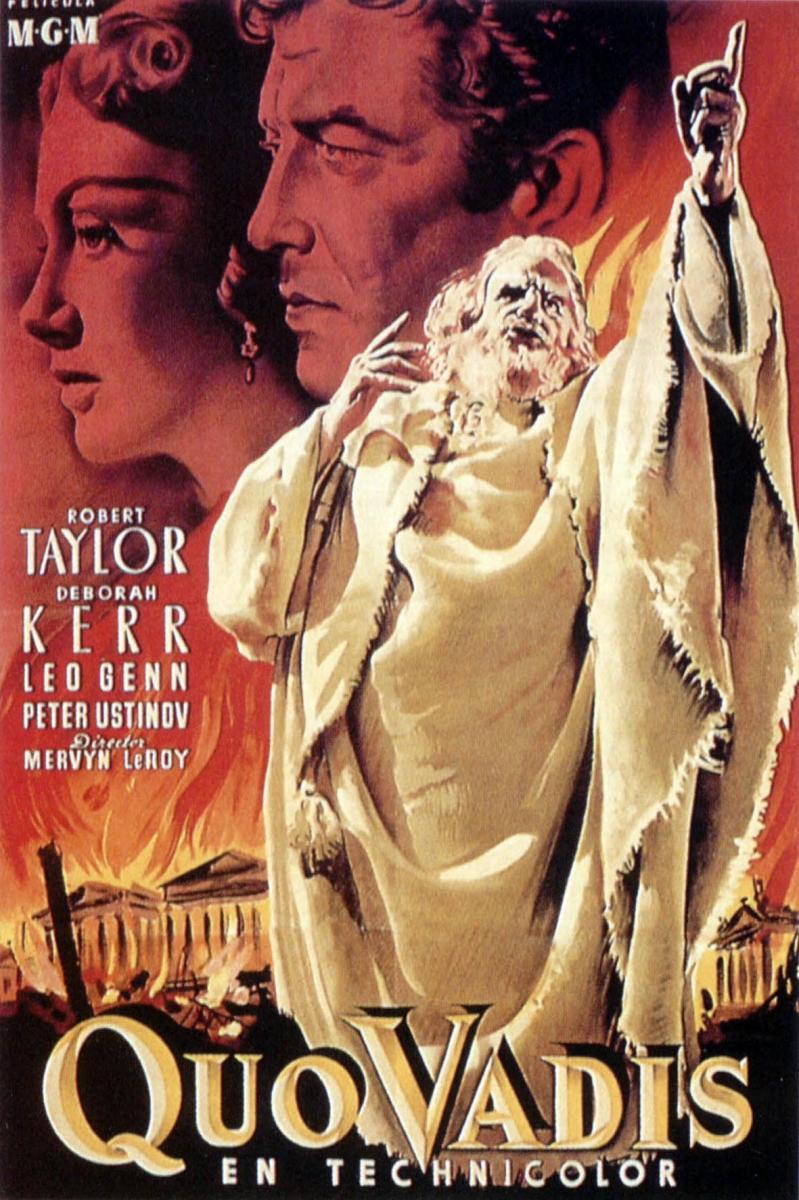
Cast:  Robert Taylor (Marcus Vinicius), Deborah Kerr (Lygia), Peter Ustinov (Nero), Buddy Baer (Ursus), Leo Genn (Petronius), Marina Berti (Eunace), Patricia Laffan (Poppaea), Finlay Currie (Peter)

Director:  Mervyn LeRoy   

Personal Rating:  4 Stars


***

    Post-WWII America nurtured an increasingly religious atmosphere that set the stage for a burst of cinematic achievement involving Biblical subject matter. Generated in part by the widespread panic over Communism taking root during the Cold War, many of these movies contain pretty blatant attempts to make far-fetched historical comparisons, inserting modern themes and ideals into an ancient setting. Still, the best of the bunch have managed to retain much of their timeless power. Quo Vadis, the epic historical fiction drama of conflict and conversion, is certainly among them.

    Robert Taylor stars at Marcus Vinicius, a Roman officer newly returned to his homeland after fighting in foreign wars. While visiting a retired general and his wife, he falls madly in love with their ward and adopted daughter, Lygia, who had been brought to Rome as a barbarian hostage years before. Attracted by her beauty, Marcus wastes no time trying to woo and win her. But when Lygia resists his advances, he callously arranges for her to taken away from her adopted parents and brought to the palace of the Emperor Nero, where he hopes to be made her new “guardian”.

   Lygia eventually manages to escape back to her parents with the help of Ursus, her loyal body-guard. Undeterred, Marcus goes in search of her, hiring a Greek guide to track her down. In the process, he discovers that Lygia and her parents are converts to the new Christian religion, and that their philosopher friend, Paul, is actually the famous Apostle to the Gentiles. After he tries to recapture Lygia as she is leaving a Christian gathering, a street fight ensues in which Ursus again comes to the rescue, Marcus is injured, and his guide is killed. Mercifully, Lygia nurses her pursuer back to health and admits she does feel some attraction for him. Nevertheless, she maintains that Christ will always have precedence in her heart. This wounds his pride, and he leaves her in anger, vowing never to be lured by the Christian beauty again.

    Meanwhile, Emperor Nero hatches a plot to burn Rome so that he can write an epic poem about the conflagration and build a new city in its wake. Marcus’s uncle, Senator Petronius, tries to use to his influence and wits to keep the emperor’s madness in check, but his efforts prove to be in vain. Marcus realizes that Lygia will be trapped in the inferno and rushes to her rescue, in spite of Nero’s wife, Poppaea, who lusts after the young Roman officer and tries to prevent him from going.

    After outracing the Emperor’s charioteers en route to Rome, Marcus makes his way through the burning city, locate Lygia, and force the Praetorian Guard to open a bridge they were blocking to prevent Nero’s palace from being raided. As the mob pours into the palace courtyard, Poppaea convinces Nero to make a scapegoat out of the Christians, in hopes of doing away with Marcus’s Christian lover. Although Petronius warns Nero that by condemning the Christians he will be condemning himself in the eyes of history, the emperor takes her advice and unleashes a firestorm of persecution.

     Meanwhile, Peter the Apostle receives a heavenly vision on the Appian Way telling him to return to Rome to minister to the persecuted Christians there. He discovers that they are being burned alive and thrown to the lions for their faith, and boldly exhorts them to hold fast from the top of the amphitheatre before being arrested himself. He is thrown into the same cell as Lygia and Marcus, both of whom have been arrested by the imperial government for treason. Awaiting inevitable execution, they both realize the true meaning of love before facing the ultimate test of faith in the amphitheatre.

    In the tradition of many of the great Biblical epics of the era, Quo Vadis is top-notch cinematography. Triumphant Roman legions march in a splendid parade; lavish feasts unfold at Nero’s court; Rome is incinerated through the fury of the emperor’s insanity; Christians are brutally tortured and martyred in the lion pit; Nero is overthrown in a mass popular uprising. The panorama alone is impressive, and the Technicolor grandeur is a feast for the eyes. Happily, the film also manages to keep the bulk of the plot up to par in the realm of emotional intensity and human sentiment rather than letting it get drowned out by impressive visuals. Unfortunately, while the Hollywood backdrops and characters are bold and brilliant, historical accuracy tends to have been shoved to the back burner.

    For example, while Nero was certainly no piece of cheesecake and put the Christians through Hell on earth, he was also a much more complex and multi-faceted character than the practically-evil-in-every-way villain that the film portrays. It is almost certain he was innocent of the burning of Rome, and never tried to incinerate the people inside. Actually, he went over and above to provide assistance for the distressed population, opening his palaces to house them and food and medical stores to provide for their needs. He even headed expeditions into the smoldering ruins to search out survivors. The legend of him “fiddling” while the city went up in smoke was likely devised to mock the emperor’s musical performances which many people felt were below his station. He, meanwhile, had a very exalted opinion of his own artistry, and, as the film depicts, could be quite obnoxious about it!

    Nero did indeed blame Christians for the fire and unleashed a horrific persecution against them, but this was not the main reason for his overthrow. Rather, it had to do with economic pressure, and the anarchical state that came about in the wake of Nero’s regime resulted in the execution of his replacement, Emperor Gaius, and intense factional infighting. While it’s true that he did have one of his attendants help him commit suicide, but it was not by the hand of one of his disillusioned former lovers. Furthermore, he did not strangle Poppaea in a fit of rage beforehand. Far from it; he actually went into an almost inconsolable state of grief when she died of natural causes! 

    In essence, in its eagerness to heighten the conflict between Pagan Rome and the Early Christian Church, Quo Vadis takes multitudinous liberties with the facts. But then, who among us cannot admit that Peter Ustinov was brilliant in his portrayal of a tyrant both diabolically insane and also darkly humorous in his childish tantrums that bring death and destruction on so many? It may be hyperbole, but its delicious hyperbole nonetheless. I still think it would have been better if they just stuck to the historical script, but I would also venture to say that, unlike the inventive spurts in Braveheart, nothing is going to be irreparably damaged as a result in this day and age. 

    Robert Taylor shows himself to be a decent actor in his role as Marcus, but what you see is pretty much what you get in every role this guy has ever played, whether the setting is Ancient Rome or Medieval England or the American Old West. In Quo Vadis, his wolfish chasing after Lygia turns me off to his character almost instantly, and I find it hard to understand why she should suddenly find him so lovable just because he got hurt after a struggle with her body-guard!

    Marcus's better self does come out later in the film, but I think it would have been much more natural if Lygia’s fondness for him had been revealed then instead of out of nowhere earlier on. The couple’s dialogue in prison has more substance then anything else in their romantic romp. Lygia does try to explain how she “sensed” his inner goodness beneath the predatory exterior, and expresses her desire to have been able to bear him a son. Marcus, for his part, explains his difficulty in believing in Christ, in spite of his admitted admiration for the Christians. They are subsequently married in the prison by Peter the Apostle.

    It is a treat to be able to watch a well-acted dramatization of the pious legends involving St. Peter in Rome, including his encounter with Christ on the Appian Way who tells him to return to Rome lest He be crucified a second time. Peter does return and is crucified, upside-down, on Vatican Hill, the current headquarters of the Church Nero tried to destroy so long ago. And who could not love Finlay Currie in the role of Peter, the grandfatherly guardian of the early Church? Who could feel the urge to let out a rousing cheer when he returns to Rome to encourage his spiritual children in the arena to stand fast for Christ? Who could not feel a chill run up his spine to hear them sing in a hymn of praise in the face of death? As a Catholic, this is about as inspirational as religious movie-making gets.

    Leo Genn as Petronius makes the ultimate “noble pagan”, from his cynical witticisms to his dignified suicide. His dying request that Nero should resign himself to “butchering his people, but not the arts” in reference to his song-writing is the most satirically scrumptious line in the movie. The film clearly points to him as a symbol of the best of Roman culture, while at the same time showing that the sun is slowly setting on the empire and her old ways. Natural virtue is gradually yielding to supernatural enlightenment, and the world is soon to change forever.

    Petronius’s mistress, Eunice, is also a source of sympathy, demonstrating natural passions that blossom into true love and end with the taking of her life to join her dying lover. We may not be inspired to commend her for her actions, but we probably won’t condemn her either. She is so very human, just like Petronius, and they probably prove more relatable to the average viewer than the Christians portrayed. Perhaps there is something in them that shows goodness is monopolized, and that God is reflected in all His creation, whether they believe in Him fully or not. And in the end, there may be hope for the two them after all through a miracle of grace, for as Petronius says, “If the Christians are right, this will be but a brief parting.”

    Patricia Laffan as Pompea is a blood-curdling seductress, with wickedness and wiles that liken to gifts straight from the devil. While the issues of character assassination do play a role here, this portrayal is so wonderfully wicked that she makes an excellent counterpart to the fictionalized Nero. She’s also the right woman for the job of setting into the motion the climax by ordering Lygia to dressed as a bride and tied to a state in the amphitheatre. The only thing standing between her and a savage, ground-pawing bull is her long-suffering body-guard, Ursus.

     The intensity of this physical struggle is matched by Marcus’s interior struggle as he is held captive in the emperor’s box, forced to watch helplessly as the fight to the death between man and beast unfolds. Straining at the ropes that bind his hands, realizing his total inability to effect the results, the faith that he could never manage to find finally comes to him in a flood, and he prays for Ursus through gritted teeth, “Christ, give him strength!” The sheer passion behind this desperate plea makes it one of the most memorable and moving parts of the film.

    Quo Vadis is one of those momentous achievements in cinematic history that can never be recaptured. The plot may be historically inaccurate in parts, and some of the themes from Post-war America may be dated, but the true story of the sacrifices made by the Christian martyrs is timeless and needs to be retold. In an age that has become increasingly secular and indifferent, all Christians are called to walk our own Appian Way and ask, “Quo Vadis, Domini? Where are you going, Lord?” When we find the answer to that question, like St. Peter, we must pick up our crosses and follow.  


Marcus (Robert Taylor) admires Lygia (Deborah Kerr) at Nero's court