Search This Blog

Showing posts with label R rated. Show all posts

Thursday, July 30, 2015

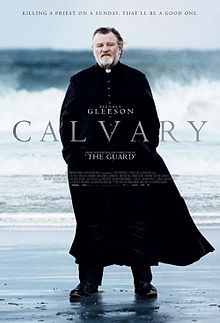
Calvary


     For quite a few months now, I have read reviews in Catholic magazines and on Catholic websites about the Irish production called Calvary. Quite a few friends urged me to watch it as well, and denoted it to be a Catholic classic. To be honest, it wasn't exactly on my top 10 list. Well, perhaps it was, but it was my top 10 worst list! Perhaps it is partially because of my old-fashioned sensibilities, but I found it to be terribly crass and graphic, with a meandering pace, a hard-to-follow story-line, and a fall-off-a-cliff ending. It has always been my firm belief that true art depends upon good taste, and this film, in my opinion, lacked it considerably.  

    I found it hard to understand the motives and behavior of the priest, and don't feel that what he did by staying in his parish and allowing himself to be shot was so heroic. Actually, I thought it was rather dumb, and he really should have gone for the police or gone on a little trip out of the county a long time ago! We are Catholics, not Quakers. We can claim the right to defend ourselves.  

     In Calvary, everyone in the village is depicted as being sinister and morally warped to a disturbing extent, which is a bit over the top and unrealistic. This is no doubt used to heighten the tension, but in the end, it comes off as being a movie-maker's ploy.  

    I mean, I can appreciate dark themes and characters, such as in The Hunger Games, but I personally felt this went over-the-top and was wanted a layered mood and diversity of characters. So...yeah. I thought it had a good premise, but fell a long, long way short of I Confess.


Sunday, June 22, 2014

The Last Samurai

Year:  2003

Filming:  Color

Length:  154 minutes

Genre:  Action/Adventure/Drama/Inspirational/War

Maturity:  R (for graphic battle sequences)

Cast:  Tom Cruise (Capt. Nathan Algren), Ken Watanabe (Lord Moritsugu Katsumoto), Koyuki (Taka), Tony Goldwyn (Col. Bagley), Masato Harada (Omura), Timothy Spall (Simon Graham), Shin Koyamada (Nobutada), Shichinosuke Nakamura (Emperor Meiji)

Director:  Edward Zwick

Personal Rating:  3 Stars

***
   
        Beautiful Japanese mountains. Beautiful Japanese actress. Confusing piece-meal of English and Japanese dialogue. Confusing blood-and-guts battle sequences. Some decent spiritual overtones. Throw in a greasy-haired Tom Cruise searching for his identity whilst guzzling sake and you have a pretty good summary of this very mixed, though very memorable big-budget on-location period piece.  

    The story opens in the America not long after the Civil War where we first meet Captain Nathan Algren, played by our darling Tom. Acting as a sharpshooter at a circus attraction, he is manipulated by the masses as a wartime hero but disillusioned by the atrocities he witnessed and took part in during the course of his military career. He soon gets a new opportunity to change his surroundings when his old commanding officer, the cynical Colonel Bagley, offers him a position in the Imperial Japanese Army which has asked the U.S. Army to help them modernize and suppress an uprising of the traditional warrior class, The Samurai.

    Ambushed by the Samurai in a forest, Algren’s forces are annihilated and he is captured by the legendary shogun, Lord Moritsugu Katsumoto. Wounded and suffering from alcohol withdrawals, Nathan is put in the custody of Katsumoto’s beautiful sister, Taka, whose husband had been killed by Algren in the battle. Although she initially forces herself to care for him even though she does not want to, she eventually takes pity on him, and he responds by asking her forgiveness for the pain he has caused her.

    Gradually, Algren learns respect for the Samurai way of life and learns their methods of fighting and spirituality. Yes, we do wonder how Teriyaki Tom becomes Mega Buddhist/ Super Samurai so quickly, but we’ll just let that one slide. Basically, before you know it, he’s serving as the shogun’s body guard companion when he rides into Tokyo to try to reason with Emperor Meiji and convince him not to proceed with his policy of disarming the Samurai and robbing them of their traditional way of life.    Instead, he is almost captured, and his son Nabutada is killed.

    Fearing for his friends and the things he has come to hold dear, Algren agrees to help lead the last samurais in a desperate last stand against the modernized imperial army with their superior weaponry and tactics. He successfully beats off several imperial attempts, but then the Gatling guns are brought in by the other side to combat the raw courage and flawless fighting skills of the individual warriors. This results in a fight to death for the future of Japan and a conflict between the allure of the material and depth of the spiritual.

   The Last Samurai isn’t the worst movie in the world, but it definitely lacks in some major levels with regards to clarity. The overall feel is meandering and hard to follow, making me feel as if I were hovering over the story rather than getting into it. The makers admitted that they were trying to make this more of a visual picture than a dialogue-driven one, and the result leaves the viewer admiring the gorgeous on-location shots of Japan but confused as to what’s happening in the plot.

    What little English dialogue there is usually winds up being either out of place for the setting or in Japanese with English subtitles. Not only do things get extremely hard to follow as a result, but also monotonous in pace. The long, drawn out scenes of Algren’s captivity among the Samurai could probably have been cut down by half, as could the oft times cartoonish martial arts fights, especially the one in which Katsumoto’s son is killed.

    Tom Cruise, in my opinion, is a pretty lousy actor who sticks out like a sore thumb wherever he shows up. He’s just obnoxious to watch most of the time, especially in the first half of this when his bad attitude is at its zenith. His character, and most of the others, don’t seem filled out enough for us to develop a real attachment to any of them. I will admit that the fact he did most of his own stunts and martial artistry is rather impressive, even if the fight scenes were generally overblown.

    Two emotional scenes I would say Cruise pulls off okay are the final doomed charge of the Samurai and his audience with the emperor who decides his fate. He has a very intense expression the whole time, like someone holding back tears, and does a good job generating that sort of emotion in the popcorn-munching throng at the theatre. The Samurai sword sequence at the end is reminiscent of Braveheart, and a nice touch considering the emphasis on the sword being seen as a warrior’s soul, strong yet flexible, cutting yet ornate. Also, they were the symbols of the Samurai’s power that the Imperial government was literally trying to take away.

    There are some pretty bloody battles, but nothing that can’t be easily fast-forwarded for those who wish to do so. Other than that, there is really nothing morally reprehensible in this film. Some people have been deeply disturbed by the fact that Nathan helps Katsumoto commit kill himself on the battlefield. But Nathan repeatedly prevents his friend from committing suicide throughout the film, and is obviously not in favor of it.

   He only takes part in the act when they’re both laying wounded on the battlefield and Katsumoto begs him to assist, to save his honor. His actions may not be commendable but it understandable, and reminiscent of the suicides that take place in Quo Vadis. The suicide also sets the stage for a moving moment when the imperial soldiers all kneel down out of respect for Katsumoto as Algren cradles the dead samurai in his arms, surrounded by slain warriors.

    One of the highlights of the film, for me at least, is Koyuki, a young Japanese actress with a lovely face and graceful demeanor who plays Taka. Like Murron in Braveheart, she symbolizes of all the highest ideals that the main characters fight for, and even the land itself. Her honor, compassion, modesty, strength, and beauty epitomize the best aspects of the Samurai and the reason they fight so hard to preserve their code of living. Thank heavens, and finally in keeping with the right mood, there are no sex flings in a grass hut to be found. Indeed, when Nathan spies Taka washing her hair in a nearby spring, she modestly tucks up her robe to cover her bare shoulders.

    Spiritually, there are a few interesting aspects. One is the redemption Nathan finds through his time with the Samurai, who are sworn to help people “find their souls.” In America, it is inferred that Algren “sold his soul” and become nothing more than a shell after participating in brutal massacres that haunt his dreams and cause him drown his memories with alcohol. His role as a marksman in a circus side-show is symbolic of how low he has sunk. When offered to the position in Japan, he thinks that training the imperial forces will be nothing more than another job to earn some much needed cash and burn off his pent-up energy and frustration.

    But providence, though not directly mentioned, seems very much in control, and Algren finds himself redeemed through defeat and capture. Taka, almost like a guardian angel of sorts, puts aside her own feelings and tenderly nurses him in his hour of need. This kindness brings out his better side and inspires him to apologize for killing her husband. She not only forgives him, but also sees more clearly the goodness in him.

     When he joins the Samurai cause, she lovingly dresses him in her husband’s armor, as a symbol of his transformation. The follow scene of him receiving a Samurai sword from Katsumoto and riding into battle to face much larger forces is unfailingly inspiring.  Another moving aspect is the way Taka’s young sons come to love Algren, even though they knew he killed their father. They seem to take the attitude of their mother: “He did his duty, and you did your duty.”

     The iconic scene where he tries to go up against a Samurai in the village and is beat silly basically demonstrates how weak he is spiritually. Later, when he is allowed to learn martial arts, it is a symbol that he is finally on the road to finding his soul through the help of others. Yes, this is Eastern religious belief to the max, interconnecting the body-spirit dynamic, and may be rather foreign to Christian audiences. But looking at it broadly, we do believe that the body is the Temple of the Holy Spirit. Hence, there is some connection at that.

      “I was never much of a church-goer”, Algren records in his journal, “but there is something timeless about this place, this people.” He eventually comes to embrace the Samurai arts of warfare, artistry, healing, and shamanism, and determines to “fight for the things I love.” This is interesting, if not completely fair to traditional Christianity. There is a tendency in modern Hollywood to glorify exotic spirituality, whether it be Buddhism or Druidism or Islam or what have you. The proponents of these religions and indigenous or Eastern cultures are always shown in a rosy light, while Christianity and western practices are portrayed as being either fanatical or hypocritical.

    This is just stupid considering how deep a faith and a culture we westerners have. If we have rats in our numbers, well, so do other religions and cultures! Why make Christianity look dumb? We have profound spiritual practices, resonant rituals, and deep meditations. And why make the gifts of Christendom look worthless? We have as rich of a heritage as any.

    As in the Highlands of Scotland prior the last Jacobite Rebellion, Japan’s traditional system at the time period this movie this film is set in was indeed in need of an overhaul. While the code of the Samurai may have been admirable for the most part, many individual shoguns used their position to run something of a protection racket, and the common people often lived in the terror of their corruption. Hitherto, Japan had been completely cut off from the outside world, and the common people were deprived of modern convenience. All those who wanted to modernize were not arrogant wretches who had lost their souls, as is indicated. It is noteworthy to point out that, viewed from a different perspective, Nathan Algren is actually a traitor to his own flag.

    That having been said, there is a natural sympathy that we all have for a simpler way of life, built on a reasonable foundation. The real message of the film comes down to this: In efforts to modernize, can we go so far as to destroy the truly worthy things in life, such as the intimacy of community, a sense of the spiritual, a respect for the earth, and appreciation for the aesthetic, putting quality before quantity? At the end of the film, Emperor Meiji is shown as striking a balance between old and new, timeless and innovative, by accepting the sword of “The Last Samurai” and allowing Algren to return to his “spiritual place” and “spiritual mate” in the mountains.

    So while this movie had its elements of confusion, dullness, historical incongruity, and pure ridiculousness, it also had it’s moments of depth and beauty. I may not rush out to watch it again any time soon unless I’m learning Japanese, but I think it was worth a viewing for anyone interested in the issues of international cultures and religions and the ongoing efforts to share, find balance, seek the truth, and fight for the things we love.  
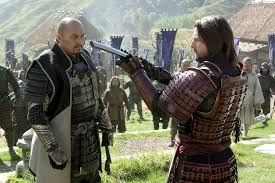
   

Katsumoto (Ken Watanabe) gives Capt. Nathan Algren (Tom Cruise) a Samurai sword


Thursday, May 8, 2014

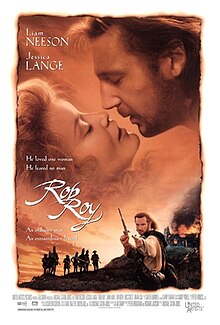
Rob Roy

Rob roy poster.jpg

Year:  1995

Filming:  Color

Length:  139 minutes

Genre:  Action/Adventure/Biography/Drama/Swashbuckler

Maturity:  R (for violence, sexuality, and language)

Cast:  Liam Neeson (Rob Roy MacGregor), Jessica Lange (Mary MacGregor), Tim Roth (Archibald Cunningham), John Hurt (Marquis of Montrose), Andrew Keir (Earl of Argyll), Brian McCardie (Alasdair MacGregor), Brian Cox (Killearn), Eric Stoltz (Alan MacDonald)

Director: Michael Caton-Jones

Personal Rating:  1 Star

***

    Trash. Pure, unadulterated trash. That’s the general description for most of this big-budget, sex-saturated action flick set in the rugged Scottish Highlands. Instead of getting an accurate portrayal the early 18th century social and political strata, or even a decent romanticized adaptation of the legend of Rob Roy, we get sensationalist filth, visually and verbally, combined with creepy characters and a confusing plot-line.

    The film opens in 1713, on the First Jacobite Rebellion, even though this historical event is skimmed over entirely. The first time we meet our anti-hero, Rob Roy MacGregor, starring Liam Neeson, he is brutally stabbing a cattle thief for the Marquis of Montrose. The next time we see him he is lacking the proper garmentry of civilized society and going for the plunge in the lake, followed up by his hopping into bed thusly with his wife, Mary, who says, pleasantly, she’s just been dreaming about being “ravaged” by a silkie….yeah, delightful couple.

    But if they’re weird, there’s worse to come. Enter the Marquis of Montrose himself, a noble sneaky rat, along with the ever-detestable Archibald Cunningham. “Archie”, as he is fondly called, is a perverted, sadistic, narcissistic, and very well dressed English dandy who also has quite a way with the sword. And he’s quite short, too, but the little creep tops everyone in the area of disgusting vulgarity in word and deed. We also get to meet the Duke of Argyll, who is at odds with Montrose and in danger of being framed as a Jacobite.  

    Cut to Rob deciding he doesn’t want to be a bounty hunter anymore and making a decision to borrow money from Montrose to buy his own heard of cattle. Montrose, ever the gentleman, agrees and then rigs a plot whereby Archie will kill Alan MacDonald, the clansmen carrying the cash back to Rob, steal it back for the Marquis, and then make it look like MacDonald has skipped town and took a ship to America with the money. It works beautifully.

    Now Montrose springs the second part of his trap, and demands that Rob Roy testify against the Duke of Argyll and say that he is a Jacobite. If he does not, the Marquis continues, he will hold the loss of the money against him and his clan. Why a commoner’s testimony against a nobleman would make or break anything is a bit of a mystery, but Rob finally starts revealing his noble side and refuses to do so. After briefly holding Archie hostage so the Marquis can’t set the guards on him, he and the men of the clan take to the hills.

    Archie-the-Evil is sent to get Rob with his redcoated troops. But since Rob is long gone, he decides to take the liberty of burning his home, slaughtering his livestock, and even defiling his wife. Rob’s brother, Alasdair, finds out what happened, but Mary swears the lad to secrecy. She even stabs Killearn, a hireling of Montrose, when he threatens to tell on her. Nevertheless, the news gets out when Alasdair is mortally wounded, and he confides to Rob the true story. Rob, as predicted, goes bats and attacks troopers on horseback.

    Also as predicted, he is captured, and Cunningham prepares to hang Rob over a bridge. But our anti-hero manages to flip himself backwards and almost strangle his captor with the rope before falling into the river and tumbling over a waterfall. Yes, he survives. No, we don’t know how. Professional secret. Anyway, he gets home and finds out that Mary is pregnant, presumably with Archie’s child. But to his credit, Rob takes it on the chin and says that he will be a father to the baby and they’ll start with a clean slate.

    Now his main goal is annihilate Archie via a public duel. The only problem is, as we have mentioned, Archie is a pretty good little fencer. The Duke of Argyll, who has finally found out that Rob refused to perjure him, promises to take care of the Highlander’s debts, but doesn’t hold out much hope for him in this upcoming fight. And his instinct proves to be basically correct, since Rob gets trounced by Cunningham, and our villain doesn’t even play dirty!

    No, Archie wins fair and square…but Rob is somehow able to cheat fate by prying his opponent’s blade away from his throat (why don’t more people manage that in the movies?) and skewering him then and there. No one really mourns the late rat, including Rob who hurries home to enjoy a well-deserved smooch with Mary in a sun-drenched field. But I must admit that a slight sigh escaped me at having to watch Archie’s nice duds get impaled along with him. Ah, the fortunes of Hollywood costuming.

    More than almost any film I’ve viewed, Rob Roy is a shiny apple that’s rotten on the inside. There are impressive scenery shots, elegant costuming, and a traditional music score by Capercallie. There is also some interesting cinematic artistry exercised, especially in the scene which flashes back-and-forth between Archie chasing MacDonald on horseback and the celebration being held nearby where pulse-pounding reels are being played. Immediately after, the Gaelic lament “Allein Duinn” is sung at the celebration (even though it was written over 60 years after the events depicted) at the same time as Cunningham is stabbing MacDonald in the woods. Another nice sequence involves Archie, decked out his military splendor, leading his red-coated columns out to capture Rob Roy, accompanied by the tune “O’Sullivan’s March.”

    But the picture reaches new lows in the area of unnecessary vulgarity and brutality, earning its R rating to the hilt, and doesn’t have a deep enough plot to bring any substantial meaning out of the mess. It’s as if the script writer were trying to beat some sort of record with regards to how much sexual slang and how many stabbings could be stuffed into a 2 hour production. There was really no way of getting around it easily, even though I did use the fast-forward button repeatedly.

    The characters’ general comportment, unfortunately, match their choice of linguistics. Rob and Mary MacGregor may be married, but there evident obsession with each other as lovers is a cheap substitute for deeper emotions rarely brought out in this film. I’m heartily sick of those two making out (and I mean way out) almost every time they make an appearance together on screen. I mean, come on, do we really need to see this? Don’t they have any other hobbies as a couple fit for public exhibition? Can’t they just enjoy a walk in the woods or a picnic by the lake without having to send the kiddies away and bring sex into the equation?

    It’s devoutly to be hoped that most normal married people have more that binds them than a fiery sex-life. But the movie spends much more time on that than anything. Two particularly awkward examples are when Mary reaches under her husband’s kilt (accompanied by some vulgar verbiage) and later, when she’s angry at Rob for having to head for the hills, she shouts like an uncouth bar-maid “Find a sheep to comfort yourself!” Yes, it is disgusting and unwomanly and plain mean to say such a thing, especially to one’s husband.

    There are no real religious references to speak of, and in the midst of all the turmoil, no one is heard to call out to God for aid. Even the vaguest hint of spirituality is deadened by the oppressive attitude of usury that pervades the film. None of the main characters, heroes, villains, or undefined, stand out as being particularly upstanding or moral. Both Rob and Mary brutally murder people with knives, and no one shows mercy or forgiveness to those who have wronged them. Instead, they will not rest until their vengeance is satisfied.

    What virtues they have consist of a more natural as opposed to supernatural variant. Most notably, Rob refuses to perjure because he prizes his reputation as a man of his word. In spite of her initial resistance to the this stance (resulting in the sheep comment), Mary does come to see that if Rob perjured the Duke of Argyll, he would no longer be himself, and if he were no longer himself, he would not longer be her Rob. With regards to Rob’s view on the meaning of honor, he tells his young sons that it is not a thing that men get, but that grows within them. When they ask him if women can have honor too, he replies that they are the heart of honor, and gives his wife a glowing smile.

    For her part, Mary doesn’t want Rob to find out she has been raped so he won’t act rashly and put himself in danger, going so far as to murder a would-be informant later on. When the secret finally gets out, Mary mentions the possibility of aborting the baby that may be Cunningham’s, but Rob makes clear that the baby isn’t the one who deserves to die and accepts his wife’s child as his own, saying, “If it’s a boy, name him Robert, and if it’s a lass, name her after my own dear Mary.” This is touching and a good pro-life message. But then it really is the least he could do under the circumstances.

    Needless to say, Archie is like the devil incarnate (or conversely the antithesis of Sir Percy Blackney from The Scarlet Pimpernel), and the screenplay writers take every precaution to make sure we know it. Of course, we should have known it to begin with since, just like his villainous confederates Col. Tavington from The Patriot and Capt. Hayward from The Last of the Mohicans, he has a proper English accent and dresses well. Really well, actually. I must confess that I paused several film clips just to marvel at his magnificent 18th century attire. But for some inexplicable reason, modern heroes, or rugged anti-heroes, or what have you, are expected to be talk in a rustic dialect and be slovenly dressers.

    Exactly what people are supposed to take away from this cultural preference mystifies me. Yes, we all know that good clothing and clipped accents don’t make a good man, if that’s what they are trying to get across. But good clothing and clipped accents doesn’t make a bad man either! Furthermore, while such outfits and old-fashioned ceremonial customs may seem stupid and foppish for many today, back then, it was quite normal and not at all sinister for noblemen to behave like noblemen.

    So to conclude another one of my long-winded rants about the Hollywood-ization of the British culture and class system: why, why, why must they all be portrayed evil mass murderers, or pompous, self-consumed fops, or both? Sure, there were rats in the upper classes. And rats in the lower classes. And decent human beings, and even saints, that came out of both as well! Why, why, why can’t these populist, modernist, mega-million dollar producers get it through their thick skulls and give us some more diversity than “evil nobleman vs. gallant peasants” or in every single big-budget period piece???

    Historical accuracy, regarding what we know about the real or even legendary Rob Roy, is generally lost in translation. The stolen money saga that set Rob on his career as an outlaw (a career that was almost totally overlooked in the film) was actually perpetrated by either one of Rob’s men or the big man himself, not the Earl of Montrose. While there is a legend that his wife had been defiled by Killearn, another hireling of Montrose (not Archie, since Archie never existed!), the fact that Rob Roy later captured him and treated him with great kindness tends to put paid to that theory, unless of course the real Rob was much more forgiving than the movie version of himself.

    The plot itself suffered on any number of plains. For one thing, why does Montrose have to go through such an elaborate plot, involving murder and cover-up, just to retrieve the 1000 pounds from Rob Roy? Why not simply withhold the cash and bribe him to testify against the Duke of Argyll to begin with? And why would Rob’s testimony that Argyll was a Jacobite mean so much to the court anyway? Rob himself admits he was a former cattle thief, and it’s not specified if he has any particular connection with the nobility other than being a hireling of Montrose.
   
    The rest of the plot follows the same disjointed path that completely skips over the many Robin-Hood-like adventures the legendary Rob Roy is said to have had. All these thrills culminate in the most boring and contrived duel scenes in cinema history. The only reason he manages to kill Archie seems to be orchestrated by producer intervention since, villain or no, the shrimpy nobleman has him beat and has every right in the book of fair play to make a kabob out of him! Images of the blatantly set-up final fight between Mel Gibson and Col. Tavington in The Patriot come to mind here…..but that’s another story.

    Overall, Rob Roy was not just a let down for me as a history buff, but also a disturbing experience for me as a Christian. To me, a movie is a work of art when it knows what to show and what to indicate. Good taste is virtually nonexistent in this film, whether it had to do with sexual intercourse or death by the sword or using the chamber pot. It is disgusting and degrading, and I would never recommend it to anyone, child or adult, or ever watch it again myself. It lacked the virtues of faith, hope, and charity in major ways, and supplanted true love with physical passion, accuracy with sensationalism, and a good story with a catastrophic contrivance. 
Rugged Rob Roy (Liam Neeson) holds foppish Archibald Cunningham (Tim Roth) hostage

Thursday, February 20, 2014

Braveheart

Braveheart imp.jpg

Year:  1995

Filming: Color

Length:  177 minutes

Genre:  Biography/Drama/Epic/Inspirational/War

Maturity:  R (for language, sexuality, and graphic battle violence)

Cast:  Mel Gibson (William Wallace), Catherine McCormick (Murron), Sophie Marceau (Princess Isabelle), Angus Macfadyen (Robert de Bruce), Patrick McGoohan (King Edward I), Peter Hanly (Prince Edward), Brendan Gleeson (Hamish), Liam Carney (Sean)

Director:  Mel Gibson

Personal Rating:  3 Stars 

***

    There is much to like and much to dislike about this sprawling “new-fashioned epic”. As much as I feel it cannot be dismissed because of its beautiful visuals and moving story-line, I also feel it cannot be endorsed due to goriness, vulgarity, sexual sensationalism, and blatant meddling with historical facts. In other words, it’s worth the viewing if you have a changer in your hand and are willing to take it all with a grain of salt.

    The story opens with young William Wallace, a common Scottish lad whose father and brother are killed because of their opposition to King Edward “Longshanks” of England, who is trying to wrest control of Scotland. William is adopted by his learned uncle, who teaches takes him traveling and teaches him to use his mind as his primary weapon.
   
    After receiving a good education and traveling to mainland Europe, the fully-grown Wallace, now played by Mel Gibson, returns to his native land to find that “Longshanks” has resurrected Prima Nocta, an old rule giving English lords sexual rights to the brides of Scottish commoners on their wedding night. Needless to say, this isn’t all that popular, and when Wallace woos and wins his childhood sweetheart, Murron, played by Catherin McCormick, he weds her in a secret ceremony to prevent her from being misused. Still determined to be a man of peace in the midst of conflict, he tries his best to stay clear of the trouble – until Murron is assaulted by a group of English soldiers and, in the ensuing fight, killed.    

    Heart-broken and infuriated, Wallace launches a popular rebellion against English rule, and ordinary Scotsman rally to his charismatic leadership. Meanwhile, the Scottish nobles, including a young Robert de Bruce, play it safe and bide their time to see whether or not the rebellion will be able to get off the ground. But even after Wallace and his troops defeat English forces at the Battle of Stirling Bridge, the Scottish nobles decide they would rather negotiate with King Edward than continue fighting an uphill struggle for independence.   

    Wallace will have none of their back-stepping, and marches south into England, bringing fire and sword to the city of York. King Edward decides to send his daughter-in-law, the French Princess Isabella, to negotiate with Wallace and try to buy him off with gold from his treasury. But instead of getting rid of the bold Scotsman, Isabella is impressed by his dedication to the cause of freedom for his countrymen. Already locked in an unhappy marriage with the heir to the throne of England, Prince Edward, who prefers male lovers to his wife, she soon becomes embroiled in an affair with William Wallace.     

    Going back to Scotland, Wallace tries to encourage Robert de Bruce to unite the nobles and commoners in opposition to Edward’s tyranny. But instead of fulfilling his promise to do so, Bruce allows himself to be influenced by his power-hungry father and winds up fighting alongside the other nobles on King Edward’s side instead. The result is disaster for Wallace at the Battle of Falkirk, and he just manages to escape with his life.
        
    After living as an outlaw in the hills and wreaking vengeance on the nobles in night raids, Wallace is lured into another meeting with Robert de Bruce (yes, by now, the guy should be avoided as a jinx!) who has all the best intentions, but fails to realize that he is once again being manipulated by his dear papa, who has the rebel leader captured and handed over the English.  

    Wallace is hauled down to London and ordered to recognize Edward as his liege-lord. He adamantly refuses and is condemned to death by a new method: being hanged, drawn, and quartered. But even though Wallace’s days are numbered, Robert de Bruce is about to cut ties with his father and find the courage to become the new champion of Scottish liberty.   

    Braveheart is an epic, and not an entirely worthless one at that. Unlike some big-budget extravaganzas, it never loses track of the human element while at the same time maintaining high standards of visual spectacle. The shots of the lush countryside and soaring mountains of Scotland (and Ireland, in reality!) are breath-taking, and the use of light and shadow is excellent. The music score by James Horn was top-notch, especially the tracks “Outlawed Tunes” and “For the Love of a Princess”. Plus, the sheer scale and organization of the battles must be complimented, even if I hold back from a round of applause for the reasons outlined below. 
 
    My longstanding belief that we don’t need to see and hear everything in order to “get the picture” is stronger than ever after viewing this flick. Graphic brutality and foul-mouthed expletives are fairly common throughout the film (which I used the fast-forward button on repeatedly!), particularly during the battle scenes. In addition, there is a highly disgusting “additive” in which the Scottish soldiers reveal there “lack of underwear” by lifting their kilts at the approaching the English troops! I frankly don’t care if guys did do things like this in the midst of battle frenzy; the civilian audience certainly doesn’t have to share in the experience!   

    With regards to costuming, some of it is absolutely exquisite, while some of it rankles because of its glaring inaccuracy. But this just fits in with the general 2-dimensional angle at which the film focuses on Wallace and his fellow rebels. In reality, the real Wallace was not a dirt-poor commoner dressed in slovenly Highland attire, but instead came from the Lowland gentry and would have probably worn styles similar to other knights in the south of Scotland and in England. The most famous bit of Hollywood improvising was the use of blue woad paint smeared on Mel’s face during the Battle of Stirling Bridge, something hijacked from the Dark Ages and applied to the Middle Ages to further press the “Celtic” appeal of the picture. This just goes to show how hypocritical it was of Gibson to insist on “realism” when it came to blood spilling and heads flying, even when he abandoned it everywhere else!

    The whole Prima Nocta premise is based on no historical grounds, but was interjected to sensationalize the plot with shocking sexual misdemeanors. The real Edward “Longshanks” was certainly no angel, acting ruthlessly in his bid for power over all Britain and brutally crushing any resistance to his authority. But he also had a more attractive side. He could be quite pious, a generous benefactor of the poor, a talented musician, and a devoted husband to his wife, Queen Eleanor of Castille. None of this is even hinted at in Braveheart.   

    As for his son, the future King Edward II, although he certainly could not match his father’s warrior prowess, he was not the simpering milksop portrayed, nor was he exclusively homosexual. While it does seem likely he had male lovers, he also had quite a few mistresses and definitely seems to have consummated his marriage, resulting the in the birth of the future King Edward III – who, by the way, could not have been Wallace’s son because the real Princess Isabella was not brought over to England to marry Prince Edward until almost seven years after William Wallace’s death!    

    The relationship between Wallace and Bruce is, for the most part, fictionalized. Bruce did indeed hold back from joining the rebellion and seemed willing to play “all ends against the middle” to assure his own family’s dynastic ambitions. But he did not directly fight for the English against Wallace, at Falkirk or anywhere else. Also, while there may indeed have been an element of “carrying the torch” from Wallace to Bruce, it was not quite so straightforward as depicted. But I can manage to take this in stride, since it does fit the general flow of history and the continuity of the popular imagination. Besides, it’s hard to believe Bruce would not have found inspiration in Wallace, even if their interaction was not as muddled as depicted.

    As I mentioned above, the “Celtic vs. Saxon” perspective is played up to the hilt in this film. An Irishman is even brought over to join the Scottish rebels in a fight against the common “Sassenach” enemy. This simplification of complex demographics, political realities, and personal motives typifies why Braveheart added fuel to the fire in creating a romantic notion of present-day Scottish independence and undermining the unity of The United Kingdom.  For that, I can never quite forgive this production, although as a Christian, I must forgive the living, breathing producers and proponents, as odious as they sometimes are!    

    But in spite of all this, for dramatic appeal and potent dialogue, you really can’t beat some of the scenes in this film. In the early part of the movie, when the anonymous Scottish bride is about to be taken away to assure the English lord’s Prima Nocta rights, everything is put into slow motion as she calmly prevents her husband from putting up a futile struggle by kissing him tenderly, longingly. The expressions on their faces speak volumes in the way of indignation, grief, and ultimate resignation.    

    A similarly powerful instance is after the disastrous Battle of Falkirk, when Wallace meets Bruce on the field and realizes that he fought for the English. The look of increasing horror and disillusionment on Wallace’s face matches the look of increasing guilt on Bruce’s. The nobleman’s last minute decision to rescue the commoner is symbolic of the general complexity and tension played out in their relationship. 
 
    The romance between Wallace and Murron is, in my opinion, the high point of the plot Murron is portrayed throughout the movie as a type of spiritual connection and guardian for Wallace. From the time she gives him a blooming thistle at his father’s funeral when they are both little children, we get a pretty good idea there is going to be more between them in the future. Their rustic courtship in later years is irresistibly playful and charming, making her brutal murder all the more disturbing and painful later on. But even after her death, she continues to embody the Sprit of Scotland for which Wallace fights, and her apparitions to him are a constant motif.    

    When one of Wallace’s comrades scoffs that his heroics are done only because he thinks Murron is watching him, Wallace replies, “I know she is.” At his execution, he holds her mantle and sees her moving towards him among the throng of spectators, coming, it seems, to “take him home.” In the final scene, her mantle is carried by Robert de Bruce as he takes command of the fight for Scotland’s freedom and Wallace’s sword is hurled forward at the enemy. It is an undeniably powerful moment.   
 
    Exactly why this deeply moving romance wasn’t enough for the screen writers boggles my brain, but stead of being contented with it, they decided to manufacture a liaison between William Wallace and Princess Isabella, riddled with inaccuracy and bad taste, creating probably the lowest point in the film. Even if it wasn’t so obviously fabricated, the whole plot twist just made me lose respect for Wallace as a character, especially since his wife was still a very present force in the film and it almost felt like he was cheating on her as well as committing adultery with another man’s wife!   

    There are a few randomly redeemable aspects of this, such as the parley between Wallace and Isabella in a tent outside York. When she tries to offer him gold, saying “Peace is made with such things,” he quickly retorts “Slaves are made with such things!”
   
    Also, just before Wallace’s execution, she brings him a vial containing a pain-killing drug, reminiscent of the numbing wine offered to Christ on Cavalry. He pretends to drink it for her sake, but then spits it out after she leaves to make sure he is able to retain the full capacity of his senses, just as Christ rejected the wine-soaked sponge after tasting it. Also in keeping with the Passion narrative, Wallace asks for God to give him the strength to “die well” before being led out onto the scaffold.     


    There is one final point I have to mention before finishing up, and it has to do with the name of the film. Although the movie is a fictionalized biopic of William Wallace, the epithet “Braveheart” was actually used for Robert de Bruce, who requested that his heart be cut out and taken on crusade after he died. However, in the spirit of understanding, it can be said that both Bruce and Wallace were “brave hearts” in the purest sense of the word and have been remembered as such for generations. The lasting truth is that both of them were heroes in their own way, and Scotland rightly remembers them as her favorite sons.   

    In conclusion, I must reiterate my mixed emotions towards the film in general. Some aspects of it were truly worthwhile, raising the mind to high ideals and stirring the blood. I could truly enter in to the struggle of many of the characters, their loves, hates, passions, betrayals, defeats, and triumphs. However, I think Mel Gibson and his crew let the picture’s potential greatness slip away when they decided to rely on crudeness, sensationalism, fictionalization, and an undergirding Nationalist agenda to bolster their retelling of William Wallace and The Scottish Wars of Independence.

  
William Wallace (Mel Gibson) courts his childhood sweetheart, Murron (Catherine McCormick)

Friday, January 31, 2014

The Last of the Mohicans


Year:  1992

Filming:  Color

Length:  114 minutes

Genre:  Action/Adventure/Drama

Maturity:  R (for graphic battle violence)

Main Cast:  Daniel Day-Lewis (Hawkeye), Madeleine Stow (Cora Munro), Steven Waddington (Duncan Hayward), Russell Means (Chingachgook), Wes Studi (Magua), Jodhi May (Alice Munro), Eric Schweig (Uncas), Maurice Roeves (Col. Edmund Munro)

Director:  Michael Mann

Personal Rating:  1 Star 

***

    There is painful, and there is very painful. This revisionist cinematic production of James Fennimore Cooper’s The Last of the Mohicans falls into the latter category. Or at least that’s true if historical accuracy, believable acting, and a well-written plot mean anything to the vast array of viewers. Or at least a chosen handful of them. But I digress.
    
    The story opens in Colonial America during the French and Indian War, whereupon we are promptly introduced to Daniel Day-Lewis playing Hawkeye, a buckskinned frontier scout known as “The Long Carrabine” who looks just a little bit too prettied-up for the part. Traveling with his adopted Mohican father and brother, Chingachgook and Uncas, he makes a pit-stop in a remote settlement where British officers are trying to coerce American colonials to reinforce the defenses of local British forts against the French attacks. In true stereotypical fashion, the redcoats are portrayed to a man as dandified tyrants, fanatic about their duty to the Crown but with a definite lack of talent for real fighting.

    The colonists refuse to comply with British demands, saying they will not leave their women and children defenseless at home while they are serving elsewhere. Hawkeye, loitering around in the crowd, also gets his chance to make a splash by announcing that he doesn’t see himself as “subject to any man”. And here we come to first major bend in the road: unlike previous productions, Hawkeye is most certainly not on the British side.   

    Realizing they can make a process a lot easier by just lying to the colonials in order to gain their allegiance, British General Webb makes a cursory promise that they can leave to protect their homes should they see fit (accompanied by ominous music and an evil snicker, of course). Then we get our first up-close glimpse of Major Duncan Hayward, a young British officer who we remember for being a nice guy in the book and past film versions, but who has now been transformed into an incorrigible louse. He gets to give an overblown speech about making “everywhere England” at the council-of-war, and then speedily exits to take care of some personal business.  

    Enter Miss Cora Munro, played by the attractive Madeleine Stowe. She is the eldest daughter of the British commanding officer at Fort William Henry, and it is up to Major Hayward, an old family friend, to get her and her younger sister, Alice, safely to the fort and their father. From the get-go, Duncan seems to have an unlucky streak in both love and war, since his marriage proposal to Cora doesn’t particularly exhilarate her and his detachment is subsequently wiped out by renegade Indian scouts.   

    Duncan and his lady-friends seem doomed to be tomahawked (especially since Duncan is less than athletic in hand-to-hand combat), but then, charging out of the woods just in the nick of time comes the dashing, crashing, man’s man, Hawkeye, who shoots up or scares off all the attackers with the help of Chingachgook and Uncas. Yes, one must wonder how they manage to do what a whole detachment couldn’t do, just as one would wonder how Mel Gibson manages to annihilate a British detachment with just two little kids as back-ups in The Patriot. But for Cora Munro, logistics don’t matter. Hawkeye is her hero, and love is soon wafting through the wilderness air. In keeping with his buoyant perspective when facing set-backs, Duncan begins scheming to do away with “The Long Carrabine”. 
  
    By the time everybody makes it to Fort William Henry under the cover of a French barrage, things inside are looking pretty bleak. Colonel Munro, who in the book and other movies had been portrayed as a rather proud but basically decent career officer, is remade into a war-criminal who has incurred the particular wrath of a Huron warrior named Magua because of atrocities perpetrated against his tribe. Munro also goes back on the promise to let the Americans go home should their homesteads be attacked, even though Indians are massacring everyone in their path.    

    Hawkeye, of course, has to step in here and help some of the colonials escape after a cozy fireside chat where the Americans assert their opposition to tyranny in true revolutionary fashion, even though the foreshadowed revolution is a long way off. For this good deed, Hawkeye is thrown into the fort’s prison and sentenced to hang. Cora makes a gallant effort to plead for his life in front of her father and Duncan, but to no avail. Duncan even goes so far as to deny that a promise granting the Americans leave to go home was ever made, and his-would-be-fiancée proceeds to disparage him and make a rousing declaration in favor of “freedom” for the colonials.     

    Cutting to the chase, when the fort finally surrenders to the French, Magua and his Hurons disregard the terms of surrender and slaughter many of the British and American prisoners. Once again, Hawkeye, who conveniently hasn’t been hanged yet, rescues Cora and Alice, and starts paddling up-stream in a convenient canoe that happens to be on-hand. Duncan, also renting a parked canoe, follows in hot pursuit. Yes, the whole thing does look as ridiculous as it sounds. Anyway, after everyone bales out near the rapids and cools off behind a picturesque waterfall, Hawkeye breaks the news to Cora and Alice that their father has had the misfortune of getting his heart cut out by Magua. And speaking of the devil, Magua shows up as if on cue, encircling their waterfall oasis.
      
    “No matter where you go, I will find you!” declares Hawkeye, in order to thematically synchronize with the title song track written by Clannad, and then he and his Mohicans leap through the falls and head for the hills while the girls and dear ol’e Duncan are taken prisoners. But to their credit, it’s not long before Hawkeye and family show up again at a nearby Huron village where Cora, Alice, and Duncan are about to be burned at the stake. During a long and messy transaction involving walking the gauntlet and using Duncan as a French translator, Hawkeye tries to convince the Huron top-brass to release their prisoners unharmed. The top-brass decide to compromise: Duncan will be released, Alice will remain in captivity, and Cora will be incinerated.         

    Not a good deal as far as the two rival lovers are concerned, and they start whining in unison, “Take me! Take me!” (I couldn’t help but mentally insert, “No, take me…..out of my misery!!!”) Showing impeccable good taste, the Hurons choose Duncan, who had purposely mistranslated Hawkeye’s attempts to offer himself in exchange so that he would be taken instead. This touching gesture of last-minute redemption results in him being raked over the coals, with Cora shrieking “What are they doing to Duncan??” (Great minds think alike: I asked the same thing at the beginning of the film when I realized they had transformed him into a rat!) In the true spirit of throwing someone an anchor when they’re drowning, Hawkeye then uses his marksman to skills to….er….end his rival’s pain.    

    With only a few more main characters left to deal with in a film that’s running overtime, Uncas is killed trying to rescue Alice, Alice jumps off a cliff (no, we don’t know why), and Magua is killed by Chingachgook. With no further ado, Hawkeye and Cora smooch on the bluffs as the sun sets over the wilderness, and Chingachgook makes a few dour predictions about the future demographics of Appalachia since he is, evidently, “The Last of the Mohicans.” Or maybe he’s just saying that to attach himself to The Wild Bill Hickok Show in the future. It’s a non-issue.
    
    By now, you have probably realized I’m not a major fan of this chick-flick-romp-in-the-woods. But even so, I’m going to go the extra mile to say something nice about it. I’ll admit that it does have some appealing visual features. Costuming is good, props are good, sets are good, and scenery is good. One scene that particularly stands out as a majestic display of old-fashioned pageantry was the parlay between Colonel Munro and General Montcalm in which both armies line up in their spit-and-polish best with colorful banners flying against the backdrop of lush forests, dark mountains, and a foreboding cloudy sky.

     Also, I must say I absolutely love the music track by Dougie MacLean entitled “The Gael”, which I first heard played by the Royal Scots Dragoon Guards. I think they did a much better job than the actual film rendition, and I feel the tune itself is a thousand times more inspirational than the motion picture to which it has been inextricably attached. More’s the pity; I want it to sign a petition to have it rehashed when someone takes the notion to create a good big-budget blockbuster set during the French and Indian War!    

      As for any spiritual overtones, I suppose I could say that the main characters seem to have a belief in the afterlife, and Chingachgook does offer a memorable prayer to “The Great Spirit” for the repose of his son’s soul. But that’s small pickings in comparison with James Fennimore Cooper’s novel, which makes numerous references to faithfulness of the characters and their belief in the workings of providence. Traditional Christianity definitely takes a back seat to native spiritual practices in this rendering. While the film does not contain anything directly immoral (except perhaps gratuitous fight/torture scenes which can easily be skipped without missing out on what little “plot” exists), there isn’t anything outstanding in the realm of virtue either.

     I guess Duncan sacrificing himself might have been a nice twist, if the rest of the plot hadn’t been so lame. But the fact is it was so lame. There’s really no way around it. The romantic triangle totally underwhelmed me by its superficiality and predictability. It lacked the substance needed to sustain a would-be epic, especially because so many of the other characters had been made unsympathetic or downright detestable, and was bolstered by pathetic pop-music-generated dialogue. Acting was equally horrendous, with the noteworthy exception of Jodhi May’s dramatically intense facial expressions before taking her flying leap onto the trampoline below the papier-mâché cliff in her role as Alice.  

    I found it very hard to get past the obvious agenda being pushed in the movie, portraying the British as monsters with the French not much better. The Indians and American settlers, on the other hand, are portrayed as being “victims” of Imperialism who would live in peace and harmony if not for the intervention of the big-bad-big-wigs from Europe. In reality, Indian tribes were almost constantly fighting each other before and during the colonization of America.

    Furthermore, it was the white settlers who had as much, if not more, to gain from the wars of colonial expansion as their British rulers, and this was proven by their resentment of any attempt of British authorities to curtail their incursions into Indian lands. Trying to constantly pit the British and Americans against each other in the colonial period is simply overdone, and I do wish more motion pictures would decide to focus on the positive connections between Mother Country and her Colonies. 

       I have no problem with an honest, critical analysis of European Imperialism and the class system it was built on. But it irks me to no end when self-righteous revisionists try to generalize and condemn whole swaths of people from a different time period because their views did not coincide with present-day political correctness and their customs relied more on ceremonial decorum than is currently fashionable in our jeans-and-tee-shirt society. Even the best ceremonial scenes from The Last of the Mohicans tend to be tinged with attitude of contempt for the ways of the past and the code of honor to which gentleman were taught to follow. By making it all seem stupid and shallow, the film has instantly lost touch with the past it aspires to represent.  

     I am not a book purist, and am usually fairly lenient on film adaptations for their tweaking of original plots. After all, visual dramatization is a different art form from written novelization, and different considerations are needed to make it work. However, this particular film had me yelling at the TV almost the whole time, and I couldn’t be bribed to watch it again. When movie producers try to completely “reinvent the wheel” by projecting modern perceptions into the past, vilifying characters we used to like, killing off others at random, and then introducing a synthetic romance to plug the holes in their cynical plot, I say the whole enterprise has gotten off message and its high time to toss the camera reels in a back-lot ceremonial fire with the incomparably luckless Duncan.   


Last of the Mohicans
Hawkeye (Daneil Day-Lewis) humors Chingachook while he rants about demographics