Search This Blog

Showing posts with label epic. Show all posts

Thursday, June 5, 2014

The Ten Commandments

Year:  1956

Filming:  Color

Length:  220 minutes

Genre:  Biblical/Epic

Maturity:  PG (for intense thematic elements)

Cast:  Charlton Heston (Moses), Yul Brynner (Pharaoh Ramses), Anne Baxter (Nefretiri), Yvonne De Carlo (Sephora), John Derik (Joshua), Debra Paget (Lilia), Edward G. Robinson (Dathan), Vincent Price (Baka)

Director:  Cecil B. DeMille 

Personal Rating:  4 Stars

***

    Some movies are so classic they should absolutely positively be seen at least one in a lifetime. With regards to The Ten Commandments, it still remains an Easter tradition set in stone for many. In spite of some far-fetched twists in the plot and hammy acting in places, Cecil B. DeMille’s “baby” has grown and thrived because it succeeded in his mission to make the Bible exciting and touched a chord for the post-war world trying to assess the true meaning of liberty.

    Charlton Heston stars as Prince Moses of Egypt, a Hebrew rescued from the Nile by Pharaoh’s daughter when he was only an infant. However, his adopted mother is the only one who knows this, and goes the extra mile to conceal it from her brother, Pharoah Seti, and the royal court. Favored by Seti and despised by his adopted cousin, Ramses, Moses wins great military victories and builds magnificent cities all while romancing with the seductive princess Nefretiri.

    But his lavish lifestyle comes to a grinding halt when a Hebrew swaddling cloth reveals his true identity. Unbeknownst to everyone else, he goes down to the mud pits and works like a slave to be with his “people”. In the course of his time there, he strangles an Egyptian taskmaster for trying to misuse an Israelite woman, Lilia, and for beating her lover, Joshua. He apprehended and brought before the Pharaoh’s throne to the shock of all. He then boisterously declares that he is favor of freedom for the slaves and is sent into exile in the desert.

    When he seems doomed to die, he is rescued by Bedouin shepherdess, Sephora, and her bevy of younger sisters, all overjoyed at finding a real live man! He gradually adapts to his life as a member of the tribe and tends his flocks beneath Mount Sinai, considered to be inhabited by God. He eventually marries Sephora, even though he is still mooning over Nefretiri who had thrown herself at his feet during his trial before Pharoah and vowed she would never forget him.  

    One day Moses runs into Joshua, who has escaped from captivity and come to hail him as the Chosen One who will lead the Children of Israel out of bondage. Moses is skeptical at first, but then he spies a burning bush that is not consumed by the flames on top of the Holy Mountain and decides he must see it more closely. He has a mystical experience with God, and acknowledges his mission to lead his people to the Promised Land. Coming down from Sinai, he is no longer himself.

    In Egypt, Moses and his brother Aaron go head-to-head with now Pharoah Ramses, his old rival, who has married Nefretiri and has a small son. Pharoah, needless to say, isn’t particularly moved when Moses tells him to “Let my people go!” As a result, the famous plagues descend on Egypt. At the same time Nefretiri tries to romantically reconnect with Moses, but he spurns her, and she in turn hardens Pharoah even further against him.

    When the final deadly plague slays the first-born of every house in Egypt, including the royal palace, the Hebrews are finally allowed their freedom. But Pharoah is soon goaded into changing his changing his mind by the embittered Nefretiri who has lost both her old love and her child. A climactic chase ensues, ending up at the shores of The Red Sea and the parting of the waters for the Israelites. But the conflict is not over. While Moses ascends Mount Sinai once more to receive the Commandments of God, the Children of Israel will come up against their own worst enemy: their sinful nature.

    The Ten Commandments is the Biblical epic from the golden era of the 1950’s. DeMille was an expert at serving up a feast for the eyes, and this was his ultimate extravaganza of panache and panorama. It’s a richly detailed drama, laden with sub-plots and character analysis as well as visual splendor. For the time period, the special effects were nothing less than stunning. While we might now be excused for cracking a smirk when the cartoonish fire descends from the sky or the green fog machine emits its lethal substance, or the gelatin Red Sea is poured out of monstrous cartons in reverse, it would be nothing less than pompous for us to sneer.  

    Beyond these imaginative efforts, there are some truly grand scenes including the mass Exodus of the Children of Israel. It is so well choreographed, impressive in its scale but also intimate in the way it focuses on individuals, such as a little boy herding ducks and a woman giving birth to a baby and old man dying and asking for his shrub to be planted in the Promised Land. The subsequent chase by Pharaoh and his charioteers is also a masterpiece.

    One clip that always stays with me is when Nefretiri gazes out of her balcony as we see the full might of the Egyptian host charge across desert, shimmering from the heat and golden sand. Of course the race between the walls of jello-water may be a tad hoaky, but it is still pretty exciting. One more note I have to make involves the color of the sky at intense moments. The eerie blood-red color or storm-black hew it sometimes takes on is deliciously surreal.

    This film is chock full of artful symbolism, like the moment when Nefretiri is playing Hounds and Jackals with Pharoah Seti and the head of her game piece flies off, skidding across the marble floor and landing at Ramses’ feet. Also there is the scene when Ramses tries to discredit Moses with his father, casually laying weights on a scale as each charge is leveled against his brother. Accused on giving the slaves too many privileges, Moses slams down a brick on the other side of the scale, demonstrating the fact that he has gotten his slaves to build a city, whereas Ramses has not.

    The bulk of the main acting is pretty good. Charlton Heston shines once again as the man-against-the-odds, going from glory to griminess before reemerging as liberator. As in equally famous role as Judah Ben-Hur, he rather block-headedly refuses to make use of the opportunities afforded him by his exalted position, even spurning Seti’s offer to forgive him providing he vow he would not lead the Hebrews in rebellion against him. Instead of using tact or grace in his wording (which I think could have helped his people much more from the get-go!), he declares he definitely would lead “his people” rebellion after all!

   The thing that’s a bit irksome in this is his instant disavowal of his loyalty to Egypt and the Pharaoh, even though he was been raised in the court since an infant. Great, so he’s Hebrew by blood, but does that change all his past perceptions and beliefs in a twinkling? The whole thing is blown up for dramatic effect, and even I will admit it is dramatic if a bit unrealistic. One way or another, it does help propel him on his search for the divine. In an interesting twist, Heston is voice of God coming from the burning bush, since he thought interlocutions may well come out that way. A bit cheesy the way they slowed down his voice to sound almost like an alien, but interesting concept nonetheless.

    His counterpart, Yul Brynner, makes a wonderfully agile villain that you almost find yourself admiring at given times. He may be a power-hungry slave-driver who miscalculates when he defies the Hebrew God, but he has a certain noble, authoritative stride to his step, even when he finds his world crumbling around him. Judging from the way he beseeches his Egyptian god of darkness to restore the life of his son, he seems to be a very religious man. By the end of the film, he seems to have experienced enlightenment the hard way when he admits, “Moses’ god is God.”

    The character of Nefretiri, played by Anne Baxter, is probably one of my least favorite in the film. First of all, I think she throws things off in the way of plot and historical accuracy. Yes, she is your typical sword-and-sandal seductress fare, and I don’t suppose the epic would be quite complete without her. But she’s basically a sex symbol with a pathetic lack of depth who finds herself in a worn cycle of being misused while in search of true love. Actually, one of the main emotions here character draws from me is pity.

    Needless to say, the whole little love triangle with Moses, Ramses, and Nefretiri is a fabrication, and I think the character of Moses comes off the worse for it. When he is Prince of Egypt, he is gung-ho about their passionate love affair. But when he returns to Egypt years later as “The Messenger of God”, he treats her with an extremely cold attitude. Yes, she is making a nuisance of herself trying to rekindle their old romance, but I would think it would be more instinctive to feel a deep compassion for his former flame and treat her more sensitively, even if she was trying to get him to sin. She is a lost soul seeking love in all the wrong places, and instead of being firm yet still loving, he comes off as almost flaunting his new position as prophet with a haughty air.

    One love triangle apparently wasn’t sufficient, so they decided have Nefretiri and Sephora come head-to-head over Moses as well before being mutually disillusioned by his role as prophet. “You lost him when he went in search of his God,” Sephora explains. “I lost him when he found his God.” We do seem to “lose touch” with Moses as soon as he descends from Mount Sinai. This is a pity, since it deprives us of getting into his head during the most pivotal points of the movie. That having been said, I like the way these two female leads are contrasted with poetic language to explain that inner beauty is the most important of all. “Love is not an art to us; it is life to us”, Sephora tells Moses.

     Nothing is mentioned in The Bible or elsewhere about Ramses planning on killing the Jewish first-borns during the “let-my-people-go” crisis. It would have been more accurate and reasonable if the film had just hearkened back to the killings of infants when Moses was a baby and indicated that The Angel of Death was avenging that travesty than creating a new one for sensationalism purposes. This addition leads to another awkward moment: Nefretiri goes the extra mile to save Moses’ son, but Moses doesn’t show her much compassion when her own son is sentenced to die or make any major moves to try to save him.

    Two of the worst miscasts have to be the casting of Vincent Price as Baka and Edward G. Robinson as Dathan for this film. Put simply, they doom themselves by being themselves…..with turbines! Shades of John Wayne as Kublai Kahn in The Conqueror, to be sure. But that’s another gruesome tale.  And of course these two incongruent odd-balls would make a run for the same less-than-impressed girl.

    This unfortunate female, Lilia, serves as a representation of the Nation of Israel – “a water lily in the mud”.” Loved by Joshua, bringer down of walls, and misused by creepy miscasts, she almost dies as a result of the green mist but is saved by Joshua who paint’s lamb’s blood over Dathan’s door. She is later almost sacrificed at the altar of the golden calf but is rescued by Moses in the nick of time.  Innocence, defilement, and redemption – the cycle is emblematic of The Chosen People in The Old Testament.

    The Ten Commandments, for all its eccentricities and quirks, remains a masterpiece of storyteller and spectacle that cannot be repeated, and watching it is an Easter tradition for thousands, including myself. I think the transcendence of it can be best captured in the scenes where Moses is struggling through the desert being poured out, bled dry, and left literally in the dust. It is a precursor to Christ’s 40 days in the desert, and emblematic of all those who must be beaten out before they can find God and their calling in life by following His Word. As Pharoah famously says: “So let it be written; so let it be done.”   


Moses (Charlton Heston) descends Mt. Sinai with The Ten Commandments

Monday, April 7, 2014

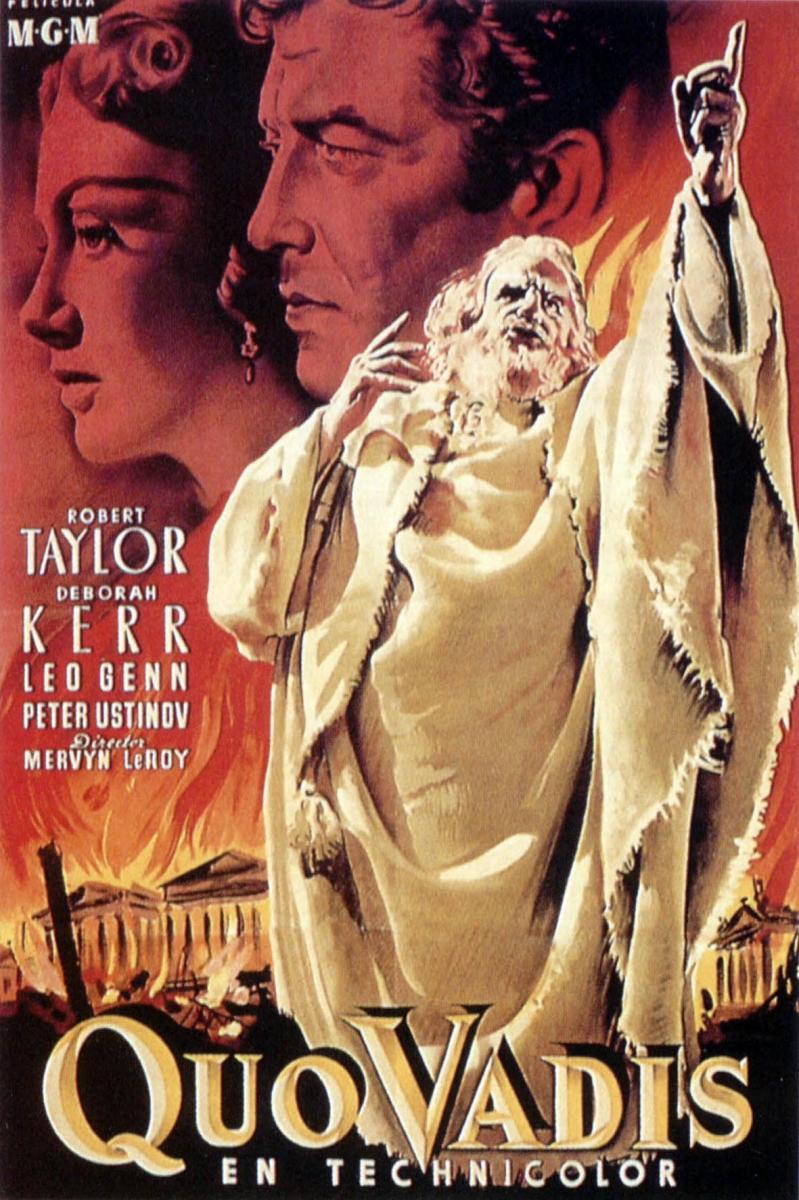
Quo Vadis

Year:  1951

Filming:  Color

Length:  171 minutes

Genre:  Drama/Epic/Inspirational/Religious/Romance

Rating:  PG (for intense thematic elements)

Cast:  Robert Taylor (Marcus Vinicius), Deborah Kerr (Lygia), Peter Ustinov (Nero), Buddy Baer (Ursus), Leo Genn (Petronius), Marina Berti (Eunace), Patricia Laffan (Poppaea), Finlay Currie (Peter)

Director:  Mervyn LeRoy   

Personal Rating:  4 Stars


***

    Post-WWII America nurtured an increasingly religious atmosphere that set the stage for a burst of cinematic achievement involving Biblical subject matter. Generated in part by the widespread panic over Communism taking root during the Cold War, many of these movies contain pretty blatant attempts to make far-fetched historical comparisons, inserting modern themes and ideals into an ancient setting. Still, the best of the bunch have managed to retain much of their timeless power. Quo Vadis, the epic historical fiction drama of conflict and conversion, is certainly among them.

    Robert Taylor stars at Marcus Vinicius, a Roman officer newly returned to his homeland after fighting in foreign wars. While visiting a retired general and his wife, he falls madly in love with their ward and adopted daughter, Lygia, who had been brought to Rome as a barbarian hostage years before. Attracted by her beauty, Marcus wastes no time trying to woo and win her. But when Lygia resists his advances, he callously arranges for her to taken away from her adopted parents and brought to the palace of the Emperor Nero, where he hopes to be made her new “guardian”.

   Lygia eventually manages to escape back to her parents with the help of Ursus, her loyal body-guard. Undeterred, Marcus goes in search of her, hiring a Greek guide to track her down. In the process, he discovers that Lygia and her parents are converts to the new Christian religion, and that their philosopher friend, Paul, is actually the famous Apostle to the Gentiles. After he tries to recapture Lygia as she is leaving a Christian gathering, a street fight ensues in which Ursus again comes to the rescue, Marcus is injured, and his guide is killed. Mercifully, Lygia nurses her pursuer back to health and admits she does feel some attraction for him. Nevertheless, she maintains that Christ will always have precedence in her heart. This wounds his pride, and he leaves her in anger, vowing never to be lured by the Christian beauty again.

    Meanwhile, Emperor Nero hatches a plot to burn Rome so that he can write an epic poem about the conflagration and build a new city in its wake. Marcus’s uncle, Senator Petronius, tries to use to his influence and wits to keep the emperor’s madness in check, but his efforts prove to be in vain. Marcus realizes that Lygia will be trapped in the inferno and rushes to her rescue, in spite of Nero’s wife, Poppaea, who lusts after the young Roman officer and tries to prevent him from going.

    After outracing the Emperor’s charioteers en route to Rome, Marcus makes his way through the burning city, locate Lygia, and force the Praetorian Guard to open a bridge they were blocking to prevent Nero’s palace from being raided. As the mob pours into the palace courtyard, Poppaea convinces Nero to make a scapegoat out of the Christians, in hopes of doing away with Marcus’s Christian lover. Although Petronius warns Nero that by condemning the Christians he will be condemning himself in the eyes of history, the emperor takes her advice and unleashes a firestorm of persecution.

     Meanwhile, Peter the Apostle receives a heavenly vision on the Appian Way telling him to return to Rome to minister to the persecuted Christians there. He discovers that they are being burned alive and thrown to the lions for their faith, and boldly exhorts them to hold fast from the top of the amphitheatre before being arrested himself. He is thrown into the same cell as Lygia and Marcus, both of whom have been arrested by the imperial government for treason. Awaiting inevitable execution, they both realize the true meaning of love before facing the ultimate test of faith in the amphitheatre.

    In the tradition of many of the great Biblical epics of the era, Quo Vadis is top-notch cinematography. Triumphant Roman legions march in a splendid parade; lavish feasts unfold at Nero’s court; Rome is incinerated through the fury of the emperor’s insanity; Christians are brutally tortured and martyred in the lion pit; Nero is overthrown in a mass popular uprising. The panorama alone is impressive, and the Technicolor grandeur is a feast for the eyes. Happily, the film also manages to keep the bulk of the plot up to par in the realm of emotional intensity and human sentiment rather than letting it get drowned out by impressive visuals. Unfortunately, while the Hollywood backdrops and characters are bold and brilliant, historical accuracy tends to have been shoved to the back burner.

    For example, while Nero was certainly no piece of cheesecake and put the Christians through Hell on earth, he was also a much more complex and multi-faceted character than the practically-evil-in-every-way villain that the film portrays. It is almost certain he was innocent of the burning of Rome, and never tried to incinerate the people inside. Actually, he went over and above to provide assistance for the distressed population, opening his palaces to house them and food and medical stores to provide for their needs. He even headed expeditions into the smoldering ruins to search out survivors. The legend of him “fiddling” while the city went up in smoke was likely devised to mock the emperor’s musical performances which many people felt were below his station. He, meanwhile, had a very exalted opinion of his own artistry, and, as the film depicts, could be quite obnoxious about it!

    Nero did indeed blame Christians for the fire and unleashed a horrific persecution against them, but this was not the main reason for his overthrow. Rather, it had to do with economic pressure, and the anarchical state that came about in the wake of Nero’s regime resulted in the execution of his replacement, Emperor Gaius, and intense factional infighting. While it’s true that he did have one of his attendants help him commit suicide, but it was not by the hand of one of his disillusioned former lovers. Furthermore, he did not strangle Poppaea in a fit of rage beforehand. Far from it; he actually went into an almost inconsolable state of grief when she died of natural causes! 

    In essence, in its eagerness to heighten the conflict between Pagan Rome and the Early Christian Church, Quo Vadis takes multitudinous liberties with the facts. But then, who among us cannot admit that Peter Ustinov was brilliant in his portrayal of a tyrant both diabolically insane and also darkly humorous in his childish tantrums that bring death and destruction on so many? It may be hyperbole, but its delicious hyperbole nonetheless. I still think it would have been better if they just stuck to the historical script, but I would also venture to say that, unlike the inventive spurts in Braveheart, nothing is going to be irreparably damaged as a result in this day and age. 

    Robert Taylor shows himself to be a decent actor in his role as Marcus, but what you see is pretty much what you get in every role this guy has ever played, whether the setting is Ancient Rome or Medieval England or the American Old West. In Quo Vadis, his wolfish chasing after Lygia turns me off to his character almost instantly, and I find it hard to understand why she should suddenly find him so lovable just because he got hurt after a struggle with her body-guard!

    Marcus's better self does come out later in the film, but I think it would have been much more natural if Lygia’s fondness for him had been revealed then instead of out of nowhere earlier on. The couple’s dialogue in prison has more substance then anything else in their romantic romp. Lygia does try to explain how she “sensed” his inner goodness beneath the predatory exterior, and expresses her desire to have been able to bear him a son. Marcus, for his part, explains his difficulty in believing in Christ, in spite of his admitted admiration for the Christians. They are subsequently married in the prison by Peter the Apostle.

    It is a treat to be able to watch a well-acted dramatization of the pious legends involving St. Peter in Rome, including his encounter with Christ on the Appian Way who tells him to return to Rome lest He be crucified a second time. Peter does return and is crucified, upside-down, on Vatican Hill, the current headquarters of the Church Nero tried to destroy so long ago. And who could not love Finlay Currie in the role of Peter, the grandfatherly guardian of the early Church? Who could feel the urge to let out a rousing cheer when he returns to Rome to encourage his spiritual children in the arena to stand fast for Christ? Who could not feel a chill run up his spine to hear them sing in a hymn of praise in the face of death? As a Catholic, this is about as inspirational as religious movie-making gets.

    Leo Genn as Petronius makes the ultimate “noble pagan”, from his cynical witticisms to his dignified suicide. His dying request that Nero should resign himself to “butchering his people, but not the arts” in reference to his song-writing is the most satirically scrumptious line in the movie. The film clearly points to him as a symbol of the best of Roman culture, while at the same time showing that the sun is slowly setting on the empire and her old ways. Natural virtue is gradually yielding to supernatural enlightenment, and the world is soon to change forever.

    Petronius’s mistress, Eunice, is also a source of sympathy, demonstrating natural passions that blossom into true love and end with the taking of her life to join her dying lover. We may not be inspired to commend her for her actions, but we probably won’t condemn her either. She is so very human, just like Petronius, and they probably prove more relatable to the average viewer than the Christians portrayed. Perhaps there is something in them that shows goodness is monopolized, and that God is reflected in all His creation, whether they believe in Him fully or not. And in the end, there may be hope for the two them after all through a miracle of grace, for as Petronius says, “If the Christians are right, this will be but a brief parting.”

    Patricia Laffan as Pompea is a blood-curdling seductress, with wickedness and wiles that liken to gifts straight from the devil. While the issues of character assassination do play a role here, this portrayal is so wonderfully wicked that she makes an excellent counterpart to the fictionalized Nero. She’s also the right woman for the job of setting into the motion the climax by ordering Lygia to dressed as a bride and tied to a state in the amphitheatre. The only thing standing between her and a savage, ground-pawing bull is her long-suffering body-guard, Ursus.

     The intensity of this physical struggle is matched by Marcus’s interior struggle as he is held captive in the emperor’s box, forced to watch helplessly as the fight to the death between man and beast unfolds. Straining at the ropes that bind his hands, realizing his total inability to effect the results, the faith that he could never manage to find finally comes to him in a flood, and he prays for Ursus through gritted teeth, “Christ, give him strength!” The sheer passion behind this desperate plea makes it one of the most memorable and moving parts of the film.

    Quo Vadis is one of those momentous achievements in cinematic history that can never be recaptured. The plot may be historically inaccurate in parts, and some of the themes from Post-war America may be dated, but the true story of the sacrifices made by the Christian martyrs is timeless and needs to be retold. In an age that has become increasingly secular and indifferent, all Christians are called to walk our own Appian Way and ask, “Quo Vadis, Domini? Where are you going, Lord?” When we find the answer to that question, like St. Peter, we must pick up our crosses and follow.  


Marcus (Robert Taylor) admires Lygia (Deborah Kerr) at Nero's court


Monday, March 17, 2014

Ben-Hur


Year:  1959

Filming:  Color

Length:  212 minutes

Genre:  Drama/Epic/Inspirational/Religious

Rating:  PG (for battle sequences and intense thematic elements)

Cast:  Charlton Heston (Judah Ben-Hur), Stephen Boyd (Masala), Haya Harareet (Esther), Jack Hawkins (Consul Quintus Arius), Martha Scott (Miriam), Cathy O’Donnell (Tirzah), Sam Jaffe (Simonides), Finlay Currie (Balthasar)

Director:  William Wyler

Personal Rating:  4 Stars 

***

    Call me biased, but once again I have to reiterate my belief that older films are by and large superior to newer films. This holds true in the field of epics. Then, screen spectacles had to be shot in a way that was grounded in live action. Now, they usually rely on an unhealthy dose of CGI. Among the greatest hallmarks of screen achievement in any era is the emotionally intense Biblical saga, Ben-Hur.  

    Charlton Heston stars as Judah Ben-Hur, a Jewish Prince whose boy-hood friend, Masala, played by Stephen Boyd, is a Roman tribune. Returning to Palestine to assume a local command, Masala tries to pressure Judah to reveal the names of zealots during their long-awaited reunion. But while Ben-Hur agrees to use his influence to discourage insurrection, he will not inform on his fellow Jews. This causes the tribune to become embittered against his old friend.

    When Judah’s sister, Tirzah, accidentally knocks a loose tile off their roof, hitting the Roman governor in the head, Masala uses this as an opportunity to take revenge and has Ben-Hur, his mother, and his sister arrested for high treason. Even though Judah insists on their innocence and begs for his family to be released, the tribune coldly refuses his entreaties and has him sentenced to serve as an oarsman on a Roman galley. During the long trek to the coast, Judah is not allowed to drink any water. When he collapses, dying of thirst, a carpenter in the village of Nazareth defies the Roman guards and gives him water from the nearby well.

    After years of rowing in horrendous conditions below deck, Ben-Hur’s ship is sunk by the enemy. His decision to rescue the Roman Consul Quintus Arius results in his being freed from slavery and raised to the position of his chief charioteer, and later on, his foster-son! But Judah cannot settle into his new life in Rome, and decides to return to Palestine in hopes of finding his mother and sister and killing his old enemy, Masala. Along the way, he meets one of the Three Kings who is in search of the Christ he visited as a little child. He also encounters an Arab sheik who, ironically, has plans to compete with Masala in a chariot race.

    Given the opportunity to act as the sheik’s charioteer, he goes head-to-head with Masala and orders him to relocate his mother and sister, or else dire consequences will follow. He also rekindles an old spark between himself and one of the serving maid’s of his household, the beautiful and pious Esther, played by Haya Harareet. She soon learns the secret that his mother and sister contracted leprosy in the Roman dungeon and are now living in the infamous Valley of the Lepers. But upon their instructions, Esther tries to hide this from Judah by telling him they are dead.

    In reaction to this misinformation, Ben-Hur, determined to avenge his family, heads off to the racing arena to have it out with Masala once and for all. After the bloody encounter, he repudiates his Roman connections and determines to join the zealots. But Esther has fallen under the influence of a traveling Rabbi who insists upon peace rather than the sword. It will later prove that the love of this gentle carpenter from Nazareth will be more powerful then his seemingly unquenchable hatred of Judah Ben-Hur.

    Ben-Hur is truly a masterpiece of the film industry and fully deserved its 12 academy awards. It’s a saga rich with detail and dimension, unlike the flat-footed Titanic which was the first film to beat its award record number.  It covers the “big picture” with so much pageantry and panache, from ancient naval battles to lavish Roman feasts to the break-neck chariot race to the power of the Crucifixion. The acting is taut and gripping, and Charlton Heston is at his teeth-clenching best as the wronged Judean Prince. To this day, the production still has the power to enchant and astound.   
  
    As far as the plot itself goes, there are many strong core values and an underlying excellence. However, I must admit there are a few elements that strike me as disjointed and dully predictable. For example, Masala’s unbridled hatred for Judah and his family seems sudden and extreme for their previously close friendship and the comparatively minor falling out they had. What could have been a complex relationship between the former friends quickly devolves into a clear-cut “good guy vs. bad guy” plotline and remains that way for the rest of Masala’s cinematic existence.

    If they had tossed in another bone of contention between the two in addition to Judah refusing to be an informer, I think that might have helped things. I know love triangles have definitely “been done”, but something like that could have beefed up his reasoning behind the actions to some extent. Even then, more misunderstanding and less malice would have made for much interesting developments. Plus, I can’t help but wish Masala had made some move towards at least a partial redemption before the end!

    Another part that I found lacking was Judah’s attitude towards his Roman foster-father, Quintus Arius. Instead of making the most of his new-found prominence by searching for his mother and sister through legal means, he has to complicate things by storming back east to deck it out with Massalah as a charioteer for an Arab Sheik, who I doubt would have hired a Jew for the task in real life! Later, Judah even refuses to heed Pontius Pilate’s perfectly reasonable advice and decides to send back the ring his foster-father had given him and, in essence, disown him!

    One immeasurably difficult stumbling block that all Biblical films set in the New Testament come across is how they will portray Jesus Christ. Admittedly, there is no way of making everyone happy in this. How can an actor possibly capture that miraculous “something” that people saw in Christ’s face that caused them to believe He was more than a mere man? What of his voice, that penetrated the soul? What of his cadence, his habits, his physical attributes? How does someone act who is supposed to be fully human, and fully divine? No film is going to be able to properly capture the reality.

    Ben-Hur, wisely, doesn’t even try. Christ’s face is never shown, and his voice is never heard. It is all left to the individual viewer’s imagination as we see the reaction of others who come into contact with the teacher from Nazareth. After all, this is not meant to be a biopic of Christ, nor even on his Passion. Nevertheless, He is what the entire plot depends on for a powerful outcome. Otherwise, the other elements of storyline deficiency would have eroded the movie and turned it into another lack-luster The Fall of the Roman Empire.

    The only aspect I didn’t like about the screen-writer’s depiction of Jesus was his reference to Him wistfully wandering in the hills while His foster-father, Joseph, is slaving away back at his carpenter shop! If the image on the Shroud of Turin is to be believed, Christ was indeed a “man’s man”, strong, robust, and muscled from hard labor. After all, after his “finding in the temple” at age 12, the Bible says “He went down with them and came to Nazareth and was obedient to them.” This certainly does not indicate any shirking of manual work or responsibility.

      But these comparatively miniscule foibles are literally washed away by the climactic ending at The Crucifixion. Esther beams as the image of saintliness, helping Ben-Hur, his mother, and his sister go to see Jesus preach. The result is different then she thought it would be, and they ultimately watch Him be put to death instead. It is then that Judah realizes He is the same man that gave him water in Nazareth, and that his life has indeed been guided by Providence. Healing comes to all of them in different ways, all the earth quakes and the rain pours down and mixes with the precious blood. This is what ensures the undying, all-encompassing potency of Ben-Hur for generations to come.


Masala (Stepehen Boyd) and Ben-Hur (Charlton Heston) share a glass of wine 

Wednesday, March 5, 2014

Titanic


Year:  1997

Filming:  Color

Length:  194 minutes

Genre:  Disaster/Drama/Epic/Romance/Tragedy

Maturity:  PG-13 (for language, sexuality, and intense thematic elements)

Main Cast:   Kate Winslet (Rose DeWitt Bukater), Leonardo DiCaprio (Jack Dawson), Cal Hockley (Billy Zane), Frances Fisher (Ruth DeWitt Bukater), Victor Garber (Thomas Andrews), Bernard Hill (Capt. Edward John Smith), Ewan Stuart (First Officer William Murdoch), Kathy Bates (Molly Brown)

Director:  James Cameron

Personal Rating: 2 Stars 

***

    When you find yourself cringing almost every time the main characters make an appearance on screen, it’s a pretty good indication something’s not quite right. Thus is the case with James Cameron’s epic disaster flick, Titanic. While there may be some redeeming aspects in the latter half of the movie, they are incapable of successfully counteracting the cheesy acting, blatant immorality, and disrespect for another time period that is hammered home at every conceivable opportunity.

    Kate Winslet stars as Rose DeWitt Bukater, a wealthy young woman who is engaged to an incorrigibly villainous business tycoon named Caledon Hockley. Among his other manifold virtues, Cal is a narrow-minded chauvinist who treats Rose like an ornament he has purchased. Although it is indicated that they have already been living together as “husband and wife”, she is obviously fed up with him by the time she gets on board the doomed RMS Titanic and makes it her priority to throw herself overboard (as if she just can’t wait for the inevitable!).

    But before she can take the plunge, a devil-may-care, man-of-the-streets named Jack Dawson, played by Leonardo DiCaprio, manages to exert his boyish charm and pull her back from the brink. The next day, when Rose meets him on deck to thank him, it is revealed that he is a starving artist, and what little income he has managed to earn mainly derives from drawing naked girls in Paris and beyond. And amazingly for her sophisticated upbringing, Rose doesn’t seem the least bit disturbed by this little tid-bit. In fact, later on at a first class dinner he is invited to as a guest for saving her from “falling” overboard, she gushes about his talent to the assembly!

    Sensing her definite lack of chemistry with straight-laced Cal, Jack invites her to a third class hoe-down in steerage, where Rose drinks, smokes, stands on her tip-toes as a challenge to the “big men”, and dances a few Irish jigs with her naked-picture-doodler. Needless to say, when Cal gets wind of this, he takes it to heart. And the result is smashed up china and a sobbing Rose whose mother insists she submit herself to Cal’s tyranny in order to pay off her late father’s debts.

    But Jack is determined to “save” Rose and convinces her to declare her independence and go on a wild fling with him on the ship. This includes standing together on the guard rails of Titanic with arms to outstretched to create the illusion of flying (innocent enough for starters) and later posing for a naked picture (I can understand being a patron of the arts, but…..umm…..) with nothing but Cal’s engagement necklace, “The Heart of the Ocean”, around her neck. They proceed to a car parked on deck (no fear of them driving off with it, anyway; no keys!) and go “all out” in the back seat. Things don’t improve.

    By this time, what we’ve all been waiting for finally occurs, and Titanic meets her Waterloo in the form of a humungous iceberg. The problems that develop as a result of this don’t stop Cal from framing Jack for stealing Rose’s necklace and giving her a good slap across the face. (Frankly, I’m on his side for once!) As it becomes increasingly apparent that the ship is sinking, Rose refuses to get into a lifeboat and goes in search of Jack in the bowels of the ship where he has been locked up by the ever-forgiving Cal.

    The next sizable portion of the plot involves the three main characters chasing each other around the ship and surviving things normal people probably wouldn’t. The climax of this hide-and-go-seek game occurs when Cal tries to convince Rose to take her seat in a lifeboat, promising if he will get Jack off the ship safely. For a moment she believes him, but then thinks again (I don’t know why!) and leaps back into the ship through the Grand Stateroom window as her boat is being lowered. The result is a major smooch sequence with Jack, and then the appearance a very disgruntled Cal, shooting at them with his pistol!

    Needless to say, they manage to evade him, and, in keeping with his character, he rigs a way to get a seat in a lifeboat by claiming he has a child. (Couldn’t the officers deduct that he wasn’t really the fatherly type?) Down under, Rose and Jack are still running around, sometimes submerged in saltwater, and are only able to clamber up on deck as Titanic is tilting at an ominous slant and about to go under for good. By hook or by crook, both the main characters manage to survive the impact of the ship sinking beneath the waves by clinging onto the railing where they first met.   

    Plunged into the icy waters, Jack helps Rose to climb on top of a piece of floating debris that can hold only one person. He, meanwhile, remains submerged in the water and succumbs to hypothermia as a result. Before he dies, he makes the despairing Rose promise that she will survive no matter what, and go on to have a life and a family and die an old lady “warm in her bed.” When a lifeboat finally does show up looking for survivors, she takes a whistle from a floating corpse and blows it with all her might, enabling her to be found and rescued.

    And she does fulfill her promise to the late doodler, living to a ripe old age and coming back to claim the naked picture of herself when Titanic is finally relocated at the bottom of the sea and its treasures brought forth. This should be creepy for those involved, but the treasure-hunters’ main concern involves the whereabouts of her necklace, “The Heart of the Ocean.” As it turns out, she still has it, but promptly dumps it overboard to prevent it from being used for publicity reasons. Soon after, she passes away peacefully in her sleep and is greeted by Jack and all those who perished in the shipwreck in an epic reunion in a glorified Grand Stateroom. It is devoutly to be hoped that an art class isn’t on the list of party activities.

    For having a plotline so obsessed with the issue of “class”, Titanic notably lacks it. While I might say it is an interesting perspective to portray Titanic as symbolic of the “evils of the age” and make her sinking something of a necessity to usher in a better world with less pride and prejudice, the scenes range from melodramatic hyperbole to sensationalist stunts, with vulgar language and actions thrown in as some sort of “spice” that makes one gag. Most of the characters come off as being flat and two-dimensional, and their interactions with one another are equally prefabricated, thanks in great part to the modern acting styles and attitudes depicted.

    Cal is too stereotypically “bad” to be taken seriously. His every move can be predicted from beginning to end, expect perhaps the “Keystone Cops” chase scene he sets into motion by taking a few pot shots at the lovers with his pistol. That was simply too outlandish to be foreseen. On the other hand, Jack is not “good” enough to be a satisfying hero for me. Can Rose (or anyone) honestly believe he’s a respecter of the rights and dignities of women? He draws naked girls for a living, for crying out loud, and I don’t care if they did give him permission! The point is he is instrumental in debasing the female body as a source of lust for monetary gain. Plus, he seems to have no qualms about having sex with a girl he just met a few days ago in someone else’s car parked on the deck of a ship. Weird.

    The fact that Rose doesn’t find any of this the least bit sketchy just sets the stage for her own appalling impropriety. She seems to associate “freedom” with being able to drink, smoke, strip down to be drawn naked, and have sex with a virtual stranger in awkward locations. For all her “independent womanhood” and complaints about feeling enslaved, she certainly is selling herself cheap and diminishing any feelings of sympathy I had for her plight.

    I will grudgingly admit there are a few clear spots in the murky water. As some have said, while it may be the lousiest romance on the block, Titanic manages to be a decent epic in some respect. When the ship actually begins to sink, and the hopeless love triangle is not the main focus, the cinematic special effects have a frightening realism about them. We also get to see moments of human tenderness and endurance in the midst of tragedy.

     A priest comforts his flock by holding their hands and preaching a sermon from Revelation about the New Heaven and New Earth. An Irish mother tells a fairy tale to her children to quiet them, even as the water seeps below deck. An elderly couple lay next to each other in bed, whispering loving words, waiting for the end to come. Thomas Andrews, the builder of the ship, remains below deck in a state of disillusionment and stops the grand clock in the stateroom. The famous orchestra remains on deck and plays “Nearer My God to Thee” in the midst of the chaos. Captain Smith, distraught by his inability to save his passengers from their fate, retreats to his cabin where remains until the glass smashes from the pressure of the water and he goes down with his ship.

    I thought it was a nice touch that Rose chose to identify herself as “Rose Dawson” to demonstrate the way he had changed her life by ostensibly “rescuing” her from a confining future and giving her a chance to live a full life. This element of gaining a second chance is further highlighted by the close-up on the Statue of Liberty as her ship anchors in New York and the pictures that are shown lined up on her end-table in her elderly years. I was also relieved that the ending made some allusion to the afterlife, even if it was a bit corny and theologically simplistic, since it did succeed in giving the tragedy something of a hopeful finale.

    The music score is, for the most part, top-notch, especially the tracks “Hymn to the Sea” with it’s ethereal Celtic overtones, “Southampton”, booming with the grandeur of the great ship, “Titanic Set”, a series of Irish reels from Gaelic Storm, and “Rose” which introduces the love theme for the first time. Of course, this theme will be expanded and developed in the theme song, “My Heart Will Go On”, which I find touching if a bit vague in its meaning. With its connections to New York, the sea, and the afterlife, the film score tends to remind me quite a bit of my late grandmother.

    That having been said, much of the real-life heroics of the sinking of RMS Titanic are skipped over or minimalized in favor of creating a sense of purposelessness and taking a jab at “the old ways”. The stiff-upper-lip courage of the British officers on the ship is recast as nothing more than buffoonish pride. The English passengers in steerage are totally unrepresented, even though they formed the largest percentage below decks.    Instead, the Irish steerage passengers and English officers are pitted against each other to emphasize a more “simply understood” Anglo-Irish conflict.

    First Officer Murdoch, a real-life hero of the disaster, is shown shooting several rioting Irishmen before shooting himself out of guilt (which is complete fiction, so much so that James Cameron had to apologize to Murdoch’s living relations). If they wanted to add this little subplot for kicks, I don’t understand why they didn’t just create a fictional character instead of mangling the story of a real one.

     The order “women and children first” is made to look like a ridiculous vestige of chauvinism. The gentleman who goes down dressed in him best sipping a brandy is shown in wide-eyed panic at the end, as if his cool veneer was all just a game he played to look impressive. Even the “unsinkable” Molly Brown is deprived of her moment of gallantry, when she commandeered her life-boat and returned to pick up survivors. And it is worthy to note that while Jack may sacrifice his life for Rose in an admittedly heart-wrenching scene, we don’t see people given their lives for strangers in a more supernatural outpouring of love.

    But the fact is that noblesse oblige was made manifest repeatedly on board the sinking vessel, and it was authentic, not just a game to look important in front of others. Read real history, and you’ll soon see that it very much a part of what it meant to be considered a “gentleman.” It meant education and good-breeding, certainly, but it also meant something more. It symbolized the duty to be leaders and protectors, the stuff of which heroes are made. It was the Christian concept that the strong should defend the weak.

    The class system was perverse on any number of levels, and inequality was rampant. Women were often degraded to an almost sub-human level by men, and the working class was viewed with snobbish contempt by their “betters”. But the concept that men should defend women and leaders should lay down their lives for their subordinates and that death should be faced with grace and dignity is timeless. This is true even if Hollywood prefers a hedonistic, libertarian, populist worldview.

      Titanic has it’s moments of triumph amidst general movie mayhem, but this is the least the producers could do to save their romantic tragedy from going down with the ship. It is highly unlikely I’d care to watch it over again. To reiterate what I said in my review of The Last of the Mohicans, shallowness and cynicism pulled the plug on the bulwark of this film’s plot, and a good portion of it deserves to be locked in a vault at the bottom of the ocean, along with Rose’s birthday suit picture.  


Rose (Kate Winslet) and Jack (Leonardo DiCaprio), surviving things normal people wouldn't!