Search This Blog

Showing posts with label 1 star. Show all posts

Thursday, July 30, 2015

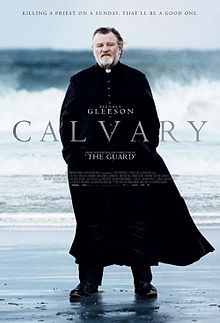
Calvary


     For quite a few months now, I have read reviews in Catholic magazines and on Catholic websites about the Irish production called Calvary. Quite a few friends urged me to watch it as well, and denoted it to be a Catholic classic. To be honest, it wasn't exactly on my top 10 list. Well, perhaps it was, but it was my top 10 worst list! Perhaps it is partially because of my old-fashioned sensibilities, but I found it to be terribly crass and graphic, with a meandering pace, a hard-to-follow story-line, and a fall-off-a-cliff ending. It has always been my firm belief that true art depends upon good taste, and this film, in my opinion, lacked it considerably.  

    I found it hard to understand the motives and behavior of the priest, and don't feel that what he did by staying in his parish and allowing himself to be shot was so heroic. Actually, I thought it was rather dumb, and he really should have gone for the police or gone on a little trip out of the county a long time ago! We are Catholics, not Quakers. We can claim the right to defend ourselves.  

     In Calvary, everyone in the village is depicted as being sinister and morally warped to a disturbing extent, which is a bit over the top and unrealistic. This is no doubt used to heighten the tension, but in the end, it comes off as being a movie-maker's ploy.  

    I mean, I can appreciate dark themes and characters, such as in The Hunger Games, but I personally felt this went over-the-top and was wanted a layered mood and diversity of characters. So...yeah. I thought it had a good premise, but fell a long, long way short of I Confess.


Friday, May 29, 2015

Battle of the Brave


Year:  2004

Filming:  Color

Length:  143 minutes

Genre:  Drama/History/Romance/War

Maturity:  PG-13 (for intense thematic elements, language, and some sexuality)

Cast:  Noemie Godin-Vigneau (Marie-Loup Carignan), David la Haye (Francois la Gardeur), Juliette Gosselin (France Carignan), Sebastian Huberdeau (Xavier Maillard), Bianca Gervais (Acoona), Gerard Depardieu (Fr. Thomas Blondeu), Tim Roth (William Pitt), Jason Isaacs (General James Wolfe), Michael Maloney (Governor James Murray), Philippe Dormoy (Voltaire)
         
Director:  Jean Beaudin

Personal Rating:  2 Stars

***

    One day, while fishing through the period piece section on NetFlix, I stumbled across Battle of the Brave. I sort of had a feeling it wasn't going to be good when I heard it was set during the French and Indian War (how could Hollywood keep from going on a splurge about evil Europeans and stuffy decorum?), but I wanted to see anyway. I’m not above being surprised by an unexpectedly good film. But my intuition proved more than correct this time, although I will admit I was surprised…by the blatant differences between the plot-line as outlined in the advertisements and how it played out in the actual production!    

    What story there is opens in Colonial French Canada, not long before the British conquest of Quebec in 1759. A young French nobleman named Francois la Gardeur has just returned from a trapping venture in the wilderness, a journey he had embarked upon to distance himself from his upper-class roots. Seeking out amour in Quebec, he rekindles an affair with a fellow nobleman’s wife, but at the same time finds himself bewitched by a beautiful and independent-minded young widow and single mother named Marie-Loup Carignan, who has learned to be a healer in the Native American tradition, and is accused of practicing dark magic.

    Meanwhile, sinister historical forces are at work. The French government in Canada is riddled through with corruption, and willing to let Quebec fall to the British to prevent an inquiry into their conduct. It is up to our wild-haired hero Francois to warn the French government about the plot, but the local authorities will stop at nothing to silence him. Throw Fr. Thomas Blondeau, a Catholic priest who is sort-of-good in that he wants to defend the poor from the desperation of a crumbling regime and the rapine of an ascending one, and yet is having sexual affairs and has this secret love for would-be witch-woman...and the whole thing degenerates into a confusing mess!

    Our noble messenger to the court of France sends a message to his lover, asking her to accompany him. But the priest, for motives that are a bit complex, mistranslated the message to keep her from going with him. This strikes off a chain reaction of unintended events…none of which are directly related to the war, nor the fact that Quebec falls to the British, without even enough production courtesy to show us the epic-ness of the Battle of the Plains of Abraham! Gah! But to summarize: “our hero” has a heart-to-heart chat with philosopher Voltaire, but fails to get an audience at the decadent court of France until after the British invasion is completed, and returns to discover that beloved witch-woman has gotten herself hitched to a his less-than-upstanding-former-friend-turned-British-lackey.

     But never fear…Gallic Lover Boy is here! Actually, cancel that…we should fear, because it doesn’t seem he has any definite plan, and one he tries to launch to rescue his lady-love from her abusive husband backfires miserably. Ultimately, deadbeat hubby has an unfortunate collision with an axe, but no one is sure who administered the fatal blow. Marie-Loup gets arrested and framed for her husband’s murder, which everyone is content to let lie since she is already a social outcast. At this point, the two main men in her life – Francois and Fr. Blondeau – try to “save her” in different ways. The former makes a vain attempt to plead mercy before the new British Governor James Murray, and the second tries to give her absolution for the murder, which she refuses. It will only be at the end of the old man’s life when the truth will be revealed and the mysterious case laid to rest with Mary-Loup.

     This film had some artistic pluses in the form of beautiful cinematography and a lush music score. It gave a good feel of the Colonial era of sprawling forests and Old World settlements, inhabited by a mix of different races struggling for survival and domination. The acting was fair enough, and the relationship between Mary-Loup and her little daughter France was touchingly rendered. Also, some of the romantic interplay between Francois and Mary-Loup was worth salvaging, even though their overall romance was pretty lame. David la Haye and Noemie Godin-Vigneau seemed to have good on-screen chemistry, and they have a talent for conveying emotions through facial expressions. And I will admit this much: the leading lady has amazingly bewitching eyes!

     But in spite of these perks, the story was a horrible miss-match of themes and plot threads that failed to coalesce into any definite vision. It is permeated with modern sentiment jet-lagged into a past time period, with Francois and Mary-Loup serving as symbolic of liberalism and modernity as opposed to the narrow-minded, old-fashioned, and corrupt characters that surround and ultimately destroy them. In this sense, the whole story takes on the visage of a morality play, even though the morals are foggy at best.

      It is not by accident that we see Francois “connect” with the ultimate liberal, Voltaire, after his repeated efforts to shake off his noble heritage which is portrayed as being corrupt overall. Needless to say, there certainly was corruption in the nobility, particularly among the French Colonial ruling class in Quebec. But portraying the upper classes as “all bad” just doesn’t do them justice. I would have liked to meet the Marquis de Montcalm, the epitome of a French gentleman, dedicated to honor, duty, and his country. So while we can sympathize with Francois’ issues to some extent, the movie fails to portray the pros-and-cons of the class system with balance.

    Likewise, we can certainly sympathize with the more open and curious ways of Mary-Loup, and her willingness to learn the ways of the Native Americans through her friendship with the Indian girl, Acoona. But trying to make almost everyone else around her into 2-dimnsional villains fails to appreciate their own perspectives, and the “comfortableness” these characters would have had holding these beliefs in their own time periods. Plus, Mary-Loup does seem to be a bit “loose in love”, so to speak, and has adapted some of the superstitious practices associated with witch-craft, so even a few eye-brows raise, it’s not a huge wonder. And of course, there has to be a priest struggling with his vow of celibacy, in a kind of creepy way…I mean, isn’t he old enough to be Mary-Loup’s father? Weird.

    Not only do the characters feel strangely out of place in their respective era, but Battle of the Brave doesn’t even live up to its own advertisement as a flick about French resistance fighters battling for “freedom.” Literally, on the cover there are three indicative words: “Rise. Unite. Fight.” But none of this ever comes about. There are no resistance fighters, and there is no battle! The war, which is supposed to be so central to the plot, is skipped through with nothing more than a shelling sequence, which kills a side character but does not influence the central plot. Instead, the story-line is totally hinged on the love affair, which reaches a dead-end and fails to support the movie with needed substance.

     On an historical note, we do get to make a brief foray made into the British establishment, whence we get to meet Tim Roth (infamous for his role as Archie-the-Villain in Rob Roy) as William Pitt (no! no!!!) and a totally-too-old, totally-too-deranged Jason Isaacs (infamous for his role as Tavington-the-Villain in The Patriot!) as General James Wolfe (Say what???!!!) who fails to do anything impressive but rant about wildly and mutter poetry with a weird gleam in his eye. These blatant miscasts can be accurately classified as nothing more than a generic British villains convention, to purposely purport a politically correct and historically incorrect depiction of The French and Indian War.

    As someone who has spent more than a few years studying Wolfe and pouring over his personal letters, I was particularly frustrated to death by this obtuse portrayal. I understand that the film may have been trying to paraphrase an incident in which Wolfe, slightly inebriated and out-of-character, is said to have bragged about what he would accomplish in America, and pounded his sword hilt on the table in front of Pitt. But the way it came off was that he was always behaving like a nut, and everything he did was viewed as off-beat by those around him, including poetic recitation. This fails to explain why the legend of Wolfe has been such an inspiration to fighting men for generations.

    Wolfe was certainly a very complex character, who could often be judgmental and sometimes quite brutal. He also might have seemed a bit “manic” every once in a while. But this is only one side of the coin. A reading of his letters and the testimony of contemporaries also show him to also have had many attractive qualities, and was not some chronic maniac. He was deeply philosophical, had a marvelously witty sense of humor, and a profound sense of duty to his country and the men under his command. His soldiers adored him, and found his eccentricities inspirational, including his love of quoting poetry. Furthermore, memorization of poetry was much more common in the 18th century than it is now, and wouldn’t have even been considered as outlandish as it might be today.

     The film also messed up the character of British governor James Murray, who is portrayed as being unscrupulous and willing to have Mary-Loup executed even though he has proof she is innocent of the murder of her husband. He doesn’t want to risk putting his job in danger by angering those who are stuck in the “dark ages” and opposed to modernistic Mary-Loup. First off, they got his accent wrong: He was Scottish, not English. Second, portraying him as a fall-back villain is character assassination, unless they have some sort of proof he actually behaved in this manner. Historically, the worse thing that can be said of him was that he was jealous of General Wolfe and gave him a hard time, but as governor of Quebec, he was known for being fairly compassionate to the plight of the inhabitants and proved himself to be an able and just administrator.

     Basically, the history buff and story-lover in me was deeply disappointed by this goofed-up attempt to bring The French and Indian War to life on screen. With a predominately French cast and crew, I knew the chances of them being fair to the British were slim. But they even missed out on giving the French their proper due by getting hung up in too many soap-opera-esque love affairs and an obscure moral tags about the blessings of modernity, and the ill-fated consequences of intolerance, which is viewed as the ultimate evil in our modern age. I’m certainly not advocating it, but I think there are other vices to be brought to the fore as well, some perhaps not so politically correct…like character assassination in big-budget historical butcheries!

    I’m afraid that I must make fanfare of tossing Battle of the Brave into the ceremonial fibrotic fire-pit with its kith and kin on the death-row shelf:  The Last of the Mohicans, Titanic, The Patriot, Braveheart, Rob Roy, etc.! Judging from this illustrious accumulation of painful productions, I’d say it’s about time to have a smores fest! If I’m sarcastically harping on this subject too much for my educated readership, please bare with me. I really must write about how messed up I feel Hollywood is getting with these historical "epics", for my own sanity, and perhaps to better the planet. Perhaps it will rouse the masses to demand better fare...or something! Every little voice helps.

Francois la Gardeur (David la Haye) rides with Mary-Loup Carignan ( Noemie Godin-Vigneau)

Monday, October 20, 2014

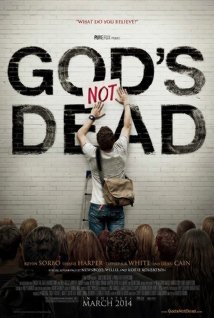
God's Not Dead

Year:  2014

Filming:  Color

Length:  113 minutes

Genre:  Christian/Drama/Inspirational

Maturity:  PG (for intense thematic elements)

Cast:  Shane Harper (Josh Wheaton), Kevin Sorbo (Professor Jeffrey Radisson), David A. R. White (Reverend Dave), Benjamin Ochieng (Reverend Jude), Trisha LaFache (Amy Ryan), Hadeel Sittu (Ayisha), Marco Khan (Misrab), Cory Oliver (Mina), Dean Cain (Mark), Paul Kwo (Martin)
         
Director:  Harold Cronk

Personal Rating:  1 Star

***

    I’ve been hearing advertisements for the new Christian independent production God’s Not Dead since it first came out this year. The title certainly caught my attention, and I had hopes that this might be a constructive that would make people think about the possibility that a Prime Mover does indeed exist. Perhaps it would move hearts towards the love of God, with gentleness and reasonability. Sadly, not only did the film fall short of these expectations, it actually set a perfect stage to turn non-Christians further away by contrived characture, constant proselytizing, and haughtiness totally contrary and detrimental to the Christian message.

    Our tale of woe begins with one Josh Wheaton, played by Shane Harper, a Christian college student who finds himself a very nasty mess indeed. His philosopher professor, Jeffrey Radission, is a rabid atheist who wishes to dispense with formalities by having all his students scribble “God is dead” on scraps of paper before the beginning of the course. Although all the other students do as they are told in order to avoid the time-consuming study of theism, Josh refuses to comply. In turn, his professor challenges him to prove to make his case that God’s not dead to the class. If they vote in favor of his argument, he will receive a positive grade. If not, he will be failed.

    Josh’s blonde and thoroughly annoying girlfriend tries to discourage him from taking up the challenge, playing the Eve role she was meant for, and threatening to leave him if he risks his grade on such a fool-hardy venture. But Josh remains undeterred and makes his case in a series of presentations before the class, making Radisson grow more and more obsessed with beating his student at his own game. He even goes so far as to seize him by the arm in the hall and threaten him (cheesily, of course) to destroy his chances of becoming a lawyer if he does not abandon his debate. As if there isn’t already enough going on to keep the viewers focused, we are jostled amidst a slew of awkwardly interlocking sub-plots.

    One of them involves a Muslim girl, Ayisha, who eventually is thrown out of the house by her traditionalist father for converting to Evangelical Christianity. Another subplot involves a liberal journalist, Amy, her struggle with cancer, and ignoble break-up with her big-bad-boy-friend, Mark (who is bigger and badder than we can credibly believe; I mean, even the meanest people I know would not respond to someone telling them about their cancer, “Couldn’t this wait?”). Yet another deviation involves Radisson’s girlfriend, Mina, who happens to be a sister of Mark (making the connection now?) and inner turmoil about staying with Radisson; and last but not least in ridiculousness, we are introduced to these two preacher guys with a busted car, supposedly introduced for comic relief purposes.

    To cut to the chase, Josh and Radisson eventually have a final show-down in the school room, and there is an attempted rehash of the conclusion of Twelve Angry Men, whereby it is revealed that Radisson really does believe there is a God, but he hates Him because his mother died when he was still a little boy. Needless to say, his students aren’t particularly impressed by this reasoning, and unanimously (quite a bit overdone on percentage, I would say) vote Josh to be the winner. But there is a final twist that allows us to meet the Christian Rock sensations “The News Boys” (all shouting and spinning lights on stage, making them anathema for someone who suffers vertigo!) and “The Duck Dynasty” (sorry, I’m with the liberal journalist on this one; how can they go through life with a clear conscious knowing they’ve killed all those innocent ducks?), and leaves Radisson flat on his back…er…literally?

    God’s Not Dead is an independent Christian film, and the genre pretty much has to be taken for what it is. And most of the time, it’s below sea level, if you take my meaning. Now, some are superior to others, but sadly the majority would be laughed out of town by a non-Christian audience for poor production quality and miserably preachy plots. Visually, this film was pretty average, with a certain desperation to be hip in setting. It lacked the innovative camera angles of October Baby, and was mediocre to the max. Acting ability was sketchy, with some moments revealing some ability, and the majority revealing nothing more than actors acting, which is exactly what actors should not look like they are doing!

    The initial plot premise was intriguing. There definitely are instances of atheistic heavy-handedness in our modern culture and the world of academia, and this story was supposedly loosely based off of a true one. Executed properly, this movie could have been portrayed as an exhilarating high stakes battle with full-bodied arguments on both side. There were a few scenes where Josh did make some impressive statements that do indeed prove helpful for Christian apologetics in showing that our faith is not irrational. But the tension and realism ultimately fell by the wayside for a number of reasons.

    The first one is the confusing style in which the plot was constructed. Instead of focusing exclusively on the debate between Josh and the Professor Radisson, the plot hops all over the place, and the characters connect far too late to make any sense out of it. The second truly unfortunate flaw in the movie is the underlying arrogance and triumphalism that will give non-Christian audiences a very shoddy picture of the essence of Christ’s teachings. The plot writers typify atheists as warped individual struggling with inner demons and personal tragedies that cause them to hate God. Christians, on the other hand, are shown as being consistently confident, somewhat obnoxiously straight-laced holy-rollers, who never seem to go through any personal doubts or dry spells in their spiritual life.

    Also, not enough quality time is spent with Josh to get to know him. What are his likes and dislikes, frustrations and heartaches, strengths and weaknesses? We don’t know. We don’t even get to follow his thought pattern as he pieces together the material for his debate, and are never allowed access to his true self at all. Not knowing him as a real person beyond his clean-cut, Christian cardboard image, it’s quite hard to feel for him. Besides, he doesn’t seem to go through much suffering at all. I mean, his girlfriend ditches him, but he doesn’t make much of a fuss over it, especially because it’s indicated she was pretty much of a shrew and didn’t really love him anyway.

    But there is something even more sinister at the root here: in the midst of all this intellectual debate, there is a noticeable lack of love in sharing the Christian message. Josh fails to show a visibly caring spirit towards his professor, even after it becomes evident that Radisson is suffering from various personal issues. Josh never even expressed his condolences for the death of his mother, whose loss propelled the professor down his atheistic path. The only real love shown to this guy in the film is revealed in a letter he finds from his late mother. But that’s it. Is it possible that we as the audience were never meant to feel compassion or kindness towards him at all?

    In contrast, there is a sense that we are supposed to want the professor to be run out of town on a rail, to beaten down and showed up in front of his class because he is the big-bad-atheist and therefore almost sub-human. We are also supposed to want him to be stripped of all earthly comforts, including his fiancée, who he actually does seem to genuinely love in spite of his selfishness. While I would be the first to agree that sometimes a person really most go through being emptied out before they can experience a spiritual awakening, all of that is in God’s hands. It’s not something that should be wished on anyone.

    The most shocking scene has to be at the end, when the professor is killed by an oncoming car as he tries to find his girlfriend who recently left him in a lurch. Lying in a rainy street, dying, the two itinerant preachers with the bum car get him to say The Sinner’s Prayer before he conks off. This is contrasted by the garish scene of all the Christians, including his ex-girlfriend, partying at the News Boys concert. Frankly, that is the one point in an otherwise extremely predictable film that I didn’t see coming. It was a mix of unexpectedly brutal and laughably hoaky, making the whole thing surreal and hard to swallow.

    What exactly are we supposed to take away from this? A sense of victory that “the bad guy” met a miserable, lonely fate only to be coerced into heaven at the last minute by “the good guys” so they can get another merit badge from God? The whole scene felt utterly repulsive, as it was so unnaturally enacted. If I ever came upon a man grievously injured, my first thought would be to try to do what I could to get him help and ease his pain, not proselytize him to death! If I thought he would die, I might ask if he were of any particular religion so that I could get the appropriate minister or pray with him, but I would not start rattling off Scripture verses in an attempt to shove my beliefs down his throat!

    Perhaps my main point is that the true sign of a Christian is the love that he/she shows for the people around him/her, as a natural flow of goodness and divine grace from one to another. It is not our mission to save as many people as we can just so we can make up a cute little list to present at the Pearly Gates. Also, it is extremely unfair to atheists and non-Christians of every stripe to paint them as monsters. Some atheists I am friends with are the kindest, most sensitive and considerate people I know. And this, I believe, is very much a proof of God and the soul made manifest through them, because they are indeed made in His Image and Likeness. Plus, to assume atheists secretly believe in God but hate Him is not always (although certainly can be) the case. There can be intellectually honest conclusions on both ends of the spectrum.

    The movie also makes a supposition that science speaks so clearly in favor of Christian perspective, that people who don’t embrace it are just plain dumb. This really is not the case. The fact is science cannot prove or disprove the existence of God, nor should it be able to. If there is an Omnipotent, Omnipresent Being, how on earth would we mere mortals be able to measure Him as a quantity with our scientific instruments? Let’s get real! But by presenting the case as if there is anything more than indirect indication for the existence of God, Christian apologists are bound to get a walloping. Josh himself does say this in the early stages of the debate, but by the end, it is extremely watered down. 

    So my case in point: God’s Not Dead was a good idea, but received a bad treatment. Actually, a worse than bad treatment; with a touchy subject like this one, harm is the only thing that could come from some of the blatantly un-Christian attitudes and ideas laced through the movie. To put it bluntly and definitively, it is one of the worst “Christian” films I’ve ever watched. Now it’s our job as living, breathing Christians to do damage control, and act like normal human beings instead of proselytizing robots. The very best way to evangelize is through example; it’s all about relationships, not shiny stickers we are trying to earn. We should want to help people, physically and spiritually, because we care about them. It should come naturally, and never be forced.


Josh Wheaton (Shane Harper) faces down Professor Jeffrey Radisson  (Kevin Sorbo)


Thursday, May 8, 2014

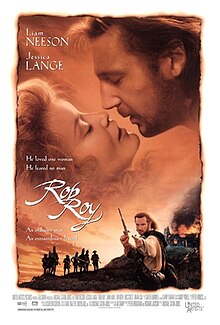
Rob Roy

Rob roy poster.jpg

Year:  1995

Filming:  Color

Length:  139 minutes

Genre:  Action/Adventure/Biography/Drama/Swashbuckler

Maturity:  R (for violence, sexuality, and language)

Cast:  Liam Neeson (Rob Roy MacGregor), Jessica Lange (Mary MacGregor), Tim Roth (Archibald Cunningham), John Hurt (Marquis of Montrose), Andrew Keir (Earl of Argyll), Brian McCardie (Alasdair MacGregor), Brian Cox (Killearn), Eric Stoltz (Alan MacDonald)

Director: Michael Caton-Jones

Personal Rating:  1 Star

***

    Trash. Pure, unadulterated trash. That’s the general description for most of this big-budget, sex-saturated action flick set in the rugged Scottish Highlands. Instead of getting an accurate portrayal the early 18th century social and political strata, or even a decent romanticized adaptation of the legend of Rob Roy, we get sensationalist filth, visually and verbally, combined with creepy characters and a confusing plot-line.

    The film opens in 1713, on the First Jacobite Rebellion, even though this historical event is skimmed over entirely. The first time we meet our anti-hero, Rob Roy MacGregor, starring Liam Neeson, he is brutally stabbing a cattle thief for the Marquis of Montrose. The next time we see him he is lacking the proper garmentry of civilized society and going for the plunge in the lake, followed up by his hopping into bed thusly with his wife, Mary, who says, pleasantly, she’s just been dreaming about being “ravaged” by a silkie….yeah, delightful couple.

    But if they’re weird, there’s worse to come. Enter the Marquis of Montrose himself, a noble sneaky rat, along with the ever-detestable Archibald Cunningham. “Archie”, as he is fondly called, is a perverted, sadistic, narcissistic, and very well dressed English dandy who also has quite a way with the sword. And he’s quite short, too, but the little creep tops everyone in the area of disgusting vulgarity in word and deed. We also get to meet the Duke of Argyll, who is at odds with Montrose and in danger of being framed as a Jacobite.  

    Cut to Rob deciding he doesn’t want to be a bounty hunter anymore and making a decision to borrow money from Montrose to buy his own heard of cattle. Montrose, ever the gentleman, agrees and then rigs a plot whereby Archie will kill Alan MacDonald, the clansmen carrying the cash back to Rob, steal it back for the Marquis, and then make it look like MacDonald has skipped town and took a ship to America with the money. It works beautifully.

    Now Montrose springs the second part of his trap, and demands that Rob Roy testify against the Duke of Argyll and say that he is a Jacobite. If he does not, the Marquis continues, he will hold the loss of the money against him and his clan. Why a commoner’s testimony against a nobleman would make or break anything is a bit of a mystery, but Rob finally starts revealing his noble side and refuses to do so. After briefly holding Archie hostage so the Marquis can’t set the guards on him, he and the men of the clan take to the hills.

    Archie-the-Evil is sent to get Rob with his redcoated troops. But since Rob is long gone, he decides to take the liberty of burning his home, slaughtering his livestock, and even defiling his wife. Rob’s brother, Alasdair, finds out what happened, but Mary swears the lad to secrecy. She even stabs Killearn, a hireling of Montrose, when he threatens to tell on her. Nevertheless, the news gets out when Alasdair is mortally wounded, and he confides to Rob the true story. Rob, as predicted, goes bats and attacks troopers on horseback.

    Also as predicted, he is captured, and Cunningham prepares to hang Rob over a bridge. But our anti-hero manages to flip himself backwards and almost strangle his captor with the rope before falling into the river and tumbling over a waterfall. Yes, he survives. No, we don’t know how. Professional secret. Anyway, he gets home and finds out that Mary is pregnant, presumably with Archie’s child. But to his credit, Rob takes it on the chin and says that he will be a father to the baby and they’ll start with a clean slate.

    Now his main goal is annihilate Archie via a public duel. The only problem is, as we have mentioned, Archie is a pretty good little fencer. The Duke of Argyll, who has finally found out that Rob refused to perjure him, promises to take care of the Highlander’s debts, but doesn’t hold out much hope for him in this upcoming fight. And his instinct proves to be basically correct, since Rob gets trounced by Cunningham, and our villain doesn’t even play dirty!

    No, Archie wins fair and square…but Rob is somehow able to cheat fate by prying his opponent’s blade away from his throat (why don’t more people manage that in the movies?) and skewering him then and there. No one really mourns the late rat, including Rob who hurries home to enjoy a well-deserved smooch with Mary in a sun-drenched field. But I must admit that a slight sigh escaped me at having to watch Archie’s nice duds get impaled along with him. Ah, the fortunes of Hollywood costuming.

    More than almost any film I’ve viewed, Rob Roy is a shiny apple that’s rotten on the inside. There are impressive scenery shots, elegant costuming, and a traditional music score by Capercallie. There is also some interesting cinematic artistry exercised, especially in the scene which flashes back-and-forth between Archie chasing MacDonald on horseback and the celebration being held nearby where pulse-pounding reels are being played. Immediately after, the Gaelic lament “Allein Duinn” is sung at the celebration (even though it was written over 60 years after the events depicted) at the same time as Cunningham is stabbing MacDonald in the woods. Another nice sequence involves Archie, decked out his military splendor, leading his red-coated columns out to capture Rob Roy, accompanied by the tune “O’Sullivan’s March.”

    But the picture reaches new lows in the area of unnecessary vulgarity and brutality, earning its R rating to the hilt, and doesn’t have a deep enough plot to bring any substantial meaning out of the mess. It’s as if the script writer were trying to beat some sort of record with regards to how much sexual slang and how many stabbings could be stuffed into a 2 hour production. There was really no way of getting around it easily, even though I did use the fast-forward button repeatedly.

    The characters’ general comportment, unfortunately, match their choice of linguistics. Rob and Mary MacGregor may be married, but there evident obsession with each other as lovers is a cheap substitute for deeper emotions rarely brought out in this film. I’m heartily sick of those two making out (and I mean way out) almost every time they make an appearance together on screen. I mean, come on, do we really need to see this? Don’t they have any other hobbies as a couple fit for public exhibition? Can’t they just enjoy a walk in the woods or a picnic by the lake without having to send the kiddies away and bring sex into the equation?

    It’s devoutly to be hoped that most normal married people have more that binds them than a fiery sex-life. But the movie spends much more time on that than anything. Two particularly awkward examples are when Mary reaches under her husband’s kilt (accompanied by some vulgar verbiage) and later, when she’s angry at Rob for having to head for the hills, she shouts like an uncouth bar-maid “Find a sheep to comfort yourself!” Yes, it is disgusting and unwomanly and plain mean to say such a thing, especially to one’s husband.

    There are no real religious references to speak of, and in the midst of all the turmoil, no one is heard to call out to God for aid. Even the vaguest hint of spirituality is deadened by the oppressive attitude of usury that pervades the film. None of the main characters, heroes, villains, or undefined, stand out as being particularly upstanding or moral. Both Rob and Mary brutally murder people with knives, and no one shows mercy or forgiveness to those who have wronged them. Instead, they will not rest until their vengeance is satisfied.

    What virtues they have consist of a more natural as opposed to supernatural variant. Most notably, Rob refuses to perjure because he prizes his reputation as a man of his word. In spite of her initial resistance to the this stance (resulting in the sheep comment), Mary does come to see that if Rob perjured the Duke of Argyll, he would no longer be himself, and if he were no longer himself, he would not longer be her Rob. With regards to Rob’s view on the meaning of honor, he tells his young sons that it is not a thing that men get, but that grows within them. When they ask him if women can have honor too, he replies that they are the heart of honor, and gives his wife a glowing smile.

    For her part, Mary doesn’t want Rob to find out she has been raped so he won’t act rashly and put himself in danger, going so far as to murder a would-be informant later on. When the secret finally gets out, Mary mentions the possibility of aborting the baby that may be Cunningham’s, but Rob makes clear that the baby isn’t the one who deserves to die and accepts his wife’s child as his own, saying, “If it’s a boy, name him Robert, and if it’s a lass, name her after my own dear Mary.” This is touching and a good pro-life message. But then it really is the least he could do under the circumstances.

    Needless to say, Archie is like the devil incarnate (or conversely the antithesis of Sir Percy Blackney from The Scarlet Pimpernel), and the screenplay writers take every precaution to make sure we know it. Of course, we should have known it to begin with since, just like his villainous confederates Col. Tavington from The Patriot and Capt. Hayward from The Last of the Mohicans, he has a proper English accent and dresses well. Really well, actually. I must confess that I paused several film clips just to marvel at his magnificent 18th century attire. But for some inexplicable reason, modern heroes, or rugged anti-heroes, or what have you, are expected to be talk in a rustic dialect and be slovenly dressers.

    Exactly what people are supposed to take away from this cultural preference mystifies me. Yes, we all know that good clothing and clipped accents don’t make a good man, if that’s what they are trying to get across. But good clothing and clipped accents doesn’t make a bad man either! Furthermore, while such outfits and old-fashioned ceremonial customs may seem stupid and foppish for many today, back then, it was quite normal and not at all sinister for noblemen to behave like noblemen.

    So to conclude another one of my long-winded rants about the Hollywood-ization of the British culture and class system: why, why, why must they all be portrayed evil mass murderers, or pompous, self-consumed fops, or both? Sure, there were rats in the upper classes. And rats in the lower classes. And decent human beings, and even saints, that came out of both as well! Why, why, why can’t these populist, modernist, mega-million dollar producers get it through their thick skulls and give us some more diversity than “evil nobleman vs. gallant peasants” or in every single big-budget period piece???

    Historical accuracy, regarding what we know about the real or even legendary Rob Roy, is generally lost in translation. The stolen money saga that set Rob on his career as an outlaw (a career that was almost totally overlooked in the film) was actually perpetrated by either one of Rob’s men or the big man himself, not the Earl of Montrose. While there is a legend that his wife had been defiled by Killearn, another hireling of Montrose (not Archie, since Archie never existed!), the fact that Rob Roy later captured him and treated him with great kindness tends to put paid to that theory, unless of course the real Rob was much more forgiving than the movie version of himself.

    The plot itself suffered on any number of plains. For one thing, why does Montrose have to go through such an elaborate plot, involving murder and cover-up, just to retrieve the 1000 pounds from Rob Roy? Why not simply withhold the cash and bribe him to testify against the Duke of Argyll to begin with? And why would Rob’s testimony that Argyll was a Jacobite mean so much to the court anyway? Rob himself admits he was a former cattle thief, and it’s not specified if he has any particular connection with the nobility other than being a hireling of Montrose.
   
    The rest of the plot follows the same disjointed path that completely skips over the many Robin-Hood-like adventures the legendary Rob Roy is said to have had. All these thrills culminate in the most boring and contrived duel scenes in cinema history. The only reason he manages to kill Archie seems to be orchestrated by producer intervention since, villain or no, the shrimpy nobleman has him beat and has every right in the book of fair play to make a kabob out of him! Images of the blatantly set-up final fight between Mel Gibson and Col. Tavington in The Patriot come to mind here…..but that’s another story.

    Overall, Rob Roy was not just a let down for me as a history buff, but also a disturbing experience for me as a Christian. To me, a movie is a work of art when it knows what to show and what to indicate. Good taste is virtually nonexistent in this film, whether it had to do with sexual intercourse or death by the sword or using the chamber pot. It is disgusting and degrading, and I would never recommend it to anyone, child or adult, or ever watch it again myself. It lacked the virtues of faith, hope, and charity in major ways, and supplanted true love with physical passion, accuracy with sensationalism, and a good story with a catastrophic contrivance. 
Rugged Rob Roy (Liam Neeson) holds foppish Archibald Cunningham (Tim Roth) hostage