Search This Blog

Saturday, March 28, 2015

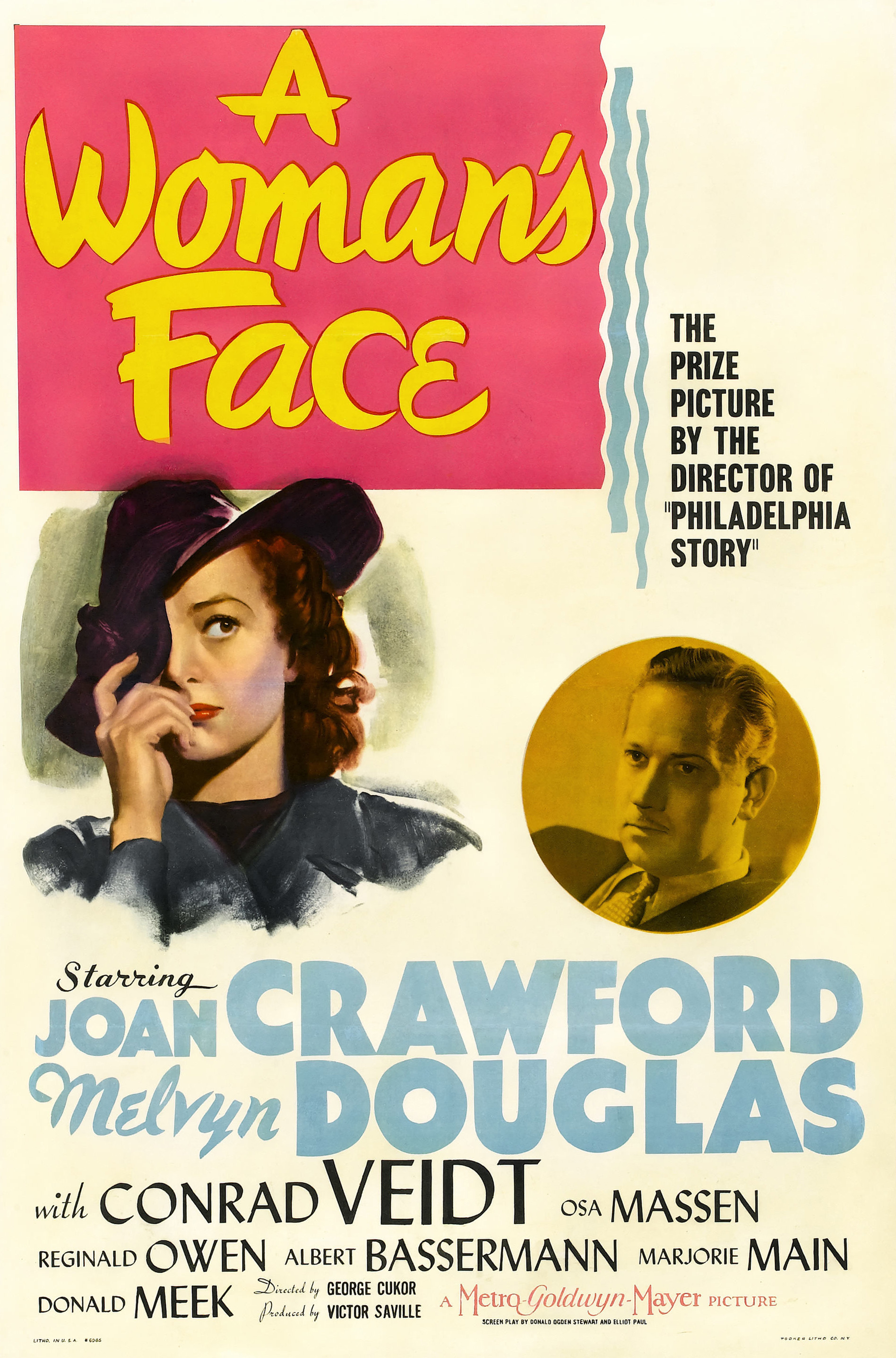
A Woman's Face


Year:  1941

Filming:  Color
Length:  105 minutes

Genre:  Drama/Noir/Suspense

Maturity:  PG (for intense thematic elements)

Cast:  Joan Crawford (Anna Holm), Melvyn Douglas (Dr. Gustaf Segert), Conrad Veidt (Torsten Barring), Osa Massen (Vera Segert), Richard Nicholas (Lars-Erik Barring), Connie Gilchrist (Christina Dalvik), Reginald Owen (Bernard Dalvik), Albert Bassermann (Consul Magnus Barring), Marjorie Main (Emma Kristiansdotter),

Director:  George Cukor

Personal Rating4 Stars

***

   Certain movies come to you by complete surprise, and are surprisingly well worth the viewing. In the case of this film noir diamond-in-the-rough, it just so happened to be among at the end of a VHS that was included in a bargain-bin at a yardsale. When I first started watching it, just to see what it was, I was none too impressed. The scenes were dreary, and the story-line seemed quite hard to follow. But as I stuck with it, I became immersed in this edge-of-your-seat thriller that feels near Hitchcockian in mood.

   Set in 1940’s Sweden, Joan Crawford stars as Anna Holm, a woman with a scarred face and a scarred heart, running away from her torrid past at the same time as she lashes back at the world for all her past sufferings. Operating a black-mail ring and using a restaurant chain as a front, she is given a packet of clandestine love letters stolen from the vain and frivolous Vera Segert, who frequents one of the restaurants. Torsten Barring, the mysterious stranger who stole the letters, wants to become partners with Anna, who he admires for her cunning criminal mind in spite of her disfigured face.

     Anna is unaccustomed to the attentions paid to her by Barring, and soon falls head over heels in love. Her low-life cohorts mock her out and threaten mutiny, but she assures them that the letters from Vera will enable them to blackmail her and make a profitable sum. But when she goes to the home of Mrs. Segert to extort money from her in exchange for the letters, she accidently runs into her husband, Dr. Gustaf Segert, a respected surgeon who sees Anna’s face and believes he can restore it. Realizing this might be her only chance for regaining her former beauty, she agrees to undergo the experimental procedure, even though it is known to be dangerous.

     Over the course of multiple agonizing procedures, Segert is intrigued by Anna’s elusive personality, and comes to admire her determination and strength in comparison with his shallow, unfaithful wife. However, he still senses that there is something about Anna that is dangerous, and even after the operation is a success and her face is restored, he questions whether the beauty of her soul can be restored so easily. Still, after she leaves, he has hope that no matter what her past might have been, she will use her new-found beauty to make a fresh start for herself in the world.

    But still desperate to secure the love of Torsten Barring, Anna becomes enmeshed in a plot to murder his young nephew, Lars-Erik, so he will inherit his uncle’s vast estate in the mountains. Although initially hesitant, she eventually agrees and applies for a job as governess for Lars-Erik. But as she gets to know Torsten’s affable uncle, Consul Magnus Barring, and the adorable little Lars-Erik, she begins to feel like a human being again, and her own icy heart begins to thaw. Will she have the courage to break with her dark past and forge a brighter future, or will she be defined by the scars that once disfigured her face?

    A Woman’s Face is one of those obscure, unusual little movies that turns out having profound examinations of the human condition. It stands out in the film noir genre as having a “method to its madness”, so to speak, and cutting to heart of the true meaning of beauty and love. Although the first scene opens in a courtroom where Anna is being tried for murder, the rest of the story is told through flash-backs based on the testimony of the witnesses. I initially found this technique rather confusing, but after a while, I began to appreciate it, and even found it particularly gripping.

    As fits the mood, it was shot in black-and-white and emphasizes the play between light and shadow, just like Anna’s own struggle between. We only catch several direct glimpses of Anna’s scarred face, because she wears her hat low, and this adds to the mystery as to whether or not she has been made “beautiful” when she is in the court room. The first time we see it is when Barring approaches her with the clandestine letters, and hides his shock by pretending he merely saw that she had something in her eye. It is this gesture that makes Anna feel accepted by a man at along last, and enables Torsten to manipulate her for his own ends.

    The cast is superb, and does an excellent job acting out the diverse roles. I have never been a major fan of Joan Crawford, and yet she really does shine in this film and show her talent for portraying a woman crossed between malicious intent and an almost pathetic desire to return to innocence. Melvyn Douglas is a very steady, very logical Dr. Gustav Segert, who comes to realize that for all his medical expertise and ability to heal the scars on Anna’s face, he is woefully unable restore the beauty of her soul. Still, he is there when she needs him, and stands up in her defense at the trial. Conrad Veidt makes a deliciously elegant, chillingly slithery Torsten Barring, who reveals the full extent of his evil nature a little at a time.

    As much as I feel for Dr. Segert’s marital woes, as I Catholic, I don’t believe that necessarily validates him having an extramarital romance. Now, I’ll grant that his wife is cheating on him, and is totally self-consumed, so he might have grounds for annulment there. But still, I don’t know if just jumping from woman to woman is the right way to handle the situation! That having been said, he sees something beautiful in Anna that enables her to break the dark bonds that have ensnared her, and she is finally able to accept and receive true love. It’s interesting to note that Anna made a study of famous love letters throughout history, from the likes of John Keats, even in the darkest periods of her life.
  
    I love the Swedish setting! It’s so unusual, and dark, and almost mythic. I enjoyed seeing how the Swedish court proceedings unfolded, and the unique customs such as taking an oath before testifying “as a son/daughter of a Christian”. But one thing strikes me as being rather strange: how is that this film is made (and seemingly set) in 1941 Scandinavia, and yet there is no mention of the Second World War? I mean, I know Sweden was neutral, but I’m sure it had to be permeating the news! But then again, perhaps the heart of the movie really was about the war after all, and Torsten Barring was just another form of Adolf Hitler. His declaration that some people are entitled to be evil and to conquer is the thing that finally shakes Anna out of her infatuation with him. At any rate, drawing the parallel is certainly a valid one.

    Lars-Erik is actually the key character in the movie, whose innocence strikes a chord deep within Anna that pulls her out of the darkness and into the light. Although she has been accustomed to being treated as sub-human because of her scarred face, and thought she had to be a she-wolf in order to survive, his unconditional love for and trust in her awakens her stifled conscious and the realization that she can be good. It is symbolic that at a party she is dressed as a local Swedish saint who is patroness of children. Barring mocks her for this, and she assures him she is not completely on the side of the saints. And yet the chance for it has been opened, and she can bear to turn her back on it completely.

    The turning point in the movie takes place on the ski lift in which Anna is riding with Lars-Erik. According to Barring’s plan, she is supposed to unlock the gate and let the lad fall to his death. Although she starts to do so (and the close-up shots seem like something straight out of an Alfred Hitchcock production), she realizes that she cannot, and pulls him back to safety. When Torsten realizes she will not follow through with his plan, he kidnaps young Lars-Erik and takes off with him on a sleigh. Anna realizes his devious intent and alerts Dr. Segert, who also happens to be visiting Consul Magnus. Then the two of them set off on a break-neck chase to rescue the child…and the unexpected series of events that lead Anna to be accused for murder before the court unfold.

    A Woman’s Face is a suitably dark yet beautifully deep film noir drama about the powerful reality that ever person has the chance to be redeemed and start anew, no matter their checkered past. It also shows that beauty is something that comes from within, and defines the essence of the person, as opposed to mere physical traits. Couple this meaningful moral with artfully rendered suspense, exquisite performances, and a break-neck sleigh race in the Swedish mountains, and you’ve got a film not to be missed!
Torsten Barring (Conrad Veidt) bewitches Anna Holm (Joan Crawford


Tuesday, March 10, 2015

Tangled


Year:  2010
Filming:  Color

Length:  100 minutes

Genre:  Animation/Fantasy/Family

Maturity:  PG (for mild fantasy violence and brief rude humor)

Cast:  Mandy Moore (Rapunzel), Zachary Levi (Flynn Rider), Donna Murphy (Mother Gothel), Ron Perlman (Stabbington Brother), M.C. Gainey (Captain of the Guard), Jeffrey Tambor (Big Nose Thug), Brad Garrett (Hook Hand Thug), Paul F. Tompkins (Short Thug), Richard Kiel (Vlad), Delaney Rose Stein (Young Rapunzel)
         
Directors:  Nathan Greno and Byron Howard

Personal Rating:  4 Stars

***

     For a long while, people urged towards watching some recently-released 3D animated flicks. I was generally hesitant, as I tend towards the simpler artistic style of a previous generation and am wary of excessive CGI. Nevertheless, when I watched the beginning of Tangled over at a friend’s house, this fanciful new take on the story of Rapunzel brought a smile to my face, and I decided I really should take her advice and order it from the library to see what happened after our heroine knocks the outlaw in the head with a frying pan!

     Our story begins with a flower, a very special, magical flower that has the power to heal illnesses and unlock the secret to eternal youth. An old woman named Mother Gothel hordes the flower in order to make herself young and beautiful ever and anon. But when the queen of the kingdom becomes deathly ill, soldiers are sent to track down the flower to heal her. When they finally locate it, she drinks the liquefied golden petals and is restored to health. Later, her baby daughter winds up having hair as gold as the flower…and with the same healing and rejuvenating properties!

    But Mother Gothel isn’t about to take the loss of the flower lightly, and she kidnaps the baby princess, realizing that by fondling her hair and singing the same song she used to sing to the flower (as the narrator observes, creepy, right?), she is able to restore her youth and beauty just as well. She keeps the child in a high tower so no one will find her, and raises the little princess as her own. She is named Rapunzel, and grows up to be an artistic and spirited teen, turning her tower into a place of light and creativity. However, she still yearns for contact with the outside world, which her “mother” always denies her.

    However, Rapunzel gets her chance to sneak away when an unsuspecting, rather cute outlaw named Flynn Rider climbs into her tower for sanctuary after stealing the royal crown! She convinces him to be her guide so she can go see the floating lanterns that are released every year on the long-lost princess’s birthday. Of course, Rapunzel is unaware that she is in fact said princess, and she just wants to enjoy the experience and soak in the beauty. So Flynn, a good-at-heart sort of guy who also has just been hit in the head by a frying pan, agrees that he will take Rapunzel out on the adventure of a lifetime, and she in return will keep his bag of treasure safe for him.

    Along the way, they encounter a variety of obstacles, including a gallant mount that seems bent on trying to sabotage Flynn, soldiers of the king bent on trying to capture Flynn, and Mother Gothel, who has now realized Rapunzel has escaped and is determined to get her and her magical hair back to the tower. At the same time, Rapunzel transforms Flynn and inspires him to give on himself and reform his roguish behavior.
But as they begin to fall in love, secrets of the past and misconceptions of the present threaten to tear them apart. Will Rapunzel have the courage to liberate herself from past bonds and embrace a whole new world?

    Tangled is an artistic delight, combining the best of both worlds with regards to traditional flat-screen animation and new digitalized 3-D animation. The floating lanterns scene is particularly dazzling with regards to multi-dimensional effect, song choice, and general romantic feel. Everything from facial expressions to flowing hair looked incredibly realistic. The animators and technicians managed to capture not just accurate form but also movement, not a mean feat whatsoever. They also managed to capture the flavor of past time periods, and integrate them into a modern expression. Occasionally I wish the slang was curtailed to keep with an older mood, but I can take it in stride. As a note, I noticed that the costuming used for the guards looks like a combination of Ancient Roman Legionaries, the Vatican Swiss Guards, and British Infantry from the Napoleonic Wars!

    Rapunzel is a charming leading lady with spunk, ingenuity, and quite a bit of courage. While she loves her smothering “mother”, she cannot bear to remain shut up in her tower forever, and must allow her spirited nature more room to move. Like the Lady of Shallot, the final break with the past comes with the arrival of a man, who finally gives her the chance she’s been waiting for to broaden her horizons. It was great the way Tangled had Rapunzel’s golden, healing hair is tied in with the golden flower with healing powers that was given her ailing mother when she was enduring a difficult pregnancy. This explains why Mother Gothel kidnaps our heroine to begin with, and allows her hair to grow so long. This creative explanation in Tangled gives it one up on Frozen, which basically gave explanation for the incredible princess-powers that generate the plot.

    Honestly, I feel rather sorry for Mother Gothel. She’s self-consumed and can be pretty ruthless when pushed to desperation. She tries to hoard the magic flower and keep it all to herself when other people are in need. If she had been willing to share it to begin with, perhaps she wouldn’t have to go through so much work to keep it later on. Plus her kidnapping a baby princess for her magic hair in order to be forever young is pretty parasitic, to say the least! I have to wonder why she wants to be forever young in the first place...does she have any boy-friend prospects, or anything?

     And yet, I’m afraid it is her character that makes me have one major reservation about the movie. For all her faults, Mother Gothel is not your typical Disney witch. She’s much more human than that. We can’t despise her outright. While her motives may have started out quite base, she did raise Rapunzel as her own, and was the only mother the little girl ever knew. There is a scene in which Rapunzel asks Gothel to go get her some special shell paint for her birthday. Gothel had just freaked out at Rapunzel when she asked to leave the tower and go see the lanterns, and now she feels guilty. Hence, even though it will mean a long journey, she agrees to go as requested.

    The point I’m trying to make is that deep down inside, I believe that in spite of her manic desire for eternal youth she has come to love Rapunzel, as much as she is capable of loving anyone, and Rapunzel has come to love her as well. I suppose I didn’t like the assumption projected in the film that just because Gothel wasn’t her “real” mother the bond could somehow be instantaneously dissolved with no further ado. As I’ve expressed in the past, the concept of family as much as friendship depends more on emotional attachment as opposed to bloodlines.

    To make the whole situation more intense, Mother Gothel dies a terrible death, falling out of the tower window after being tripped by Paschal the chameleon, ostensibly one of the good guys! Rapunzel doesn’t seem lastingly disturbed by this. Granted, Gothel did stab Flynn a few minutes earlier, but all of these complex relationships should have put Rapunzel in therapy by now! I mean, this woman who has been the only mother you’ve ever known dies horribly in front of your eyes, and how is the restoration of Flynn supposed to make up for that and give the finale an oh-too-happy feel?

    I would have liked it so much better if Gothel had actually had a conversion experience, realizing that the most important thing is relationships, not physical beauty. Otherwise, she could have just disappeared into the forest or something, and spared us all from some of the traumatic connotations! I’m totally in favor of Rapunzel getting away from her, since has shown herself to be a possessive spirit and toxic character, but does it all have to end so gruesomely? Especially for a kiddie flick?

    Of course, there is a redeeming aspect to all this, since Flynn sacrificially cuts off Rapunzel’s magic hair that could have healed him after being stabbed. Like in Beauty and the Beast, the protagonist dies, but is restored to life through the tears of his lady love. The only loss here…I miss Rapunzel’s cool, glowing, song-reactive, healing, youth restoring, golden flower hair! :-(

    But beyond all these rather intense aspects, there is some genuinely humorous content, mostly revolving around the irrepressible Flynn and his less-than-amicable horse who is “out to get him”! Also, we get to stop by “The Snuggly Duckling Inn”, un-aptly named thug-land extraordinaire! Even though some of the action sequences are over-extended and over-the-top, the mix between excitement and character development is pretty good. Plus, Flynn’s narration is genuinely hilarious, and helps draw the viewer into the story as one of his confederates. I’m thinking here of the method used in Sir Laurence Olivier’s outstanding production of Richard III…only this is the fun version!

    Needless, to say, the “Prince Charming” bit just doesn’t enter the equation here! Not that I mind in this case (Flynn, for the most part, rocks!), although I do like my fair share of  genuinely noble nobleman too, and sometimes think there is a modern conspiracy afoot to constantly belittle the landed and make them horrendously unheroic. Nevertheless, it should be noted that Rapunzel is a royal, as are her parents (whose characters are scarcely explored at all, but still they seem like good-guys). Hence, there isn’t a complete bias towards the lower classes…;-)

     So my generally feeling towards Disney’s reboot of the Rapunzel story is mostly positive, with a few reservations, mostly involving Mother Gothel.  The artistic quality alone is impressive, and the plot holds together much better than some other Disney princess stories such as the botched-up Brave and to a lesser extent the frazzled Frozen. Some believe that Tangled may in fact have ushered a neo-Renaissance for Disney studios. Whether or not the productions live up to this hoped-for generational trend is yet to be ascertained, but Tangled at least will continue to be enjoyed as a classic for years to come, entertaining, thrilling, and teaching lessons about spiritual freedom and sacrificial love.
Flynn Rider (Zachary Levi) and Rapunzel (Mandy Moore) fall in love