Search This Blog

Showing posts with label Biblical. Show all posts

Monday, May 25, 2015

Noah

Year:  2014

Filming:  Color

Length: 137 minutes
Genre:  Action/Biblical/Disaster/Drama

Maturity:  PG-13 (for intense thematic elements and some sexual innuendos)

Cast:  Russell Crowe (Noah), Jennifer Connolly (Naameh), Ray Winstone (Tubal-Caine), Anthony Hopkins (Methuselah), Emma Watson (Ila), Logan Lerman (Ham), Douglas Booth (Shem), Leo McHugh Carroll (Japheth), Madison Davenport (Na’el), Nick Nolte (Samyaza), Mark Margolis (Magog), Adam Griffith (Adam), Ariane Rinehart (Eve)

Director:  Darren Aronofsky

Personal Rating:  2 Stars

***

   
    Where do I begin in my analysis of this newbie Biblical blockbuster, which has elicited ecstatic adulation and equally fervent cat-calls of disdain? Well, I suppose as good a place as any would be the rock monsters helping build the ark. Of course, the Cockney stow-away wouldn’t be a bad beginning either. Or perhaps we could talk about the narcotic berry juice and Noah’s fire-throwing machine. And then there is the Geiko car insurance salesman Serpent in the Garden of Eden. We’ll cover all of the above, and some.

    The story opens somewhere at the dawn of human history, after the fall from grace in the Garden of Eden. The descendents of Seth continue to keep their covenant with the Creator and maintain their role as stewards of Creation as veggie-loving gatherers, while the descendents of Caine have become blood-thirsty meat-eaters. After young Noah’s father is murdered by said-carnivorous-types, it is believed that all the descendents of Seth are officially kaput. But the lad eats his greens and grows up, turning into a prehistoric version of Russell Crowe and getting hitched to the long-suffering Naameh, played by Jennifer Connolly.

       Together they have three sons, Shem, Ham, and Japheth, and adopt a daughter named Ila, who was wounded by marauders as a child and is believed to be unable to conceive. Nevertheless, as the children grow into young adults, Shem and Ila fall in love, and it seems that they intend to get married even if they will be unable to have children of their own. All this is fine and dandy, until Noah begins having strange prophetic dreams about a great flood which will destroy the earth. In order to be further enlightened as to why he is having these dreams and what he should do about them, he decides to seek out his grandfather, the ancient Methuselah played by an equally ancient Anthony Hopkins.

     Along the way, he and his family encounter some rock monsters (no, I’m serious, let say it again…) rock monsters who apparently used to be angels called “Watchers”, until they tried to help Man after the fall in the Garden of Eden. This for some inexplicable reason they angered the Creator and were transformed into talkative craters who now have a chance to redeem themselves by helping Noah and his family…somehow! Still following this…? Good!

      Anyway, Methuselah gives Noah some narcotic berry juice, which causes him to have a few psychedelic visions to help interpret his dreams (although the possibility of it just causing more confusion is high…like high!). Nevertheless, he comes to conclusion that the world of men is indeed about to be punished, and that he is supposed to build an ark in order to save the animal life of the planet, which had done no wrong since the Fall. He also figures that he will be giving humanity a new start as well, with his family to start all over again. Fortuitously, the rock monsters are ready and willing to be of assistance in building the ark as Noah oversees preparations for the future 40-day-cruise. But there is trouble in paradise.

     For one thing, Noah starts getting progressively anti-human, because of all the corruption he sees in the camp of Caine’s descendents. He even magnifies the flaws of his family, and finally decides that the Creator really wants for all of humanity to die out in this flood after all, and leave only the animals the keep the balance of the great circle of life. Of course, this decision on the part of the patriarch is a tad traumatic for the rest of the family, who he agrees should be able to survive, but only because Ila is barren and therefore unable to continue reproducing the species. Ham, is forced to leave behind his new-found girl-friend when the flood waters start to rise, takes all this rather to heart.

    However, Naameh teams up with Methuselah and they cook up something of a cure of Ila so she will be able to conceive, enabling the human race to continue. Just before the waters start rising, Ila and Shem have a fling in the woods, and she becomes pregnant. But there are more pressing concerns, as the Cockney-accented Tubal-Caine, one of the chiefs of the evil meat-eaters, leads his hoards to destroy the ark. But never fear…rock monsters are here! And after a massive CGI-packed space-opera-battle, Noah and family manage to barricade themselves into the ark with their ga-zillion animal companions.

     But the ocean voyage gets rocky when Noah discovers that Ila is pregnant, and is fit to be tied. He is, at this point, totally convinced that it is the Creator’s will to wipe out humanity, and this throws a bit of a wrench into the system. So Noah decides that, if the child is a girl, and thus capable of reproducing, he will have to kill it. This doesn’t go over well with the other voyagers, and a would-be mutiny begins to develop. Compound this with a certain Cockney stow-away…and a very nifty fire-throwing machine…and you’ve got one wild ride through uncharted waters!

      There are multitudinous questions that need to be asked about this movie…starting with…who the heck decided to cast Russell Crowe as Noah? After his role as Lucky Jack in Master and Commander, it seems as if every film I see the man in he has been badly miscast, from the off-key Javert in Le Miserables to the Irish-accented outlaw anti-hero in Robin Hood! He was okay in Cinderella Man, although I still think they could have gotten someone to fit the role better, instead of recruited a New Zealander to put on a fake New Jersey accent! As one of my friends commented about his role as this ancient Biblical narcotic imbibed patriarch, “Well, at least Lucky Jack got to stay on the high seas in a boat of his own!” That’s about the only consolation.

    Next question: Were the rock monsters really necessary to enhance the story?? I cannot find words to describe the sheer uselessness of their presence in the plot! They were nothing more than generic versions of the Ents from Lord of the Rings, who blast off into paradise after being pulverized into itty-bitty rock chips! It was just…baaaaad. Actually, all the “special effects” were pretty cheesy, from the little aardvark-dog that gets hunted down by the carnivore-villains, to the Geiko-looking-snake in the Garden of Eden, to the 3-D deluge, to the narcotic berry juice dreams…everything! Sadly, this makes the story of Noah into something between a fantasy flick and a disaster romance…so Tolkien meets Titanic, in a prehistoric CGI setting!
 
    Another odd feature of Noah is its fixation with making meat-eaters evil. Just to clarify, I have all the respect in the world for vegetarians, and I am a partial vegetarian myself. I am also an animal lover, and if I had to kill to have meat, I would content myself with munching on dandelions for a lifetime. But does the fact that I need protein as found in a chicken sandwich make me evil? Are human beings evil for being carnivores? Are cats, or any other meat-eating animal, evil for eating meat? I think not. We are simply part of that “circle of life” that God put in place to assure balance in Creation. We must be good stewards of our resources, and always conscious and respectful of the natural world. Yet it was nothing more than a modernistic jab to make the good-guys vegan and the bad-guys carnivorous.

    Then there’s the whole concept of making Noah anti-human. This kind of harkens back to the above problem of making animals on a par or superior to people. I do understand, to some extent, where the screen-play writers were coming from when they purported that the animals were being saved because they were innocent, and were still the way the Creator made them, whereas Man had degenerated into a thing so unlike what he was meant to be. But still, why Noah suddenly became so violently anti-human was never properly explained. And the concept of his wanting to kill his grandchild through much of the movie just seemed a bit far and away. Admittedly, there are some pretty dark passages in the Bible, but there is nothing like this with regards to the story of Noah. In this case, it was a bit like…character assassination.

    Of course, there were a few saving graces to the movie. One of my favorite scenes was when Noah told the Creation story to his sons on the ark, which is shown if vivid flashbacks, combining modern evolutionary theory with the traditional Creation narrative. And surprisingly, it actually fit together quite convincingly! After we see the nature of species diversify and become more complex as each “day” passes, we finally reach the creation of the first Man and Woman, who bodies are shown to be glowing with an angelic aura. Now, this may sound a tad cheesy, but actually it is quite an evocative method of demonstrating their “ensoulment” that makes them unique from all other creatures, and the Divine Grace that illuminated them before the fall.

     Also, I do think that, in spite of everything that was wrong with this flick, its heart was generally in the right place.  At least it started asking some interesting questions, even if the answers tended to muddled or just plain bizarre. It shows that people have always sought to “be like God”, which some, like Tubal-Caine, interpret as an excuse to be cruel and arrogant in their efforts to subjugate the earth. Others, like Noah in this portrayal, honestly seek out the will of God, but often misconstrue it, with near disastrous results. 

    In the end, the film does come to the conclusion that the Creator has written his will upon the heart of Man, and that it His will that humanity should be given a second chance. The flood was indeed a cleansing and renewing precursor to the Sacrament of Baptism, after which Noah and his family could start their lives again, as Children of God. The rainbow (cosmically rendered as it was in the movie) was a symbol of that bond between God and Man, the Creator and His Creation, and a promise of an even greater redemption to come.
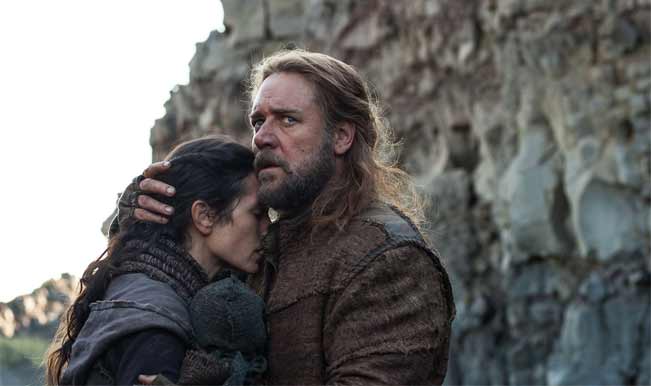
  

A stressed-out Naameh (Jennifer Connolly) embraces her husband, Noah (Russell Crowe)


Wednesday, February 25, 2015

Son of God


Year:  2014
 
Filming:  Color

Length:  138 minutes

Genre:  Christian/Drama/Inspirational

Maturity:  PG-13 (for intense thematic elements)

Cast:  Diogo Morgado (Jesus), Roma Downey (Mary), Amber Rose Revah (Mary Magdalene) Darwin Shaw (Peter), Sebastian Knapp (John), Greg Hicks (Pontius Pilate), Louise Delamere (Claudia), Adrian Schiller (Caiaphas), Matthew Gravelle (Thomas), Joe Wredden (Judas)
         
Director:  Christopher Spencer

Personal Rating:  3 Stars

***
   
     I had my reservations when I first saw the cover picture for Son of God. The guy playing Jesus looked much too hip, and too, well…some goo-goo-eyed girls would say “sexy.” I am not among that group, but the queer smirk, greasy hair, and furrowed brow is quite stereotypical of the type said to be so. Anyway, I figured it was only a matter of time before I would have to watch it and give my review of it, so I finally did. While I certainly endorse the spirit of the production and applaud some of its efforts to bring an original portrayal of The Greatest Story Ever Told to modern audiences, the feel is sometimes down-right cartoonish and incongruent with the image of Jesus and his ministry as portrayed in the Gospels.

    The story opens with St. John the Evangelist reflecting on the story of Salvation and his own time spent with Jesus Christ. We get to see some flash-backs of memorable moments in the Old Testament, including Adam being formed out of the earth (he’s plastered in dirt, as a matter of fact…kind of icky…), Eve taking a bite out of the forbidden plum (yes, plum…or date…or something!), Noah in the ark weathering the storm (CGI to the max), Moses parting the Red Sea (looks like the compu-water from Noah’s flood), and Samson swinging around a donkey jaw (gosh…wouldn’t want to mess with him in a contract squabble!).

    Then we finally get to the heart of the story: the Birth of Christ. After a brief stop with the Wise Men at the stable-cave (I though they showed up two years later, when they were in a house?), we take a major leap forward in time, and meet a certain fisherman named Simon…who happens to be Cockney. A now fully-grown Jesus, played by Diogo Morgado, wades out to meet him in his fishing boat, and performs the miracle of filling his fishing nets. Inspired by this stranger’s charisma and ability to control nature, he agrees to answer his call to “change the world”.

     Picking up more followers along the way, including John and Mary Magdalene, Christ travels across Judea, preaching about the Kingdom of God, healing the sick, performing various other miracles, and angering the Jewish Sanhedrin by calling them out on their hypocrisies. At the same time, he disappoints those zealots who want to rise up and cast out the Romans from Israel, preaching that they should instead “turn the other cheek.” Among those disillusioned is one of the twelve apostles, Judas Iscariot, who finds himself trapped in an inner battle about how best to proceed.

     Ultimately, the Jewish authorities convince Judas that he would be doing everyone a service if Christ was brought before them, ostensibly “just to talk.” It’s supposed to be a quiet, undercover affair. As it turns out, things don’t quite work out that way, and when the guards come to arrest Christ after Judas identifies him with a traitorous kiss, a melee breaks out (no seriously…St. Peter becomes the Avenger, with super-powers to knock out five guards and hack off that guys ear with super-sword…yes, over-the-top…). Then he is dragged away to be tried in the dead of night by the Sanhedrin for blasphemy. The next day, he is brought before the Roman governor Pontius Pilate, and the most vital events in World History unfold.

     First, I will say on a positive note that Son of God, which is a portion of The Bible TV Series, has reached an amazing spectrum of viewers who previously knew next to nothing about The Bible and the Story of Christ. It ran of British Public TV, moreover, which a veritable anomaly in a country that is becoming more and more hostile to public displays of Christian belief. The results have been quite extraordinary, and have shown that these stories have not lost any of their power over the generations, but continue to resonate strongly as a quintessential synthesis of the human experience. It is a story that even the hardest skeptics once or twice in their lives wished were true.

    As the producer pointed out, there is something about his retelling that has struck a chord with modern audiences. By updating the retelling to focus on a charismatic teacher who set out to change the world, it took many by surprise and helped them approach the story in a new way. But unfortunately, as I assumed, trying to modernize the story also sapped it of much of its historical realism. The attitude of the characters are far too 21st century, and their accents were just a tad too British! Now, I have loads of respect for some British actors, especially old-time ones like Richard Burton, Jean Simmons, Laurence Oliver, James Mason, etc. But they used a traditional Shakespearian approach that lent itself to period pieces without seeming awkward or out-of-place.

    I could never completely reconcile myself with the portrayal of Jesus. Diogo Morgado seemed to be too much of a hipster, too full of himself, and occasionally struck me as an out-and-out punk. The scene where he meets Simon Peter and wades out to his boat, basically forcing him to take him on board, just seemed sort of annoying. Also, Scriptural dialogue is altered and modernized at will, so when Simon asks what Christ’s mission is, He says (in a rather cheesy manner), “To change the world!” Of course, Christ did change the world, but it just seemed so generic, like something you’d see on one of those Dollar General inspirational posters.

    In their effort to make Jesus more accessible, the producers also tended to water-down the dramatic effect of his words and statements and mesh them with other sequences that don’t fit right together. One particularly anti-climatic adjustment is when Jesus makes the prophecy about the destruction of the Temple...while playfully poking a little girl in the belly! We know “Jesus loves the little children”, but instead of giving that reality its own scene, they tried to blend with a totally different and deeply serious topic, which seemed totally out of place. Also, when Christ turns over the tables in the temple, he seems to be only mildly ticked off, not filled with the zeal for His Father’s House that gives way to Righteous Anger.

    There is a concentrated effort to boost the roles of women in the story of Christ, particularly Mary Magdalene, portrayed by Amber Rose Revah. Unfortunately, this often comes off as a clumsy push of the feminist agenda, as she is ever-present with the apostles, at every miracle, in every fishing boat, almost as “one-of-the-guys”. I wouldn’t have minded a little bit of “extra presence” for Mary…but she was popping up everywhere, and it was getting rather annoying! This is only coupled by the excessive CGI employed to make the miracles seem more miraculous…or in my opinion, more fake! I have always believed that an encounter with the Divine, with the truly miraculous, would be “realer than real”, not cheaply sensational. It’s just the same as saints being the most realistic sort of people.
    
    This Bible movie feels the need to repeat the rather tired “evil Roman” mantra, using villain music every time a red-cloaked soldier or imperial eagle comes into view. Now, I’m sure being conquered by the Romans was no picnic, but they actually did a lot of really beneficial things for the world, and their conquered provinces, too! Furthermore, I will add that the Israelites themselves were no strangers to conquering land by force of arms themselves…in fact, they had a history of wiping people out as opposed to merely subjecting them! Whether or not God told them to do so is still a major debate among theological scholars; but coming from a Natural Law perspective, I personally believe otherwise.

    Pontius Pilate is depicted very darkly in this version, as opposed to the traditional, fairly sympathetic portrayals of other films. Granted, he was a soldier’s soldier, and could be quite brutal in the interests of maintaining Pax Romana, but he also seemed to be a man of at least some degree of sincerity did not want to have the blood of an innocent man on his hands. In this film, they seemed hesitant to give the guy any slack at all. In fact, they put him into the literary villain position several times.
   
     For example, Pontius Pilate and his entourage are shown traveling down the road, they come across an Israelite who’s blocking the road with his broken cart. Some Roman soldiers come and push it out of the way, but the owner of the cart protests that “it isn’t fixed yet”, and get into a struggle with them. Evidently there’s this kid sitting in the back of the cart that fails to get off, and when the soldiers thrust the cart into a ditch, he gets crunched.  My first thought was did the guy with the broken cart literally think the Imperial Governor to wait for him to get this thing fixed? Second, why didn’t the kid climb off the cart when the soldiers and his father started struggling? The thing is that this seemed to me to be a re-run of the sequence in A Tale of Two Cities when the aristocrat runs over the kid in the streets of Paris to prove how rotten he is.

      I will admit there are a few interesting elaborations made, such as Christ picking up a stone and hovering it overhead before offering it to the crowd when the woman was brought before him accused on adultery. It was a dramatic expression of the fact that really only Christ was the one without sin, who had the right to pick up the stone, but he refrained from throwing it. There were also some unique cuts and overlays done in this production. For example, at the same time Christ is shown praying at Gethsemane, the scribes are shown offering up incense in a pre-Paschal ceremony and Pilate and Claudia are shown praying to their ancestors. Just one slight problem…isn’t praying to one’s ancestors a practice of the Shintoism of China, not the polytheism of Rome?

      The best section of the movie was definitely between the Last Supper and the Crucifixion. For a little while, I managed to forget the previous hour of pain and found myself engrossed by the Passion narrative. Part of this was because the actor playing Christ spoke less and let the story itself undergird his acting style. The other part is just that the story itself is so powerful it stands alone as impactful. I find it interesting how Christ is shown as embracing Peter when he said he would never deny him, temporarily believing it, but then experienced the revelation into the future, and says very painfully that he would indeed, three times.

    The torturous scourging and crucifixion are portrayed with a sense of brutal reality, but not undue gore. I thought it was interesting how the Pharisees were shown to block out the supporters of Jesus from intermingling with the crowd who called for Barabbas. The Virgin Mary, Mary Magdalene, and John all cry out in favor of Christ, but behind locked gates. Roma Downey gives a very moving portrayal of the Blessed Virgin Mary, who meets her Son as he falls beneath his cross, and tries to help him lift it up. Later, she cradles his dead body in her arms. She has such a deeply anguished expression, and she became for me the most sympathetic figure in the film.
   
    Son of God is certainly not on my top-ten list of Biblical dramas (I’m a strident oldie fan-girl, as you all must know by now!), but if it can reach a given audience and inspire them to delve more deeply into the real story of Jesus Christ, more power to it. Let’s just hope it doesn’t confuse a whole generation with regards to a time-sensitive-perception of a hipster Rabbi as opposed to the Timeless Son of God in the fusion of His Divinity and Humanity. There are doubtless mixed responses and reactions from all quarters. Still, Christopher Spencer definitely deserves a capital E for Effort.
Jesus (Diogo Morgado) takes part in the Last Supper before His Passioin